Weekly Lightning Chat: MasterCard’s new sonic brand identity

MasterCard recently debuted what it’s calling a sonic brand identity—a “distinct, memorable melody that will serve as a foundation for its sound across the globe,” from point-of-sale chimes to telephone hold music. The announcement (appropriately introduced via audio press release) triggered both interest and eyebrow raises from the brand nerds among us at Grafik. Is the concept of a “sonic identity” really a new one? Or is it just a slicker label for the good ol’ corporate jingle? And during an era in which half the country owns a smart speaker, does every brand need a signature sound?

Let’s start with what distinguishes a sonic brand identity from that of a lowly jingle. In theory, the former is associated with a brand for the long haul (making it as important as the visual logo), while a jingle is just a few notes at the end of a radio or television ad. But through the sustained use of tropes like “I’m Lovin’ It” and “We Are Farmers,” brands like McDonald’s and Farmer’s Insurance have been able to elevate the use of jingles and lodge their tunes deep within the consumer psyche. Whether it’s whistled, tapped out playfully on a keyboard, or crooned by a bunch of Minions, hearing “Ba-da-ba-ba-ba” is sure to conjure a craving for greasy french fries.

The problem with MasterCard’s new sound is that it isn’t all that…memorable. I had to play it over and over again just to write this article because I kept forgetting what it sounded like. There are no accompanying words to commit its meaning to memory. And as some commenters pointed out, the airy string ensemble doesn’t exactly embody MasterCard’s weighty, spherical logo in the way that a more bass-heavy sound could. To be fair, years of aural conditioning could (pardon the pun) change our tune on the matter. MasterCard plans to use this “wherever consumers engage with Mastercard—be it physical, digital or voice environments”—so the true test of success will be whether consumers come to recall/associate the brand with its sound.

Outside the more traditional realm of advertising, digital storefronts, mobile apps and user interfaces all present opportunities for custom audio. Tech products like Facebook, Slack, and Venmo each have distinct sounds, which help users audibly recognize they’ve received a comment, a message or a payment without even having to look at a screen.  Consumer brands are following suit, especially with the rise of smart speaker devices. For example, when I get a push notification from the ESPN app, my device chirps out an abbreviated version of the well-known Sports Center tune. And notifications from Houzz, an app focused on residential architecture and interior design, are announced via a “ding-dong” doorbell sound.

Physical environments have perhaps the most potential to create multi-sensory attachments between consumers and brands. One of our creative directors mentioned the feeling of relief he gets when a United Airlines flight touches down and Gershwin’s “Rhapsody in Blue” begins to stream over the loudspeakers. Our marketing specialist, who happens to be a musical scholar, pointed out that the oboe and woodwind instruments used in the piece are considered classically American. United’s decades-long licensing of the piece—and the strategic touch points at which they play it—undoubtedly cast a halo effect over how people experience their brand.

If you’re trying to figure out whether your company needs a sonic brand identity or not, think about where you interact with customers. What sounds may enhance that experience, or create more explicit recognition of what makes you special?

Do you care about corporate social responsibility? Prove it.

In a recent Nielsen study, 66% of respondents were willing to pay more for products and services from companies committed to positive social and environmental impact. As consumers, shareholders, and employees increasingly demand Corporate Social Responsibility (CSR) from brands, companies are realizing that the way they address the environment, human welfare, trade, and stewardship directly impacts their bottom line, as well as the planet.

CSR is nothing new. Rock-solid brands built on financial and operational commitments have been held up as models for corporate success for several decades now. Patagonia’s storied history of Corporate Social Responsibility began in the early ‘70s when they advocated for a local surf break at a Los Angeles city council meeting. By 1986, founder Yvon Chouinard had pledged an “earth tax” to commit either ten percent of profits or one percent of sales (whichever was greater), to environmental activism—donations so far have exceeded $89 million dollars.
Photo of Tom Frost on the mountains. Yvon Chouinard, Image: Tom Frost, Aurora Photos

From this pledge grew the 1% For The Planet program which, with its nearly 2,000 partner companies, has generated more than $175 million. And when the recent corporate tax cuts were passed, Patagonia announced that its savings would go directly to the program as an additional contribution above their 1% pledge.

“Instead of putting the money back into our business, we’re responding by putting $10 million back into the planet. Our home planet needs it more than we do,” said Patagonia CEO Rose Marcario.


But the commitment goes beyond donations— what makes CSR integral and authentic to a brand’s identity is whether it impacts how its business is run. In addition to sizable financial contributions, Patagonia infused its operations with sustainable business practices. It promotes ethical supply chains and material sourcing (which has a knock-on effect for suppliers) and promotes recycling initiatives through its WornWear program. They even launched a venture capitalist arm, Tin Shed Ventures, which has provided funding for environmentally and socially minded companies to the tune of $75 million so far.

More and more companies are partnering on CSR efforts, creating a halo effect that positively impacts both brands. For instance, in addition to working directly with grassroots environmental groups through Action Works, Patagonia partnered with Walmart in 2009 to establish the Sustainable Apparel Coalition, which now provides standards and indexes for their over 200 established brands and their manufacturers.
new york times ad for patagonia Patagonia’s Black Friday Ad, The New York Times, 2011

While a commitment to environmental activism is a difficult feat, the perceived risks and negatives —the “unrealistic expectations” of CSR standards, the expense of changing supply chains and updating labor or trade practices, the use of CSR as “risk management,” or a distraction from a businesses’ economic role— are unfounded, as Patagonia reached an estimated $1 billion in sales in 2018. As their social commitments, responsibilities, and investments grow, so does their revenue.

As you build CSR initiatives authentic to your own brand values, take Patagonia’s humble beginnings to heart. While their environmental focus makes sense for an outdoor clothing brand, what choices do companies in other industries make?  Starbucks focuses on recycled and fair-trade food materials, 100% ethically sourced coffee and tea, food bank donations, funding clean water projects in underdeveloped areas through their Ethos bottled waters, and a Global Farmer Fund that has committed over $50 million towards loans and financing for coffee farmers. Tech giants Microsoft, Intel, and Apple all announced initiatives to source 100% renewable energy for their manufacturing and retail processes.

As a mid-size branding and marketing firm, we aren’t a consumer logo. Yet, the work we do for our clients reaches millions of people. We create concrete deliverables (e.g. conference and sales displays), traditional print materials, websites and digital campaigns, and positioning and marketing strategies for client growth—where does that leave us in our CSR efforts? Besides monetary contributions to, and volunteering for, our non-profit clients, we are actively exploring ways to ensure transparency and data security in all our digital efforts; we also seek to ensure that trolls and bots are not skewing our analyses of our social media campaigns. As the internet continues to outrun 20th century regulations, Grafik feels a responsibility to use the powerful tools we continuously add to our digital toolbox in ways that promote empathy and understanding.


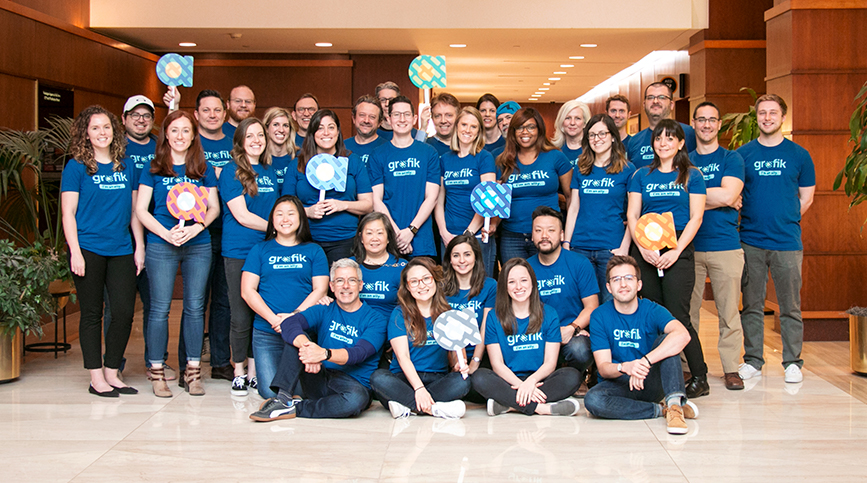
group photo of grafik wearing CCA shirts for annual giving day

Always listening: can you still trust your microwave?

A year and a half ago, I was sitting in a makerspace with fellow makers, late at night, absorbing what I could about IoT platforms. The leader of the meet-up had cobbled together a facial recognition device using an old webcam and an Amazon Echo voice assistant.  At that time, there were no devices from Amazon that had cameras, but there was a set of self-service APIs available for developers to explore and extend Alexa’s voice-assisted smarts called Alexa Skills.

Being new to tinkering with IoT, I was unaware the Alexa ecosystem had capabilities beyond voice control. What my colleague shared with us shortly thereafter surprised me. Projected on the wall was raw data being generated by his clever little contraption–hundreds of calculations evaluating physical details, as reflected in percentages, on things like whether or not he had a beard to less tangible assessments such as whether he seemed happy–all available for use if you knew what you wanted to do with the information.  The amount of data being captured was at once impressive and frightening.

A picture of code projected on a wall.


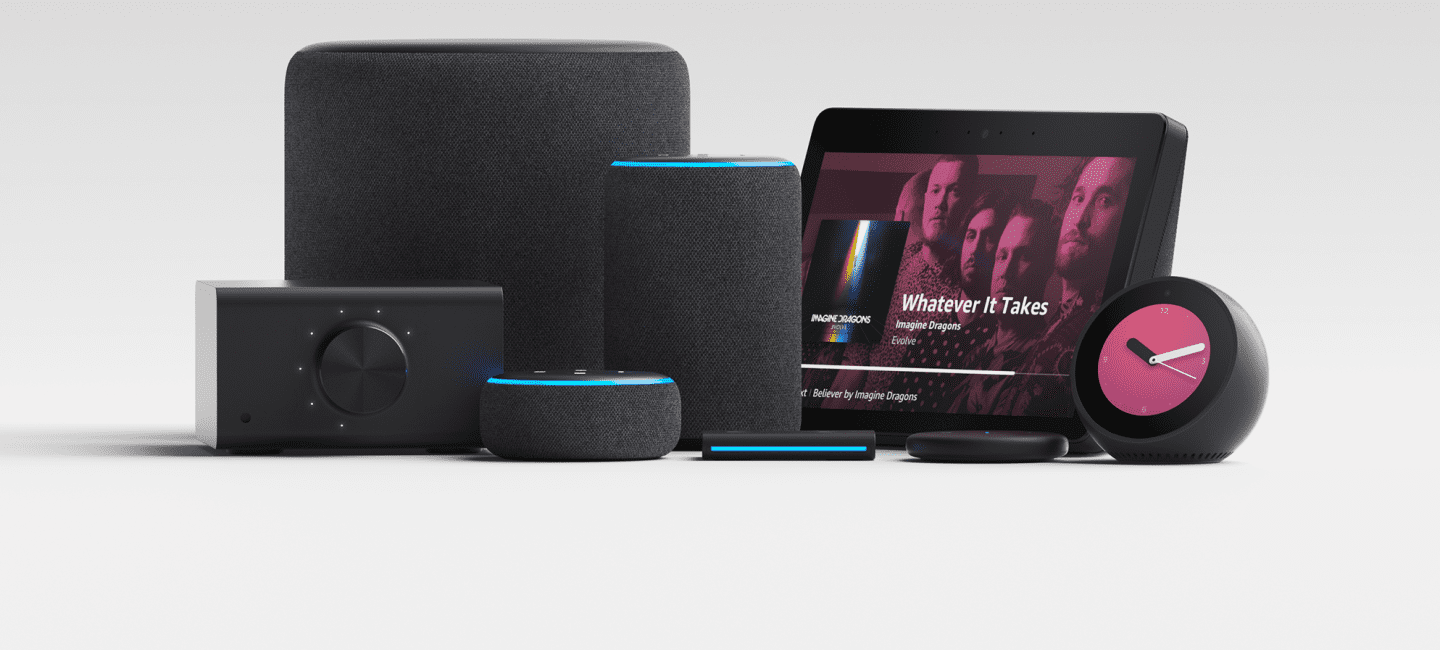
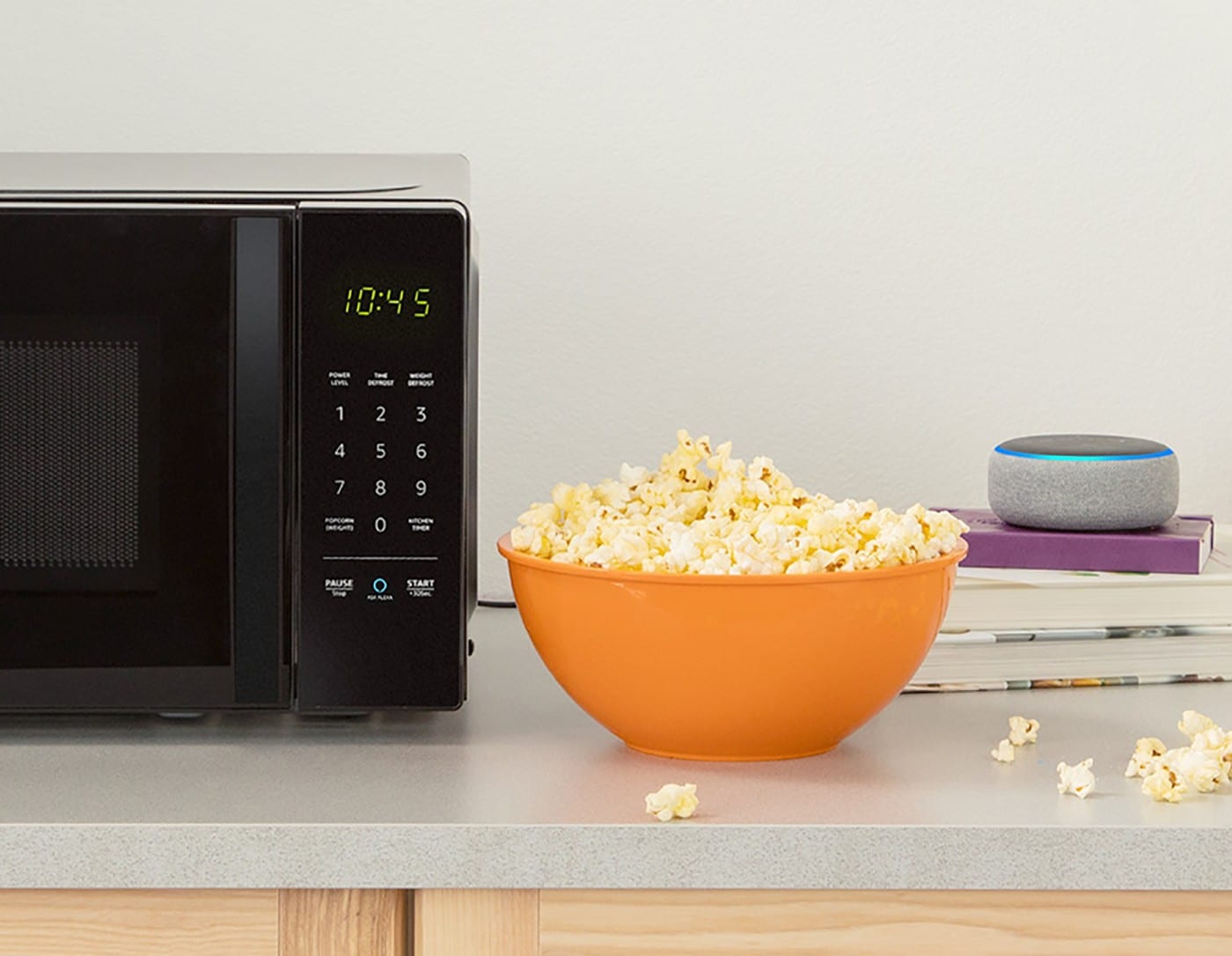
It’s been over a week since Amazon made a surprise announcement of more than a dozen new hardware products that use Alexa’s voice assistant platform. The unexpected announcement caught many by surprise, and left even more wondering why a $60 Alexa-powered microwave oven was in the mix, or even pertinent.

An image of Alexa's voice recognition products.
 

Strangely, the microwave was the one that peaked my interest the most.  Not because I am overwhelmed by the excitement of asking my smart microwave to heat up a Hot Pocket, but because it subtly conveys that Amazon has every intention of making the Alexa’s voice-control ecosystem the de facto user experience for our physical spaces, much the way Google dominates our digital ones.

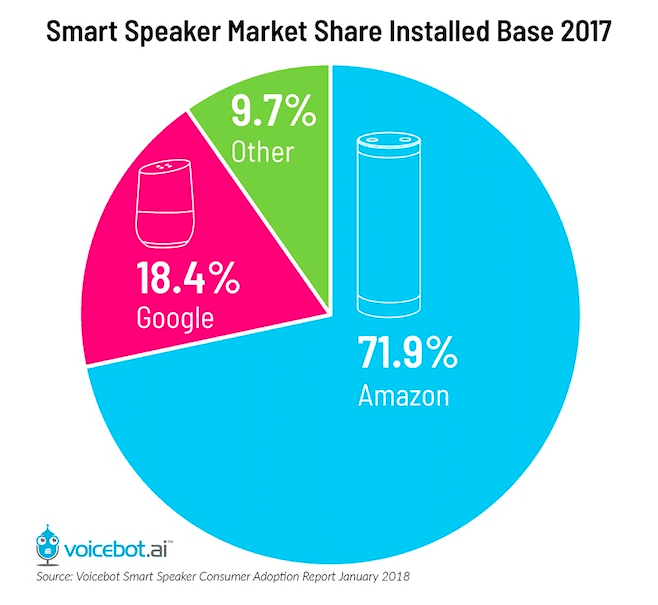
According to a March 2018 report by industry news and analysis firm Voicebot, Amazon holds 71.9% of the smart speaker market, compared to 18.4% for Google. In releasing dozens of products in new categories and at different price points, it shows they are willing to move aggressively to be the leader in how we interface with our devices in the home.

Voicebot Smart Speaker Consumer Adoption Report January 2018
 

As with Prime membership, the more Amazon can be integrated into our day-to-day life, the harder it will be to leave it. Amazon sees a tightly integrated AI-powered voice assistant and the network of devices it cooperates with as a rich source of data used to improve the quality of recommendations and enhance customer satisfaction. By extension, if everything is on the same platform, they can offer a more seamless user experience.  But should a single entity have so much control?

In a November 2017 survey, Deloitte found that consumers are generally more cautious about smart home devices compared to online activities or even other categories of IoT. Forty percent of respondents said they felt smart home technology “reveals too much about their personal lives,” and nearly 40 percent said they did not feel properly informed about the security risks associated with connected home devices.  

At the end of the day, we are talking about a cheap microwave, but when voice eventually becomes the main interface in our homes, it will be harder to ignore the looming threat of potentially disastrous privacy violations when spoken conversations and physical movement are being recorded as part of the software layer.

An image of a microwave and a bowl of popcorn.
 

As smart speakers and connected devices continue to gain popularity, it’s clear that voice interaction is the next great leap forward in UX design. But how can we as designers help brands responsibly use Amazon’s Alexa, Google’s Assistant, and Apple’s Siri to reach audiences in the clearly private space of the home? If privacy is mostly about perception, we will need to find ways of building trust through absolute transparency, sharing with customers what personal data is being collected and how it is being used. Moreso, we will need to focus product design on giving customers control over their own information by adopting best practices like cookie disclaimers and GDPR compliance.  

There’s still a lot to figure out with voice-assisted interfaces, but if the development of IoT platforms follows the path of reinforcing trust, the next decade can hopefully avoid an erosion of privacy and instead bring about its restoration.

GDPR: 4 ways to get started

On May 25th, the  General Data Protection Regulation (GDPR)  went into effect, providing European Union residents insight into how their personal information is collected, stored, and used by websites. Just being located outside the EU does not relieve your company from having to comply—the regulation protects any user accessing your website from within the EU.

Under GDPR, personal data is defined as information that can be used to identify someone, directly or indirectly. This includes IP and email addresses, cookies, location data, and names. We recommend you take the following four precautionary measures, and, of course, seek legal counsel.

1. Update Google Analytics’ Data Retention settings to 50 months

Google Analytics users are now required to set the length of time user-level and event-level data is stored on its servers before that data is automatically deleted. This update will not affect aggregated data currently used in dashboards, but will affect components such as “Custom Segments” that rely on advertising user IDs, cookies, etc.

2. Update your website’s Privacy Policy to ensure it addresses the collection and use of all website and customer data 

Inform users how the information your company collects is used, who it is shared with, and how they can act on their right to be forgotten. Privacy Policy Generators, such as Iubenda’s, provide helpful tools for getting started. See this example from AdRoll for reference.

3. Add a pop-up to your website that requires user consent

We recommend intercepting new visitors with a message such as, “We use third-party cookies to improve your experience and to analyze the use of our website. If you continue, we assume that you consent to receiving all cookies on our site. For more information, click here [link to privacy policy].” HubSpot and WordPress offer out-of-the-box GDPR and pop-up plugins for this purpose.


GDPR Cookies pop-up graphic.
Example of a user consent pop-up
 

4. Add a disclaimer to any lead capture forms that explain the exact use of a user’s email address and contact information.

This disclaimer can be a one-liner that links to your company’s privacy policy. For example, “Opt-in now to get discounts and exclusive offers. For more information, click here [link to privacy policy].”

If you have questions about GDPR, how to ensure you’re compliant, or want help executing the steps above don’t hesitate to reach out.

Reduce your tech stack to improve viability

Bob Dylan wrote “The times they are a changin” more than 50 years ago. People have listened to it on vinyl, cassette, CD, iPod, and streaming—same song, new delivery system—accepting these changes without question. Few consider what’s required to deliver any new convenience, the complexities and complications beyond fabrication that include finding talent that can make this all happen: the underlying tech stack.

For the non-tech-savvy reader, the tech stack is a combination of different technologies designed to work together to accomplish a unified goal. Typically, each technology performs a specific function within the stack. Think of it as division of labor among a team of workers.

While there are different schools of thought on tech stack size and complexity, I’d like to offer my perspective on how and why keeping your tech stack smaller and more manageable produces better results in the long run.


Plan Ahead

More often than not, your project’s key stakeholders are asking for a solution rolled out, like, yesterday. We’ve all been there. That’s why it’s important to clearly communicate that shooting from the hip will cost the company more money in the long run. Choosing the right technology stack can ensure the extensibility of your project and add dollars to your profit margin—but to do so, you must often negotiate extra time to complete the following planning activities up front:

• Discover what end-users expect and how the project owner wants to provide that experience to them. Keep a list of questions that you can standardize and add to with future experience.

• Understand the product owner’s ultimate vision for the project. Creating short term solutions can get the job done, but you’ll incur considerable technical debt in the long run if future requirements aren’t correctly considered.

• During platform selection, thoroughly audit what any proposed new technology can do, how it will benefit the project, and how it will ultimately bring your project owner’s vision to fruition.

• Socialize the requirements, goals, and strategy with everyone on your team to make sure everyone understands their importance. Addressing any confusion up front can help avoid much larger issues moving forward.


Adopt Later

New technology is exciting, however, experienced developers know to give new platforms and languages time to prove themselves in the wild with smaller, more self-contained projects before integrating those elements into their larger projects. These folks know that sometimes projects lose steam and wither on the vine, as so many have in the past. If viability and high adoption happens, these technologies tend to experience fundamental changes, as Angular experienced between its first and second versions.

Reliable documentation, community forums, long-established product roadmaps with a schedule for when new versions will be made available—all hugely contribute to how likely a new technology is to integrate into the project. Without these, the likely longevity of that technology in your stack will be limited to how long your team is willing to work with it. The more difficult pieces in your stack, the more team frustrations will spread, creating a ripple effect that destroys morale.


Consider Talent

The moment you’ve been dreading has arrived: you need to replace or add people to your team. Finding the right person for the right price is always a challenge, for any position. But if you’ve adopted features based on a flavor-of-the-week technology throughout the course of your product life-cycle, finding that right-price person with the incredibly niched skillset to fit in your stack has increased the degree of difficulty tenfold. In the off chance that you find the skills, you’ll pay an arm and a leg to get them in the door (either because they know their value, or you’ve been working with a recruiter, or both).

Because the talent you are looking for must be specialized exactly for your needs, they will come at a premium. And if you can’t find this talent, you will have to hire someone with gaps in their knowledge, and spend money and company time getting them spun up and on the same page with the rest of your team. Those costs are never completely avoidable, but minimizing skill requirements is best.


Be Critical

In the agency space, it’s pretty common to jump from one project to another without taking time to reflect on completed projects. While this is sometimes unavoidable, taking the time to properly analyze the good and the bad experienced on a project is crucial for making internal pivots. Use these opportunities to refine and improve your processes and approaches to creative problem solving.

We take development seriously at Grafik. We have fun doing what we do, but we’re always looking for ways to improve our own processes and ultimately bring greater value to our clients. Remember to take care of your team, because at the end of the day you can rest assured that a well-cared for team will take greater care of your clients, contributing to your bottom line.

Does this content bring you joy? The KonMari method to content strategy

In, “The Life Changing Magic Of Tidying Up,” organizational consultant Marie Kondo introduces her KonMari Method™, “a way of life and state of mind that encourages cherishing the things that spark joy in people’s lives.” It is a step-by-step process to never living in clutter again; everything in your home and life will have a purpose.

While reading this book, I couldn’t stop seeing the parallels between The KonMari Method™ and content strategy. And I started to get excited. Really excited.

Why? Because most people don’t fully understand what a content strategy is, let alone its magic.

A content strategy includes planning for the creation, delivery, and governance of user-friendly content in order to meet the needs of a business and its customers. In the context of tidying up, a content strategy is a lot like cleaning your house.

In the same way that KonMari can bring clarity and purpose to material things in your life, a strategy can bring clarity and purpose to your content, helping you meet both your business goals and your customer’s needs.

Here’s how to get started:

Step 1: Visualize your goals

The first step in Kondo’s method is to visualize the life you wish to have with a clutter-free space. What does that look like? When first conducting a content strategy, you must do the same. What are your business goals? What are the needs of your target audience?

To help answer these questions, I recommend conducting a card sorting workshop. This exercise helps you visualize who you want to be in relation to your audience needs. You’ll need to prepare a deck of about 120-200 cards, each bearing an adjective or succinct phrase that describes how your brand–and other brands–relate to, and are seen by, your industry.

Example of a card sorting exercise to inform content strategy
Source: Appropriate, Inc.

To conduct the workshop, sort your cards into the following categories:

Who do you want to be?
Who are you today?
Who are you not?

Once this first sort is complete, discard all the cards that fell into the “who are you not” pile. Now look at the cards in “who you are today” and discard all the ones that don’t align with the vision of your brand moving forward. Then combine “who do you want to be” with what remains in “who are you today.” From that single pile, select only the adjectives that best meet the needs of your customers and your business goals moving forward. Finally, prioritize these in order of importance.

At the end of this exercise, you will have prioritized your brand’s communication goals and outlined a message architecture. This will guide your content planning, design, and delivery process.


Step 2: Only keep content that sparks joy

Marie Kondo asserts, “To truly cherish the things that are important to you, you must first discard those that have outlived their purpose.” The same goes for your content. To do this, you will need to conduct a content audit. Start by using a web crawler to view all the content on your website. Then start sifting.

If content fails to map back to your message architecture, let it go. Only keep content that will bring your users joy.

More importantly, fight the urge to put content in archives. Most likely, it no longer serves a purpose.


Step 3: Audit one category at a time

Auditing all your content at once can be overwhelming, especially if it has become disorganized (most does over time). I recommend culling content, starting one primary navigation menu category at a time, and creating excel tabs for each bucket.

An example spreadsheet to audit the content of a website


Step 4: Review content in the right order

Moving left to right, address quantitative factors first, then qualitative. Quantitative factors can include page URLs, Google Analytics metrics, content types by page, character counts, etc. Qualitative factors can include voice and tone, messaging, audiences, and calls-to-action. Only keep content that is current, relevant, and appropriate. Once you’re done, you can start translating this into an information architecture for your website. Your IA will become an outline of where you will put your content.


Step 5: Put back content in a way that makes sense

The strategy you developed in your message architecture and the gaps revealed in your content audit, will help you identify what content to create and by priority. But before you embark on content creation, you must first identify a clear internal workflow for migration and governance. I also recommend creating editorial style guidelines for your staff. If you’re using a content management system, identify who will be reviewing content, who will be editing it, and who will be publishing it. Train all involved stakeholders. Once completed, there will be no frustrations creating content, because you and your team will have clear guidelines on how to move forward.

Creating new forms of content that bring your customers joy spark deeper relationships with your brand that may have never existed in your previous customer journey. When we decide what should and should not be on our website, we are allowing other forms of action to exist. The KonMari Method™ to content strategy is not just a process, but a mind-set. Once you create a comprehensive content strategy, you will never go back to your old ways of content chaos.

Trust your gut: “Dilly Dilly!”

Super Bowl commercial water cooler talk is the natural order of business, especially at marketing agencies, in FEBRUARY! But who knew it would follow me to March—the end of March mind you, during Spring Break. Seriously.

There I was yesterday, minding my own business, enjoying a spring training game in Florida with my son and our beloved Washington Nationals, when from the top of the aisle I hear the beer vendor bellow, “Peanuts, water, ice cold Dilly Dilly!” Again, “Dilly Dilly, ice cold!”

It’s no secret that Wieden+Kennedy’s advertising for Bud Light launched last year, ran during pretty much every football game, went viral and is now a “love it or hate it” campaign and Urban Dictionary catch phrase that just won’t go away. And then, to hear this affirmed, nay proclaimed long after the end of football season, beckoning the beginning of baseball wasn’t entirely unexpected. But it was surprising—pleasantly, even joyously surprising.

And, dammit, instructive.

What got me was the reaction of the crowd. Our beer vendor’s town crier “Ice cold Dilly Dilly!” chant sparked a wave of infectious smiles and chuckles in the sea of parents, grandparents, and kids in section 116. Good will and camaraderie drifted happily through the crowd, followed by an echo of “Dilly Dilly!” from fans in row K, responding with resolve to our vendor’s battle cry for beer, “Yes, I’ll have a Bud Light—thank you, Kind Sir—Dilly Dilly!” The chuckles grew louder and spread to section 115 next door, right behind the Nats dugout. I think Bryce Harper heard the call as well, but alas could not reply as he was next up to bat.

So, crap, I’m not supposed to be thinking about work on Spring Break. Yet, here I am, sipping coffee at 6 AM, thinking about marketing and strategy implications for Grafik and our clients. And there are several:

First of all—Strategy? C’mon. It’s not like Anheuser-Busch crafted a strategy to spew “Game of Thrones” inspired nonsense and fun in their Bud Light marketing? Well, actually, they did: in a Business Insider interview last month, Miguel Patricio, Chief Marketing Officer of Anheuser-Busch InBev, shared, “‘Dilly Dilly’ doesn’t mean anything. That’s the beauty of it. I think that we all need our moments of nonsense and fun. And I think that ‘Dilly Dilly,’ in a way, represents that.”

Okay, then the research numbers must have strongly supported the campaign? Actually, they didn’t. Mr. Patricio continued, “A lot of people asked me, ‘How did you approve that?’ To tell you the truth, we never expected this to be so successful. We did that ad, actually, because of the new season of “Game of Thrones” coming, but when we tested, it didn’t test that well. We said, ‘Consumers will get it.’ And especially with repetition. We have a chance here for this to become big. So, we went against the research and we gave a chance to ‘Dilly Dilly’ and we are so happy!”

Happy, indeed.

The lesson here is central to brand strategy—something we discussed just last week in two different branding workshops with our clients: “Don’t forget the right brain. The essence of your brand isn’t just what you say about it, it’s also how it makes people feel.” Yes, the words are important—critical in fact, but make sure they do more than just explain the “debate points” of your selling proposition. They have to articulate the idea of your brand and the feeling it conveys. This is true for all companies working through brand and marketing strategies—including Grafik’s Fortune 100, technology, startup, and Government agency clients who are all solving this right now.

The second lesson comes not only from our “Dilly Dilly” town crier beer vendor, but also from a short video segment from the seat screen on my JetBlue flight down to Florida. In an interview, a prominent CEO was asked, “What was the best piece of business advice you ever received?” She said, “Trust your gut.”

Trust it, indeed.

AB focused on how Bud Light makes you feel, trusted their gut, and launched a very successful advertising campaign. It’s not their only marketing and messaging, of course. We all know the “debate points” about why we should choose Bud Light over other light beers. But these facts, mixed with a ballpark full of fans sharing a feeling of delight and attaching it to the Bud Light brand, completes the picture.

“Dilly, Dilly!” indeed.

Dilly dilly campaign reaches consumers well past their TVs, even at baseball games

How a smart buyer’s journey guides website personalization

In a previous blog, I mentioned website personalization as a key to engaging audiences and improving mobile experiences. What, precisely, is website personalization, and how can it help your business?

Rather than following a broad one-size-fits-all approach, website personalization creates and delivers customized content to meet user needs. This is not a new approach. Shop keepers get to know their regular customers, call them by names and know their likes and preferences—it’s what keeps them coming back. For companies to achieve the equivalent on their websites, they need to use digital technology and perform regular user research to deliver personalized experiences.

Persona Development

Creating personalization starts with getting to know your customers. You can’t generalize your audience’s needs and still provide a truly relevant user experience. User research needs to be conducted on a regular basis to segment your users into key groups sharing similar needs and backgrounds, known as personas. The purpose of creating these personas is to have reliable and realistic representations of your key audience segments for reference. According to usability.gov, effective personas:

  • Represent a major user group for your website
  • Express and focus on the major needs and expectations of the most important user groups
  • Give a clear picture of the user’s expectations and how they’re likely to use the site
  • Aid in uncovering universal features and functionality
  • Describe real people with backgrounds, goals, and values
  • Help formulate decisions surrounding site components by adding a layer of real-world consideration to the conversation
  • Offer a quick and inexpensive way to test and prioritize features throughout the development process
Buyer’s Journey

Modern marketers coined the term Buyer’s Journey referring to the progression of consumers, from research to final decision, that culminates in a purchase.

It’s a three-stage process:

  1. Awareness Stage: The buyer realizes they have a problem.
  2. Consideration Stage: The buyer defines their problem and researches options.
  3. Decision Stage: The buyer chooses a solution.

The graphic below from HubSpot, illustrates a sample buyer’s journey for the simple purchasing decision of a doctor visit during an illness.

Sample Buyer's Journey
Personalized Experiences

After personas and their buyer’s journey have been determined, a company can tailor site architecture, landing pages, and on-site navigational cues that deliver relevant content and rich on-site experiences specific to each stage of that journey. An important part of your digital marketing strategy is to be omni-channel, allowing prospects to choose the right channel for them at the right time; a website alone will not sell product or drive leads.

Monetate’s 2017 Personalization Development Study reports that organizations across all levels of maturity use an array of different data sources to personalize communications. Few are fully integrating offline and online data insights today, a reflection of the challenges that still exist when integrating data sources.

(Source: Monetate’s 2017 Personalization Development Study)

Personas and buyer’s journeys help set the framework, but companies need to continue to mine analytics and digital tools to help deliver real time relevance. Retailers can provide targeted offers to online shoppers based on browsing behavior. Travel websites can offer promotions based on the current weather or season. Restaurant and coffee shops can highlight stores near a user based on their location.

Implementation Challenges

Despite the tremendous value it can bring, personalization is complicated—gathering buyer insights, data integration, and connecting systems is indeed hard work. Again, Monetate’s 2017 Personalization Development Study shows how companies can take a phased approach in their personalization strategy, making it less daunting to implement.

(Source: Monetate’s 2017 Personalization Development Study)

The findings are unanimous: personalization is important

Consumer expectations have shifted: they now expect a personal digital experience to be comparable to offline experiences. Many business and technology leaders name personalization as a top commerce technology investment priority. Personalization increases loyalty, drives higher conversions, and grows revenue. Google reports that eighty-nine percent of U.S. marketers reported that personalization on their websites or apps resulted in an increase in revenue. According to BCG, “brands that create personalized experiences by integrating advanced digital technologies and proprietary data for customers are seeing revenue increase by 6% to 10%—two to three times faster than those that don’t. As a result, personalization leaders stand to capture a disproportionate share of category profits in the new age of individualized brands while slow movers will lose customers, share, and profits.”

Personalization is Important

Personalization offers companies the ability to engage with consumers individually and to build lasting relationships. Advances in data and technology are already making this possible, and will only improve over time. Take advantage of personalizing your online branded experience to better engage with your customers, so that when they are ready to purchase, you are top of mind. Learn more about personas and content strategy

Grafik and Merritt Clubs recognized with 2018 REBRAND 100® Global Distinction Award

Grafik, a Washington, DC metro area-based branding and digital marketing agency, and Merritt Clubs, an affiliate of Merritt Companies, today announced its joint receipt of the prestigious REBRAND 100® Global Award for their collaborative efforts in successfully positioning and rebranding the Baltimore-based fitness club. This highly respected biennial competition, judged by a panel of international business, marketing and design executives, showcases the world’s most effective brand transformations through its evaluation of design and measurable results.

Merritt Companies engaged Grafik in 2017 to align its three distinct organizations—Merritt Clubs, Merritt Properties and Merritt Construction Services—under a singular vision of delivering uncompromising service. The rebrand of Merritt Clubs focused on better expressing and distinguishing its bold and vibrant connection to the Baltimore, MD community. A strategic transition from the name “Merritt Athletic Clubs” to the more inclusive “Merritt Clubs”—followed by a reimagined logo, a new mantra, visual identity, and website—have helped underscore the company’s value to both prospective and existing members and employees.

“We chose to work with Grafik because of its unparalleled creative eye and strategic, business-driven approach to branding,” said Donyel Cerceo, Marketing Director of Merritt Clubs. “We have always been focused on the well-being of our members, and Grafik captured the spirit of our clubs. The rebrand and new website are allowing us to create a stronger, more personal experience for them.”

Health clubs have come a long way since the days of a warehouse space with rows of machines. They have matured in their settings—and their marketing. For the Merritt Clubs rebrand, Grafik leveraged member surveys, market research, and online analytics to inform user experience personas that cover the entire gamut of potential members, both in the city of Baltimore and surrounding counties. The new identity underscores Merritt Clubs’ brand personality and family-friendly clubs and the new website experience makes it easy to quickly surface relevant classes and activities for each persona, and targeted offers are tested continually to achieve the best response from visitors.

“Merritt Clubs is a great example of what a true rebrand looks like. When work is grounded in research and strategy, the final product is an authentic, timeless, and effective foundation that supports business and drives tangible results,” said Lance Wain, President and CEO of Grafik. “We are a proud partner of the Merritt Companies and are elated to share in this award with Merritt Clubs.”

New Merritt Clubs Brand Driving Record Results

The new Merritt Clubs brand debuted January 2017 and year-over-year lead growth is up 39%; website visitors up 37%; page views up 28%. With this increased engagement, the average cost per lead and per sale have decreased dramatically, and marketing has gone from influencing just 13% of overall sales to 41% of overall sales. With member engagement and club visits up as well, the future looks bright for record renewals, as utilization is an indicator of likely membership renewal.

Rebrand Part of a Larger Strategic Branding Initiative for Merritt Companies

The rebranding of Merritt Clubs was part of a broader strategic branding initiative for Merritt Companies which included Merritt Properties and Merritt Construction Services. From customer service and ethics, to empowering employees to make decisions in the best interest of customers, Merritt Construction Services, Merritt Properties, and Merritt Clubs share a singular vision to build long term relationships with their customers, delivering beyond what they expect, or the industry demands.

While the three companies have a clear connection in terms of services, the overall look and feel didn’t adequately communicate that singular vision. To address this challenge, Grafik established a framework and brand architecture for a more consistent marketing of their three individual companies. This created a cohesive corporate identity, including a bold new logo system tying all the brands together.

About Merritt Clubs:

Merritt Clubs currently has more than 37,000 members who enjoy 24-hour access to locations in downtown Baltimore and the surrounding suburbs. Each location offers individual and group fitness programs including personal trainers, world-class Les Mills programs, weight facilities as well as specific amenities designed to meet the needs of the local community. Three locations feature state-of-the-art swimming facilities, and offer classes through the Michael Phelps Swim School.

About REBRAND 100®:

REBRAND recognizes the impact of strategy and creative efforts by noting standout improvements to website performance, return on marketing investment, and sales attribution. The REBRAND 100 Global awards are juried by a multidisciplinary panel of prominent, international experts. Other notable REBRAND 100 Global award winners include national and global brands such as Seimens, SAP, McAfee, Grant Thornton, Hawaiian Airlines, and AT&T. For more information, click here.

Check out the full story of our successful partnership with Merritt Clubs here!

Channels change. Your brand voice shouldn’t.

We live in an age where technology has transformed the way we approach marketing. With more access to data than ever before, digital tools are becoming increasingly robust. Marketers are now armed with an immense amount of information that allows them to target the right person, at the right time, in the most efficient way possible. But marketers who focus intently on the delivery method can often lose sight of what matters most: your brand’s voice.

While digital has dramatically changed how we market brands and where we spend our marketing dollars, the core principles of creating your message haven’t. It’s still important to go through a discovery phase to identify who you’re targeting, what’s relevant to them, and how your brand will stand out. Great creative has the power to transform businesses, inspire customers, and make people pay attention in a noisy world. So why do marketers sometimes place more focus on the medium versus the message?

The danger in that is the risk your brand faces in losing itself in a sea of sameness. And, from an investment of resources perspective, having the medium dictate your strategy and message puts the control of your brand’s voice in the hands of a platform you don’t really own. That’s scary, and here’s why:

Mediums change. They rise and they fall, or they transform so much they’re barely the same one you knew when they launched (would you have clicked on one of the world’s first banner ads?) Many of us have witnessed the demise of once popular platforms (looking at you, Vine), and are watching the costs of advertising increase on channels we’d grown to love (thanks, Facebook). It’s made marketers reconsider where they spend their dollars, change strategy, and in some cases, lose the ability to advertise on entire channels that have become too expensive or even obsolete. Who knew that Vine, once the apple of every digital marketer’s eye, would die on the vine?

Cellphone showing various forms of social media apps

Now, it’s not to say that the medium doesn’t matter any more or is any less important. Some brands like Spotify have even leveraged the power of data to create clever, OOH ad campaigns. Marketers should simply be viewing digital, and any other channel, as just that: another delivery vehicle for your message. Granted, there are certainly strategies where a message is built for a specific medium, but your campaign still begins with the creative and what your brand has to say, not where it says it.

Striking the right balance between technology and creative is hard, and marketers have incredible access to data and innovative digital tools. Investing in and staying on top of them is a must to thrive. Just don’t get caught up in chasing what’s new and shiny without thinking about what your brand is saying first.

The top 6 tech products making new homes smarter

“Ok, Google,” say “Hi” to Alexa and “Hey” to Siri. No matter how you say it and which platform you’re accustomed to speaking to, the bottom line is tech is making a big splash in at-home convenience as builders such as Van Metre Homes and EYA design homes with built-in technology packages that create an always on environment.

Gone are the days of getting off the couch to turn your lights on or preheat the oven. Remember when you had to guess who that big-eyed bobblehead was outside your front-door as you peered into a tiny peep-hole? Now we see the person drive up to the garage while digital voices alert us that someone has entered the premises; as they walk to the door we broadcast a greeting through our smartphone’s doorbell video app.

It may seem a bit scary that your new home can practically read your mind, prepare your meals, and tuck you in at night, but there are a lot of advantages to smart home automation features. Cost and energy savings, convenience, and control are just the start.

What’s really driving home automation technology is safety and home security–in other words, peace of mind. A new mom or dad can check on their little one thanks to smart cameras and other technologies. If you can’t remember whether you closed the garage after you left, you can verify remotely with an app. Automated lighting is the new scarecrow for would-be bulgars. You can set your smart locks to turn on your smart lighting when you unlock the front door. With home automation technology, you can know what’s happening inside and outside of your house at all times–very smart indeed.

The market for one-off devices to make homes safer and more secure has grown steadily; it only makes sense that major real estate developers are integrating smart home automation into the construction process. Consumers are willing to pay a premium for these modern day conveniences–by 2020 the global smart home market is forecast at more than $40 billion. With smart home automation products on the rise, here’s a glance at some of the top tech trends that developers are starting to include in thoughtfully designed homes and communities.

Read more

Don’t interrupt me; I’m talking to a chatbot

Watch a child playing alone with dolls or action figures, and in almost all cases you’ll hear a very lively discussion, with many different voices used and personas assumed. Are we hardwired to talk to non-sentient objects? Can it be as satisfying to interact with a chatbot as a human? If all you want is a fast, accurate answer – of course.

A HubSpot survey tells us that as long as they can get help quickly and easily, 40% of consumers don’t care whether a chatbot or a person answers their customer service questions. Gartner predicts that by 2020, the average person will have more conversations with bots than with their spouse (I think this stat is more revealing on the state of marriages than the use of augmented intelligence). Is this the end of world as we know it (cue Michael Stipe), or a golden age of convenience?

What, if anything, are we giving up when we interact with AI rather than a person? Or is that even the right question to be asking?

A long time ago in a galaxy far, far away—actually, it only feels that way. In truth, it was at UC Irvine just before the dawn of personal computers. The computer science department needed an English graduate student to grade papers for a class called “Ethics in Computer Science.” There was no coding, no labs, the required reading was Joseph Weizenbaum’s Computer Science and Human Reason, and I was the grad student.

Considered by many the father of artificial intelligence, Weizenbaum had created ELIZA, a natural language processing program that mimicked Rogerian therapy. He named it for the flower seller in Pygmalion (perhaps better known as My Fair Lady). Reduced to its basics, a Rogerian therapist lets the patient arrive at his or her own conclusion by restating what they are told (“How are you feeling today?” “I’m a little blue.” “So, you’re unhappy?”). In his book, Weizenbaum recounts the time his secretary at MIT asked him to leave the room while she “spoke” with ELIZA. Even with full knowledge that ELIZA was a program, Weizenbaum’s secretary was having a personal and powerful interaction. And she was simply typing! Now that we talk to machines, the connection is much more intimate.

The CS students were to write papers on the difference between decision-making as a purely computational exercise and the uniquely human qualities that lead to choice (whether these are truly unique is the subject of a much larger discussion). I dutifully graded their papers, marked one a “C” that probably deserved a “D” and received an office hour visit from that student. He wanted a better grade. I went over all the flaws in logic, all the grammatical mistakes, what he could do to re-write it for a better grade.

“English doesn’t matter,” he said. “Coding will rule the world.”

“People will always speak to each other,” I said.

I think we were both right.

What we choose to hand over to machines

I do not know my own son’s phone number because I have never dialed it. It’s been programmed in my phone forever. While likely typical today, this still strikes me as strange. But handing over certain brain functions (mostly data storage) has been going on a long time.

A few thousand years ago, Homer (if there was a Homer) was never read—he was heard. Rhapsodes (yes, it’s the root of the word rhapsody) roamed the countryside and recited, or more accurately, sang the Iliad and the Odyssey from memory, as well as other histories of the Trojan War that are lost to us. Let me repeat that: from memory. These rhapsodes were not freaks of nature. Indeed, cultures without a written language studied in more modern times also share the recitation of long and complex oral histories.

Do we, in a sense, voluntarily relinquish certain brain functions to technologies: tablets, scrolls, books, recordings, integrated circuits? And can the adoption of these technologies lead to a re-wiring of our brains? Does this freedom from mundane tasks allow us to be more creative? Is brainpower a zero-sum game? A Forbes article titled AI By The Numbers cites this stat from PwC: 34% of business executives say that the time freed up from using digital assistants allows them to focus on deep thinking and creating.

From the same Forbes piece, we get this stat from Business Insider: 48% of consumers worldwide said they preferred a chatbot that solved their issue over a chatbot that had a personality.

Remember Clippy?
Microsoft's "Clippy" was an early AI integration
No one needs to design personality into our assistants; the user naturally supplies it. For years, we’ve called our cars “he” or “she.” Anthropomorphism is common and is even cited as a sign of social intelligence.

Of course, with any sea change there is dislocation. Again, from Business Insider:
“Twenty-nine percent of customer service positions in the US could be automated through chatbots and other tech, according to Public Tableau. We estimate this translates to $23 billion in savings from annual salaries, which does not even factor in additional workforce costs like health insurance.”

When I see the words savings in annual salaries I also see men and women at the unemployment office. Yes, in the long run, freedom from menial work means opportunity for more rewarding work and greater responsibility. And as we go from “augmented intelligence” to “autonomous intelligence,” the tasks that can be given to machines continues to grow. Now that programs can “see,” what other jobs will be ceded to computer vision? The London Police initiated a specialized unit called the “Super-Recognizers” just two years ago, comprised of people with an uncanny ability to recognize faces. I think a face-off between them and Google’s AutoML AI system would be a better show than Ken Jennings versus IBM’s Watson on Jeopardy was.

All of which brings me back to ethics. As we rush to commercialize advances in AI, I was surprised to learn there is an organization called the Partnership on Artificial Intelligence to Benefit People and Society, Partnership on AI for short. It’s founding partners are Amazon, Apple, Google, DeepMind, Facebook, IBM and Microsoft. Other partners include the ACLU, Human Rights Watch, Amnesty International, McKinsey, and Accenture. Interesting bedfellows. They were “established to study and formulate best practices on AI technologies, to advance the public’s understanding of AI, and to serve as an open platform for discussion and engagement about AI and its influences on people and society.” I know I’m now sleeping better. Alexa, wake me when it’s over.