The top 6 tech products making new homes smarter

“Ok, Google,” say “Hi” to Alexa and “Hey” to Siri. No matter how you say it and which platform you’re accustomed to speaking to, the bottom line is tech is making a big splash in at-home convenience as builders such as Van Metre Homes and EYA design homes with built-in technology packages that create an always on environment.

Gone are the days of getting off the couch to turn your lights on or preheat the oven. Remember when you had to guess who that big-eyed bobblehead was outside your front-door as you peered into a tiny peep-hole? Now we see the person drive up to the garage while digital voices alert us that someone has entered the premises; as they walk to the door we broadcast a greeting through our smartphone’s doorbell video app.

It may seem a bit scary that your new home can practically read your mind, prepare your meals, and tuck you in at night, but there are a lot of advantages to smart home automation features. Cost and energy savings, convenience, and control are just the start.

What’s really driving home automation technology is safety and home security–in other words, peace of mind. A new mom or dad can check on their little one thanks to smart cameras and other technologies. If you can’t remember whether you closed the garage after you left, you can verify remotely with an app. Automated lighting is the new scarecrow for would-be bulgars. You can set your smart locks to turn on your smart lighting when you unlock the front door. With home automation technology, you can know what’s happening inside and outside of your house at all times–very smart indeed.

The market for one-off devices to make homes safer and more secure has grown steadily; it only makes sense that major real estate developers are integrating smart home automation into the construction process. Consumers are willing to pay a premium for these modern day conveniences–by 2020 the global smart home market is forecast at more than $40 billion. With smart home automation products on the rise, here’s a glance at some of the top tech trends that developers are starting to include in thoughtfully designed homes and communities.

Read more

Don’t interrupt me; I’m talking to a chatbot

Watch a child playing alone with dolls or action figures, and in almost all cases you’ll hear a very lively discussion, with many different voices used and personas assumed. Are we hardwired to talk to non-sentient objects? Can it be as satisfying to interact with a chatbot as a human? If all you want is a fast, accurate answer – of course.

A HubSpot survey tells us that as long as they can get help quickly and easily, 40% of consumers don’t care whether a chatbot or a person answers their customer service questions. Gartner predicts that by 2020, the average person will have more conversations with bots than with their spouse (I think this stat is more revealing on the state of marriages than the use of augmented intelligence). Is this the end of world as we know it (cue Michael Stipe), or a golden age of convenience?

What, if anything, are we giving up when we interact with AI rather than a person? Or is that even the right question to be asking?

A long time ago in a galaxy far, far away—actually, it only feels that way. In truth, it was at UC Irvine just before the dawn of personal computers. The computer science department needed an English graduate student to grade papers for a class called “Ethics in Computer Science.” There was no coding, no labs, the required reading was Joseph Weizenbaum’s Computer Science and Human Reason, and I was the grad student.

Considered by many the father of artificial intelligence, Weizenbaum had created ELIZA, a natural language processing program that mimicked Rogerian therapy. He named it for the flower seller in Pygmalion (perhaps better known as My Fair Lady). Reduced to its basics, a Rogerian therapist lets the patient arrive at his or her own conclusion by restating what they are told (“How are you feeling today?” “I’m a little blue.” “So, you’re unhappy?”). In his book, Weizenbaum recounts the time his secretary at MIT asked him to leave the room while she “spoke” with ELIZA. Even with full knowledge that ELIZA was a program, Weizenbaum’s secretary was having a personal and powerful interaction. And she was simply typing! Now that we talk to machines, the connection is much more intimate.

The CS students were to write papers on the difference between decision-making as a purely computational exercise and the uniquely human qualities that lead to choice (whether these are truly unique is the subject of a much larger discussion). I dutifully graded their papers, marked one a “C” that probably deserved a “D” and received an office hour visit from that student. He wanted a better grade. I went over all the flaws in logic, all the grammatical mistakes, what he could do to re-write it for a better grade.

“English doesn’t matter,” he said. “Coding will rule the world.”

“People will always speak to each other,” I said.

I think we were both right.

What we choose to hand over to machines

I do not know my own son’s phone number because I have never dialed it. It’s been programmed in my phone forever. While likely typical today, this still strikes me as strange. But handing over certain brain functions (mostly data storage) has been going on a long time.

A few thousand years ago, Homer (if there was a Homer) was never read—he was heard. Rhapsodes (yes, it’s the root of the word rhapsody) roamed the countryside and recited, or more accurately, sang the Iliad and the Odyssey from memory, as well as other histories of the Trojan War that are lost to us. Let me repeat that: from memory. These rhapsodes were not freaks of nature. Indeed, cultures without a written language studied in more modern times also share the recitation of long and complex oral histories.

Do we, in a sense, voluntarily relinquish certain brain functions to technologies: tablets, scrolls, books, recordings, integrated circuits? And can the adoption of these technologies lead to a re-wiring of our brains? Does this freedom from mundane tasks allow us to be more creative? Is brainpower a zero-sum game? A Forbes article titled AI By The Numbers cites this stat from PwC: 34% of business executives say that the time freed up from using digital assistants allows them to focus on deep thinking and creating.

From the same Forbes piece, we get this stat from Business Insider: 48% of consumers worldwide said they preferred a chatbot that solved their issue over a chatbot that had a personality.

Remember Clippy?
Microsoft's "Clippy" was an early AI integration
No one needs to design personality into our assistants; the user naturally supplies it. For years, we’ve called our cars “he” or “she.” Anthropomorphism is common and is even cited as a sign of social intelligence.

Of course, with any sea change there is dislocation. Again, from Business Insider:
“Twenty-nine percent of customer service positions in the US could be automated through chatbots and other tech, according to Public Tableau. We estimate this translates to $23 billion in savings from annual salaries, which does not even factor in additional workforce costs like health insurance.”

When I see the words savings in annual salaries I also see men and women at the unemployment office. Yes, in the long run, freedom from menial work means opportunity for more rewarding work and greater responsibility. And as we go from “augmented intelligence” to “autonomous intelligence,” the tasks that can be given to machines continues to grow. Now that programs can “see,” what other jobs will be ceded to computer vision? The London Police initiated a specialized unit called the “Super-Recognizers” just two years ago, comprised of people with an uncanny ability to recognize faces. I think a face-off between them and Google’s AutoML AI system would be a better show than Ken Jennings versus IBM’s Watson on Jeopardy was.

All of which brings me back to ethics. As we rush to commercialize advances in AI, I was surprised to learn there is an organization called the Partnership on Artificial Intelligence to Benefit People and Society, Partnership on AI for short. It’s founding partners are Amazon, Apple, Google, DeepMind, Facebook, IBM and Microsoft. Other partners include the ACLU, Human Rights Watch, Amnesty International, McKinsey, and Accenture. Interesting bedfellows. They were “established to study and formulate best practices on AI technologies, to advance the public’s understanding of AI, and to serve as an open platform for discussion and engagement about AI and its influences on people and society.” I know I’m now sleeping better. Alexa, wake me when it’s over.

Data is powerful. Use it wisely

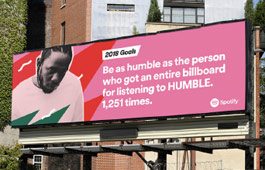
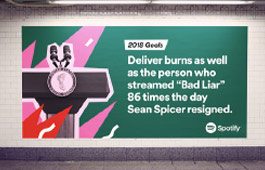
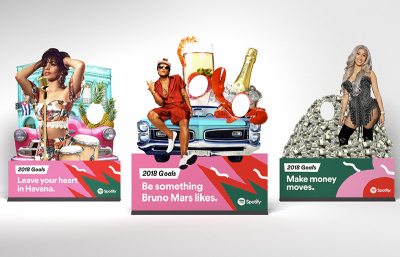
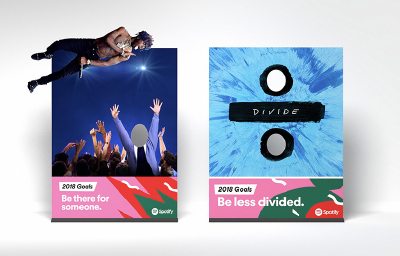
Last Spring, I praised Spotify for their witty, data-driven billboard ads. Their clever out-of-home (OOH) creative aligned the weirdness of 2017 with the equally weird streaming habits of its users. Being one my favorite campaigns, I was elated to find out that they chose to extend the campaign with a sequel focusing on a more optimistic view of the year to come.

This year’s billboards present tongue-in-cheek New Year’s resolutions (called “2018 Goals” to give the postings a longer life past New Year’s Day) based on obscure and hilarious, streaming data. They also added street-level, classic carnival-like cutouts to the mix, encouraging folks to take and share photos online.

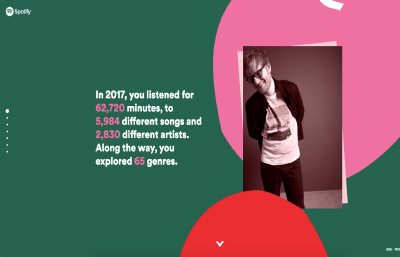
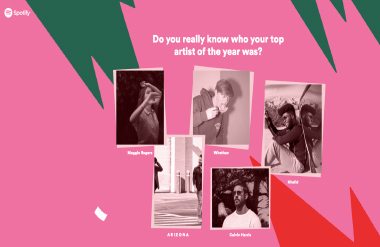
Spotify not only uses their aggregate data to reveal quirky or obsessive listening habits to the public, they provide each subscriber a personalized playlist for the past year and an interactive website. To entice users to interact with and share these websites, Spotify utilized quizzes to test the user’s own listening habits (i.e. “Do you really know who your top artist of the year was?”).

I live for this yearly tradition. I’m a Spotify fiend (as evidenced by my 44 straight days’ worth of streaming) and can’t wait to see how many minutes I racked up at the end of the year. I’m even more eager to see the strange streaming habits of my fellow Spotify addicts and how they translate to Spotify’s next OOH campaign. This kind of slicing and dicing of datasets my inner nerd on fire, and gets Spotify tons of free press from users sharing their stats while simultaneously making a personalized connection that very few monster corporations are able to execute. It’s a perfect example of a company correctly aligning its brand with a data-driven campaign.

As celebratory and wonderful as the Spotify campaign is, fellow technology giant Netflix’s attempt to use what they know about their audience was clumsy and alienating. They did a fine job of mining some unusual habits, but used it to be downright snide and nasty.

Rather than overtly copy Spotify with a billboard ad with a positive punch line, Netflix chose a social media push to tweet, and unfortunately, “troll” its users.

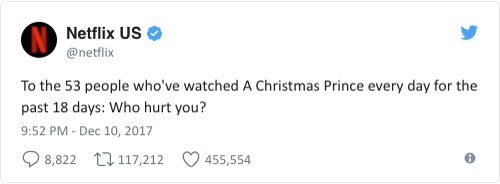
Here’s the tweet:

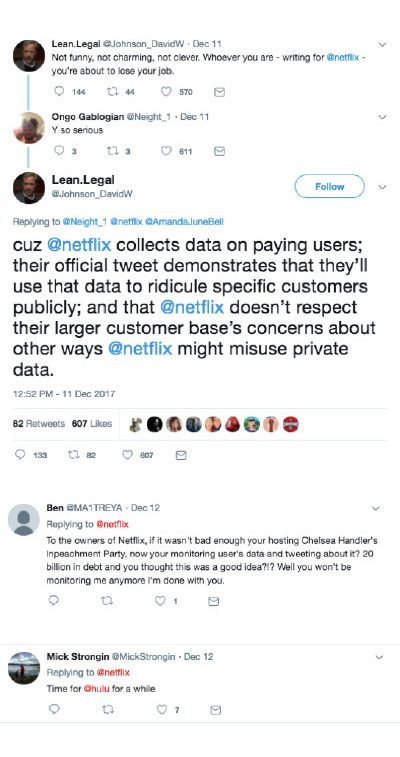
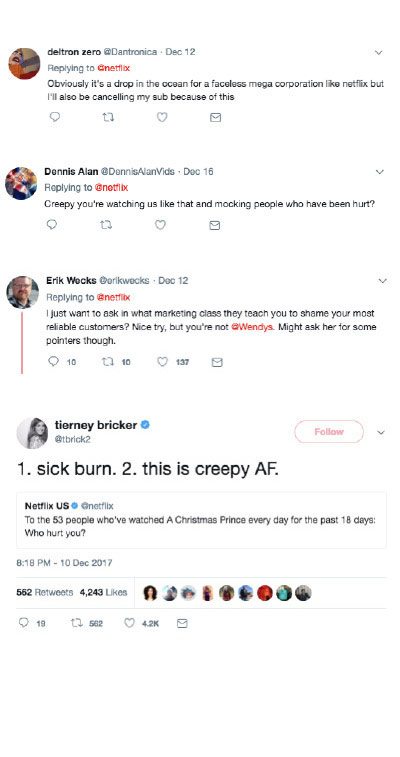
The fact that 53 people watched A Christmas Prince, a Netflix original production, 18 days in a row is certainly an outlier piece of data prime for promotion. The tweet did indeed go viral, but the backlash was brutal:

Rather than celebrating the unique streaming habits of its users, as Spotify did, Netflix ridiculed them. “Who hurt you?” comes across as judgmental and condescending, rather than praising their users’ uniqueness. I love free press and viral content as much as the next digital marketer, but not all press is good press and I’d argue that aggravating your consumer base not only impacts your bottom line, but can dilute your brand, too.

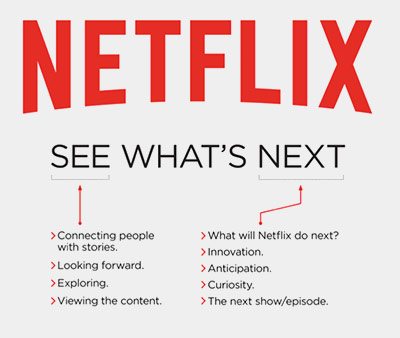
With consumers increasingly sensitive to the amount of personal data being collected, companies must be more careful than ever. If a company is willing to give their audience a peek behind the curtain and show even a breadcrumb of the mountain of data they’re housing, they must do so with a sound strategy that maps back to their brand. Consider the Netflix tweet in light of their brand, a brand with huge equity expertly mapped by Gretel in a recent re-brand.

Netflix established itself as a global innovator that connects people with stories and thought-provoking content—creating an addiction to binge watching “what’s next.” I love this branding, but it does not align with a trolling personality on Twitter.

This is not to say that trolling is never successful. Wendy’s is known for going viral on Twitter by trolling its users; Denny’s Tumblr is celebrated for its sarcastic personality—this works for both companies because they’re playful, quirky brands in the fast food industry. However, when your go-to video streaming company starts to roast you for your choices, it just doesn’t feel right. Global innovators shouldn’t troll you, they should revolutionize industries, and this misalignment of brand and social presence was the catalyst for the campaign failure.

It’s not enough to have a “trendy” strategy—companies must have the right strategy for their brand. Data-driven campaigns are a strong way to connect with a vast user base, and quirky social media personalities are prime for viral reach, but it is critical to make sure your campaign aligns with your company’s north star. As former Disney CEO Michael Eisner said, “A brand is a living entity. It is enriched or undermined cumulatively over time, the product of a thousand small gestures.”

Make sure each and every gesture you execute—whether a global ad campaign or a single tweet—aligns with and enriches your brand, and never bite the hand that pays your monthly premium.

Digital transformation will dominate in 2018

Regardless of what industry you’re competing in, digital transformation (DX) will be driven by the increasing global adoption of conversational UIs and mobile, digital and connected devices. Forrester predicts that “digital transformation will dominate business strategy in 2018.” According to research firm International Data Corporation, worldwide spending on DX technologies exceeded $1.2 trillion over the past year, and they’re forecasting a compound annual growth rate (CAGR) of 17.9 percent in 2018. This enormous spend on DX is driven by several factors, including global smartphone adoption, use of conversational UIs, growth in consumer (and enterprise) use of connected devices, and the democratization of artificial intelligence and machine learning technologies.

As mentioned, the growth of mobile smartphone adoption and usage will be a driver behind many DX initiatives in the coming year. A recent Comscore report states that more than 50 percent of searches are on mobile and 90 percent of mobile media time is spent in applications—not to mention the ‘mobile only’ share of the total digital audience in the United States grew from 10 percent to 12 percent between May 2016 and 2017. While two percent sounds small, its a staggering number of users—and this trend will only increase. According to Facebook, 91 percent of Facebook usage and 80 percent of their advertising revenue is on mobile. Research firm eMarketer forecasts mobile ad spend to reach 74.4 percent of total digital ad spend in 2018. These changes in consumer behaviors, advertising formats, and mobile media will drive the need for innovation in 2018.

As consumer expectations and behaviors evolve around how brands connect via digital devices—in particular the internet of things (IoT), mobile, and social channels—brands need to keep pace. Major brands fighting for market share are making big bets on innovation around these key categories—and will certainly increase their investments in the year to come. This trend will separate market leaders from laggards in an increasingly ‘always on’ digital economy where the demand for high levels of personalization and instant gratification are key to customer loyalty and maintaining share of wallet. Let’s look at a few of the opportunities for DX transformation that will likely dominate C-suite and boardroom agendas in 2018.

Engaging Consumers in an Always-On Economy  
Consumers are more digitally savvy and engaged than ever before. Research from eMarketer and Statista’s Digital Market Outlook reveal 227 million smartphone and 172 million tablet users in the United States today. On average, Americans spend north of 200 minutes per day accessing the internet on a smartphone, and today 81 percent use a smartphone or tablet device while watching television or streaming digital video. Recent studies on advertising saturation and digital device usage indicate the average consumer receives between 4,000 and 10,000 brand messages per day, depending on their volume of media consumption, and that they switch between screens up to 21 times per hour. Clearly, consumer attention is divided across different screens and multitasking—making the fight for consumer attention tougher than ever for brands today.

Given that in the digital age brands are ‘always on,’ marketers need to leverage marketing technology to engage digital-savvy consumers—specifically marketing clouds. These enable the creation of strong brand relationships with consumers through personalization and the delivery of the best possible customer experiences. Identifying, selecting, and implementing the right marketing cloud is a complex undertaking—and there are more choices today than ever before. Consider this, each year since 2011, Scott Brinker of ChiefMarTec has published a graphic illustrating the Marketing Technology Landscape. In 2011, the graphic had 150 companies spanning a few segments; by 2017, there were nearly 5,000 companies listed. While there are only a few dozen true ‘marketing clouds,’ most brands have a robust portfolio of marketing technology solutions—and integration is essential for success.

While chief marketing officers today face a number of challenges, engaging consumers in an always-on, hyper competitive economy is perhaps the most challenging.

In fact, Forrester’s “Predictions 2018: The CMO Bar Rises with More Pressure For Growth—Customer Obsession Disrupts Any Remaining CMO Complacency,” paints a do-or-die picture for CMOs lagging behind when it comes to the application of martech to drive better consumer experiences. The report states that “2018 will force many companies to take decisive action; while the economy is still growing and employment is healthy, the fate of companies has never been more uncertain.”  

Additionally, the Forrester report claimed “a full 30 percent of companies will fail to meet rising user expectations for customer experience, and another 20 percent will not properly adapt to the changing digital market. As a result, those firms will be acquired, or begin to perish.” If you’re sitting in the C-suite or Boardroom at any company that is falling behind,  the implementation of the right martech stack should be top of mind.

Leveraging Bots and Chatbot’s as Force Multipliers for Brand Engagement
There is no denying that the use of conversational UIs will increase exponentially in the years to come. Chatbots, human-assisted support technologies, voice controlled search assistants and connected devices for the home and office, will be the new norm.

TechCrunch recently stated that “chatbots have suddenly become the biggest thing in tech. They unlock the ability to provide personalized, interactive communication akin to talking to a human customer service or sales rep, but at scale for much cheaper than call centers.”

With chatbot development platforms offered by major players such as Google, Microsoft, and Facebook, companies like Lyft, 1-800-Flowers, Fandango, and Whole Foods are implementing them too.  

The 2018 forecast for chatbot development to support sales and customer service is significant. A recent report from Gartner projects that, by 2021, more than 50 percent of enterprises will be spending more per annum on bots and chat bot creations than traditional mobile app developments. Although human-assisted live chat has been table stakes for years, the use of software and human-assisted support chat is forecasted to increase in 2018 due to recent advancements such as segmentation and automation rules that trigger messages on site, in-app, or through email via platforms such as Intercom, Helpcrunch and Drift. Companies like Ancestry.com, Expensify, and Trunk Club are already leveraging advanced software and human-assisted support chat solutions in sales and service.

These platforms not only support sales and service, but can also support sales and audience engagement making them ideal additions for both B2C and B2B mobile applications. As the cost of implementing feature-rich software and human-assisted support chat applications continues to dramatically decrease, expect an uptick in their use as DX in the enterprise accelerates. As Google, Amazon, Microsoft, and Apple continue to find new ways to integrate the technology into a vast array of consumer experiences—including applications for the Internet of things—you’ll see companies building both B2C and B2B applications that leverage voice controlled search assistance.

With robust developer programs, open access to APIs, and unlimited opportunities to leverage voice control for interacting with applications and connected devices, companies will be exploring how to leverage these to create connected customer experiences—the possibilities are limitless. According to eMarketer, 45 million voice-assisted devices are now in use in the U.S., and that number will rise to 67 million by 2019. Given the relatively low cost of IoT application development using kits from Google, Intel, Microsoft, and other players, it’s anticipated that many organizations will commence R&D projects in 2018.

While the technology that powers these engaging brand experiences is rapidly evolving, simplifying application development and driving down the cost of research and development—the complexity of delivering brand-relevant, differentiated, and valuable experiences will remain a challenge for C-suite executives and Board members for years to come.

Transform or Face Irrelevance
There are several areas of opportunity for brands to transform the way they do business using technology today—create products, deliver services, engage audiences, and deliver experiences. It’s not just about specific technologies like marketing clouds, or chatbots, or any other application—in 2018 C-suite executives and Boards need to focus on how to create and deliver uniquely differentiated and valuable customer experiences at every interaction and touchpoint. Getting DX right isn’t a factor of how much you spend or how quickly you spend it, but rather ensuring that the initiatives will deliver the right value to all of the key stakeholders—whether that means increasing competitiveness, reducing operating costs, driving higher levels of customer satisfaction, increasing the customer lifetime value, or creating new streams of revenue.

Fact is, there are too many emerging and disruptive new technologies today to cover all of them in a single post—the few areas of opportunity that I’ve highlighted here are simply those I feel will not only engender significant investment, but also have the ability to be game-changers for those brands that take advantage of them. Take a close look at the trends in your industry, take advantage of smart third-party research, conduct your own research, and engage your customers, partners, and employees to find the biggest areas of opportunity for DX within your organization—then make the big bets that will allow you to leapfrog competitors and achieve your strategic goals and objectives. For brands that sit on the sidelines in 2018 and don’t make big bets: good luck remaining relevant.

What’s so important about your brand?

A brand, most simply, is your company’s identity. More poetically, a brand is defined by where you’ve been and where you’re going. It is ever evolving, constantly under threat, and formed by every interaction. It is what the public thinks you are, what you think you are, and who you aspire to be. A brand is your promise to the people.

The difference between a company and a brand is sometimes semantics, but in today’s rapid-fire economy of mergers, acquisitions, divestments, and consolidations, brand plays an ever increasing role in defining and shaping the expectations a consumer has of your company’s products and services.

A brand you know and trust makes purchasing decisions easy and worry-free. It’s like a trusted friend you know you can depend on. But now think about how many people you trust: probably not many, and it’s likely there are also quite a few instances where you lost trust in someone. Building trust with consumers requires consistency, honesty, communication, and sometimes even a bit of personality. To bring all of those elements together, branding needs to tell a story.

Think back to a positive or negative experience you had with a company. How did your experience shape your perception of that brand? It may have reinforced the trust you had in the brand or even caused you to swear off their products for the rest of your life. Stories shape what your brand is and what it stands for. Telling these stories in a way that is relevant, interesting, and engaging offers a glimpse at what a customer’s own story could look like and reinforces the stories that your customers already have. But while stories are fundamental in defining your brand, there’s a lot they can’t do on their own. That is where your visual identity comes in.

The visual appearance of your brand is usually the first impression. In a split second, opinions begin to form. Do I know this company? Does it look like a company I would buy from? Do they take pride in who they are? Do I trust them? Do I want to know more about them?

When most people think of a brand, they think of a logo. Some logos are so iconic and timeless that they stay virtually the same forever, while others are constantly evolving or even living. Good logos share a few similar traits–they’re unique, memorable, simple, and relevant. And while a logo is one of the most vital and obvious representations of a brand, it is far from the only one. A brand’s visual identity is also defined by its typography, colors, textures, patterns, and use of photography.

The first impression is important, but so is every other impression. Since someone’s perception of a brand is shaped every time they encounter it, the visual identity needs to be consistently applied across the board whether it’s a website, social media profile, advertisement, email signature, or even your office. Consistency is king, so don’t let sloppy implementation of your visual identity tarnish your brand.

While visual identity takes all the glory, the unsung hero is messaging. In essence, it’s the way a brand talks about itself, both internally and externally to the public. What’s said (and not said) is just as important to a brand identity as a consistent and beautiful visual identity. Messaging shows that your brand identity is more than skin deep.

All messaging needs to be built on a solid foundation. This foundation helps your messaging resonate and ring true in the hearts and minds of your audience. And at the core of this foundation is the positioning that defines who your brand is, what you stand for, and how you set yourself apart from the competition. Above all else, this statement and the rest of the messaging foundation should not be created in a bubble. It’s great that you think you’re the most revolutionary company of the 21st century, but will everyone else believe it? If not, you need to consider how to get everyone from point A to point B because it’s an uphill battle trying to gain trust when no one believes you. Great brands evolve over time, all you need to do is guide people along the journey.

Your brand is more than a logo and a catchphrase. It’s your strongest asset, your reputation, and your identity. Give it the love and attention that it needs.

4 telltale signs of revolutionary wearable tech

By 2019, one in five U.S. adults will be wearing technology (eMarketer). But as adoption grows and brands race to connect with potential consumers, there are four success factors they must consider before developing their own wearable tech products. These factors represent a healthy balance of usability and hype: product purpose (what need does it fill?), target audience (who is it for?), brand recognition (do they have enough of it to hang their hat on?) and long-term strategy (what happens after the initial buzz fades?).

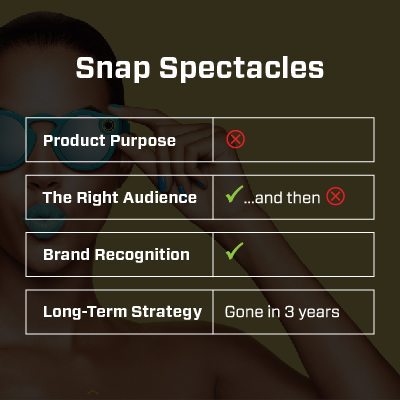
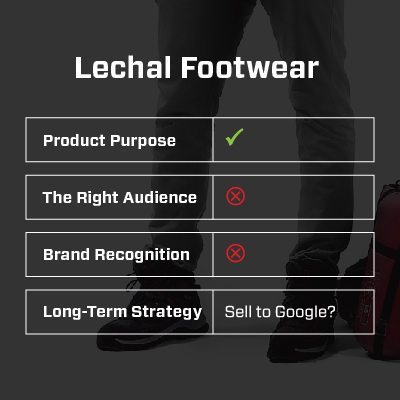
To illustrate, let’s examine how two very different brands brought wearable tech products to market: Snap Spectacles (winner of 3 Golds at Cannes this year) and Lechal Footwear (bluetooth navigation for your shoes). The scorecard below helps explain why Spectacles burned bright and then burned out just as quickly, and why you’ve never heard of Lechal, even though it’s one the best products on the market.

Snap Spectacles

We are witnessing the Spectacles product life cycle fizzle. After a flashy debut in November of 2016, Spectacles were released to the masses on Amazon by June 2017. For a company with the brand equity of Snap, selling the glasses through third-party vendors was the equivalent of, “We’re Closing! Blowout Sale!” Further marking the decline, Specta-sales dropped by 32% (TechCrunch) as Q2 wrapped in August. So, what did Spectacles do right initially? And, why wasn’t it sustainable?

1. Product Purpose: Fail
Spectacles were marketed as a toy. Unlike the release of similar wearables like Google Glass, Snap made every effort to ensure the product was perceived in a lighthearted, toy-like manner. Like all toys, they were quickly forgotten. Spectacles are simply an extended feature of the Snap app rather than a revolutionary product.

2. The Right Audience: Pass…and then fail
The exclusivity of the initial release had first-adopters drooling. However, with teens and younger millennials as the primary app users, the $130 price tag of the glasses hindered adoption with the majority of the app’s target audience. The disconnect between the product audience and the app audience (including their purchasing power) is a major contributor to declining sales.

3. Brand Recognition: Pass
Because 158 million people are using Snapchat everyday (Business Insider), Snap’s impressive brand recognition ensured all eyes were on their Spectacles. Without a doubt, this was a key factor in the initial success of the product.

4. Long-Term Strategy: Gone in 3 Years
There could be more to come in this snap story. Whispers of augmented reality and other extended features might bring new life to the 2.0 version of Spectacles. Yet, since the product is still primarily used for fun rather than a utilitarian purpose, Spectacles are unlikely to be around in a few years.

Lechal Footwear

Lechal Footwear creates footwear that syncs with Google Maps* to help people navigate on the fly. It does so with haptic feedback provided through a Bluetooth insole in your shoe. The left shoe vibrates to signal a left turn,the right shoe vibrates signaling a right turn, etc.. Lechal Footwear turns any shoe into a smart shoe.

“Stop spending your day with your head down, ears cocked as you look and listen to your phone to help you navigate. Now, navigate hands-free, hassle-free and head-up.” – Lechal.com

Anyone who has stepped out of a Lyft in a new city can recognize the benefits of this product. Lechal is certainly a more useful product than Spectacles, but most reading this have never heard of it. Why?

1. Product Purpose: Pass
This product is a great example of solid user experience design. While many wearables (including Spectacles) get in the way of humans’ natural behavior, Lechal makes sense because it fits seamlessly into behaviors that users already perform– using navigation apps on our phones and wearing shoes. Connecting the two, Lechal makes it easier for us to perform a common action and in a “barely-there” way.

2. The Right Audience: Fail
Originally designed for the visually impaired, the more wide-reaching commercial benefits came as a second path for the company. Their first consumer facing product was a shoe, but in a smart move, they shifted towards insoles and “buckles”—effectively adding navigation to any shoe. But then they added fitness tracking which diluted the purpose of the product, navigation. The disjointed messaging also creates a confused target audience. Lechal should stick to their core product goal and maintain clear marketing based around it.

3. Brand Recognition: Fail
Very few know the Lechal brand. Yet, its main functionality originally came through Google Maps. If Google Maps had instead released this product, how might its reach have soared? Imagine this headline, “Google releases new map-powered shoe: Google Steps. Always find your way.” Put me on the pre-order list, please!

4. Long-Term Strategy: Sell to Google?
What this wearable has going for it is that it truly solves a problem. If they could connect with a larger brand, like a Google Maps, to increase their visibility, we might see this product stick around for years to come.

As seen through these two examples, wearables come down to two categories: play and utility. Both can be a success with the right execution and marketing of the product’s purpose, audience, brand and long-term strategy. While innovative tech trends are always worth watching play out, the wisest of us will keep a closer eye on revolutionary products—those that genuinely solve a problem.

*Lechal footwear originally launched with Google Maps, it is unclear whether Lechal has since created its own proprietary navigation app.

Virtual reality in the real estate industry

Virtual reality (VR) may seem like our future, but it’s been our past—covertly—for much longer than most realize. Technically, we can trace the roots of VR to the invention of stereoscopic photos and viewers in 1838.

Until recently, the discussion of VR was limited to the gaming community and movie industry. Although the technology of VR has advanced at a rapid pace, it wasn’t until 2016 when Google massively promoted a low-cost cardboard headset for smartphones that awareness and utilization of VR technology took off.

In residential real estate, product presentation is the home sellers’ primary concern, especially among new luxury home builders. What sells is experience of the product. The mentality has been: until a potential buyer comes to your sales trailer or model home, you have not presented—nor have they truly experienced—the breadth of your fine product. Yet today, most new home buyers today start their search online. Anyone stepping into a sales trailer or model home is likely to already have seen many homes on different builders’ websites. So the question is: why would they choose to physically visit your model out of the many seen online? The gap of getting potential buyers to come to a home seller’s doorstep is potentially large. However, with the explosion of VR technology, this gap can be made much smaller. And cost is no longer a barrier. Putting together a simple phone app (with a cardboard headset) doesn’t cost as much as many think—Google wouldn’t have pushed for it otherwise.

While many homebuilders and agents still think in 2-D when it comes to floorplans, the younger generation of home buyers have been conditioned by games, movies, and entertainment to think in 3-D. Floorplans should no longer be limited to flat drawings. Translating traditional floorplans into interactive VR renderings is the way to move forward in new home sales. Companies such as Bricks & Goggles, Virtual Xperience, CommonFloor Retina, and Floored do an amazing job of bringing future spaces to life. The products may be viewed through a variety of platforms, such as smartphone, Google Cardboard, Oculus Rift, and desktop computer to give potential buyers a rich, walkthrough experience of homes yet to be built.

Services like roOomy and iStaging bring empty model homes to life—fully furnished—with scalable 3-D modeling and rendering, allowing customers to see the full potential of the product. Virtual staging and augmented reality technologies enable homebuyers to see move-in-ready homes with thousands of dollars of décor—that homebuilders do not have to buy.

360° video with 3-D walkthroughs present model homes in an engaging way. Last year, Facebook launched Facebook 360, which gave users the ability to capture and share 360° photos through their phone. 360° video pushes this concept further and leverages augmented reality technology to make an impression on homebuyers. Companies such as Start VR and Matterport (which some of our clients are already using) are making this type of quality service affordable. Consider adding a personable host or narrator to your tour video to make a memorable presentation, like this 360° video tour of Conan O’Brien’s office or micro-flat (USD $500,000) in Hong Kong.

Virtual technologies have become a concrete reality in the real estate industry. Homebuilders and home sellers must embrace what augmented reality offers to improve their customers’ experience of their brand.

Is your brand woke? Marketing as a vehicle for social change

At a time when civil discourse feels more divided than ever, an unprecedented number of brands are putting their stake in the ground for various social issues. Research shows that 84% of Americans believe businesses have a responsibility to bring social change on important issues (eMarketer), making it explicitly clear that today’s businesses must stay in lockstep with the current social climate or risk missing the mark with current and future customers.

“Woke” brands make sure that their values and mission serve as a compass for business and marketing decisions. #WokeBrands unapologetically declare what their brands stand for and allow their values to drive campaigns, not vice-versa. Aside from creating a more consistent, human and authentic brand message, this approach also often pays off in the form of fierce customer loyalty and brand ambassadorship.

Here’s a look at a few brands that have earned (or failed to earn) Woke status as of late:

Brand 1: Pepsi – NOT WOKE

Pepsi Advertisement

Case in point–the now infamous Pepsi Kendall Jenner commercial fiasco. See Pepsi Zero: The Taste-Free Ad With No Fans. A sad attempt to bond with protesters and members of current political and social movements like #BlackLivesMatter, Occupy Wall Street, and the Fight For 15; Pepsi left much to be desired and created a PR nightmare instead.

It is not enough to simply mimic feelings or situations of social movements. If a brand is going to connect itself to a social movement, it needs to do so in an authentic way, taking a stand in support of a side. Pepsi created a campaign hoping to broadly embody certain values without actually taking a stand for anything. Not woke.

Brand 2: Oreo – WOKE

Oreo Advertisement

Oreo has been a strong advocate for the LGBT community and a vocal supporter of marriage equality on social media.
This “Pride” image was posted to Facebook as part of a series reflecting current events using images of Oreo cookies and milk to celebrate the brand’s 100th birthday. “As a company, Kraft Foods has a proud history of celebrating diversity and inclusiveness. We feel the Oreo ad is a fun reflection of our values,” Basil Maglaris, a spokeswoman for Oreo’s parent company Kraft Foods, stated.

Oreo and Kraft didn’t deem the advertisement “controversial”—instead, they emphasized that this ad was a “reflection of their values,” whether it pleased everybody or not. Woke.

Brand 3: Ben & Jerry’s – WOKE
Ben & Jerry Advertisement

Ben and Jerry’s has unapologetically supported the #BlackLivesMatter movement through a series of social media and blog posts as well as the Women’s March on Washington and the climate change movement that tips the social justice scales for the funky ice cream maker. They are overt in asking people to join them in the movements, mirroring the urgency and seriousness of the movements themselves.

Yes, they’ve experienced some backlash, but they didn’t back down because they knew the campaigns embodied their values and what they believed in as a company. They’ve also gained new customers for life and an overwhelming increase in brand awareness in the process of following their own moral compass. From marriage equality to climate change, and now with #BLM, there’s absolutely no confusion about where this progressive company stands. Woke.

Brand 4: Banana Republic – WOKE

Pepsi Advertisement

Almost immediately after the Supreme Court overturned Proposition 8 as unconstitutional, Banana Republic launched its #BRLove4All campaign. Banana Republic invited everyone to celebrate the historic decision, each other, and love by posting photos with significant others–whether they be same or opposite sex. Those that used the hashtag #BRLove4All had the chance to be outfitted by Banana Republic for their nuptials or other special occasion. The retailer posted the contest entries to its Facebook page and showcased its diverse consumer community in a photo gallery. This campaign was a win due to its timeliness—launching as history was made—and its celebration of diverse consumers—rather than its product. Woke.

By humanizing their brands, taking a position that aligns with their stated core values, and starting organic conversations around current events and news, woke companies are able to meet their consumers where they are and make them feel okay about spending dollars with them.

Of course, there’s a fine line. But instead of ignoring current events, brands should employ relevant content marketing strategies to engage audiences in authentic ways. People want the companies they support to be ethical, sustainable, and on the right side of history. To do so, companies must define their brands’ values and mission and refresh them often as they begin to feel outdated, non-inclusive, or even offensive to certain populations.

Through keeping a pulse on social movements and allowing their own values, mission, and pillars to direct campaigns, brands create an opportunity to bond with core consumers as well as lend a hand in leading change.

Embracing perpetual beta as a strategy

How is website development like Formula 1 racing? For the answer, take a quick spin with me to the third round of the 2016 Australian Grand Prix qualifying races and see how the Mercedes F1 team maintained maximum performance by leveraging perpetual beta as a strategy.

Lewis Hamilton and Nico Rosberg of Mercedes finished first and second, with times of 1:23:837 and 1:24:197, respectively. Sebastian Vettel, racing for Ferrari, was third at 1:24:675. Note that fractions of seconds are recorded down to three decimal places—that’s how close these races, which feature top speeds of 233mph, are contested.

So, how does Mercedes ensure consistent success?  One way is using massive amounts of data to performance tune their vehicles in real time. Telemetry data (including thermal imaging tire cameras, used to improve speed, efficiency and vehicle safety) is streamed from the race car during practice sessions via Wi-Fi in the 5 GHz spectrum.

Perpetual beta as a strategy - F1 racing

This allows the Mercedes team to more efficiently test the configuration of the vehicle during the limited practice sessions before a major race.

And here’s how we return to web development. Mercedes is using a perpetual beta strategy for their F1 racecars—innovation, optimization, and performance tuning are never complete—helping them to shave time and, most important, gain a competitive advantage.

Unlike Mercedes, in the race for dominance on the web that almost every marketer competes in today, most websites are not in perpetual beta mode. Instead, sites are operated more like the typical family car than a Formula 1 racer: buy the model you can afford, use it to get you where you want to go with no thought of upgrades until the next model, and (hopefully) maintain it so the wheels don’t fall off. Most organizations budget for the design and development of a new website once every three to four years. For a company’s primary marketing vehicle, this makes little sense in a world where consumer wants, needs, and expectations change daily.

Perpetual beta as a strategy - F1 racing

Using this “family car” innovation model, most organizations invest only in requisite upfront research and analysis during their website redesign. Some simply allocate time to review clickstream analytics, while others may employ table stakes heuristic analysis, small user focus groups, and website performance analytics to answer basic questions such as:

Where did users enter the website and where do they leave?

What does a typical path through the website look like?

What content do users really care about?

How are users accessing the website (desktop vs. mobile, operating systems, screen resolutions, etc.)?

Organizations using a web analytics platform configured to track behavior flow can also:

Understand how users behave as they navigate through the website

Gain insight into the actions users take as they navigate to a particular step in the defined user journey

Identify opportunities for innovation by eliminating failure points, unnecessary steps, or by returning to previous states

Organizations that rely on their website to generate leads and transactions understand the importance of investing extra time and energy to surface additional insights from existing performance data. Google Analytics offers valuable tools for marketers and user experience designers that yield far more than behavior flow, including goal flow and funnel visualization.

The most sophisticated organizations will also leverage heat maps and user videos to reveal valuable visitor behavior difficult or impossible to interpret with clickstream analysis alone.

Heat map tests provide insights, such as:

Are visitors clicking on dead ends?

Are irrelevant elements distracting visitors?

Is there missing information from your page?

Does your page work well on different screen sizes?

Is all of your content easily searchable?

What are your site visitors really looking for?

Does your page have what it takes to keep your visitors?

Is your page helping or hurting performance?

Perpetual beta as a strategy - F1 racing

Leveraging visitor recordings takes the guesswork out of the equation and is far more reliable than a focus group—it’s empirical evidence as to what is working and what isn’t.

Perpetual beta as a strategy - F1 racing

Armed with this research, the sophisticated marketer or user experience designer can effectively analyze these data points to drive true innovation. But there’s a catch. Regardless of how innovative the website design and development is, entering maintenance mode at launch means the investment begins to lose value within, at most, a few months.

Instead, take a cue from Mercedes F1 and start operating your website with a perpetual beta strategy, never considering innovation, optimization, and performance tuning complete. How? By building evolution into your process:

Choose a CMS platform that will enable you to efficiently manage consistent innovation

Take an atomic approach to design and development

Put the right analytics tools into place to capture meaningful/actionable user experience data; analyze it frequently

Make consistent cost efficient micro-pivots to the user experience, visual design, and copy.

You’ll find this far more effective than long, drawn-out, and expensive revolutionary changes.

Perpetual beta as a strategy - F1 racing

In much the same way the Mercedes F1 high-performance pit crews use telemetry data to performance tune their race cars before a Grand Prix, you’ll continually capture value from your website.

Pepsi Zero: the taste-free ad with no fans

It’s been all over the Internet—Pepsi’s now-pulled advertisement starring Kendall Jenner. While millions of Americans are taking to the streets with a deadly serious passion not seen since the Vietnam era, Pepsi presented a world where protesting is a fun weekend activity and a can of pop will solve any problem. The consensus on the ad: tone-deaf garbage. At the tender age of one-and-a-half days, Pepsi released the standard “oops” Twitter apology, put its tail between its legs, and canned the ad.

Companies taking advantage of current events is nothing new–Pepsi’s rival, Coca-Cola, did it better in ’71 with a now iconic singalong ad. Indeed, Pepsi’s after-the-fact explanation of their intent—‘to project a global message of unity, peace and understanding’—is eerily similar to the Wikipedia description of the “I’d like to buy the world a Coke” ad. However, if you’re going to piggyback on a movement, make sure you do so with authenticity and respect. Pepsi’s “short film” was nowhere close.

If you missed the ad before it went kicking and screaming back to the bad idea pit from whence it crawled, fear not, here’s a Buzzfeed-style GIF breakdown for you.

First though, I have to ask: Why was the cellist in the ad so dang sweaty?

Pepsi Advertisement

Let’s start the diversity count: one sweaty Asian cellist, one Muslim woman photographer who can’t seem to find the perfect Getty Image shot to really sum up her “feels”—by the end we’ll have the complete cast of Captain Planet. Now, do not misread this, diversity is imperative; but rather than promoting diversity, this ad just uses it as a cheap gimmick.

So what are all these varied, beautiful people marching about? Protest signs in the ad read: “Love,” “Join the conversation,” and “Peace.” What a simple, pure, completely un-confrontational protest that manages to stand for nothing and please everyone! “Yes,” says the target Pepsi drinker, “I can definitely get behind ‘love’… maybe not gender equality, police reform, $15 minimum wages, a strong separation of church and state, and human rights for all…but ‘love’? Count me in!”

Pepsi Advertisement

Let’s talk about the model in the room, Kendall Jenner. Pepsi asked a simple question: “Who is the face of the millennial generation?” and the unpaid Gen Z intern answered: “Kendall Jenner, totally.” From the little I know about this Kardashian she does seem to be the living embodiment of a can of Pepsi: vapid sugar water. I snooped her Twitter to try and get a grasp of what she may stand for besides conspicuous consumption and delusions of grandeur, and the only thing I managed to find was this tweet:

Pepsi Advertisement

I agree! Someone give this woman a short film, please!

Sweaty cellist spots mini-Kim throwing vogue and gives her the “Yo, wanna hang?” head nod mid-protest, as if it’s the equivalent of Frisbee golf.

Pepsi Advertisement

KJ becomes filled with the need to party protest and joins the march, but not before dramatically changing into her “protest outfit.”

GO GIRL, rip off that WIG OF OPPRESSION, that LIPSTICK OF SUBJUGATION. Join your fashionable, skinny, #diverse, 20-somethings and march for… things!

Pepsi Advertisement

They also have an ice tub full of Pepsi at this protest. I missed all the free food and drinks at the last protest I went to.

Mini-Kim, being the bold, caring individual she is, sees a parched police officer and model-struts over to him with a Pepsi. Cop man takes a sip of Pepsi and makes a face that says, “Well it’s not Coke, but ok.”

Pepsi Advertisement

And the crowd goes wild! Sexism? OVER! Racism? GONE! My acne? CLEARED! Maybe, we can all actually get along? We all enjoy a nice soda pop, don’t we?

Meanwhile, our photographer friend in distress is like, “FINALLY, the shot that perfectly sums up everything I’ve been trying to say: deep down, we’re all carbonated sugar water.” We end on a call to action to “LIVE BOLDER”—despite everything in the ad being a wet noodle of an idea.

I don’t know about you, but the gnawing millennial dread I’ve been feeling fizzed away like the carbonation in America’s favorite beverage.

As a creative, if you’re going to produce an ad inspired by current events, at least ask yourself the following questions:

1. Have we actually taken a stand on this issue, or are we just taking advantage of the fact that it’s topical?

2. Are we trivializing the emotions and hardships of others for our own gain?

3. Who could potentially be upset by this, and can we get them in the room to help us tell the right story?

4. How is our product or brand being integrated—if it’s interrupting the story, can we take it out or make it subtler?

5. Are we casting the right people to make the ad authentic? Are we forcing “diversity” just to check off a box?

Pepsi did not seem to consider any of the above, and the result was an inauthentic, offensive trash fire that now has the entire Twittersphere assuming the worst about the intention behind the ad. Facing accusations of appropriating the zeitgeist for crass ends and purposeful manipulation of fresh feelings to sell an unrelated product, removing the ad quickly became the only option.

In asking, “How did this happen,” I’m promoting a simpler, less sinister answer to the question: lack of diversity in key positions. This ad went through multiple levels of people who saw none of the faults so readily apparent to so many. Look to the makeup of the crew responsible for creating it. According to the Bureau of Labor Statistics, of the Americans employed in arts, design, entertainment, sports, and media occupations in 2016, 48.5% were women, 6.6% were Black or African American, 5.5% were Asian, and 10.6% were Hispanic or Latino. [SOURCE: Bureau of Labor Statistics]

The more diverse your team, the more perspective you’ll have. We can do better.

Getting “it” right—for Strayer and America

Tuesday, February 21st saw a new day dawning for our client, Strayer University. An awareness campaign, “Let’s Get it America” created by Erwin-Penland, broke in heavy broadcast rotation. You may have heard the radio and television already. Grafik’s job was to convey the tone and feeling of the campaign—America, you have the passion, determination, grit and desire to create and fill new jobs, and we’ll be there beside you when you do—all through the journey from awareness to enrollment as a student. Banner ads, landing pages, e-mails, a home page for the campaign at letsgetitamerica.com, and more, all went live last month. Below are some samples; and don’t forget to click on the link above.

Grafik brand launch team.

Grafik brand launch team.

We’re thrilled to help this innovative, 125-year-old University (and its fun and savvy marketing team) fulfill its mission of educating working adults.

George Nicholas, Creative Director

Grafik brand launch team.

Uniting a family: brand refresh for Merritt Companies

Business owners and C-suite executives often come to Grafik looking to connect siloed business divisions, or to develop a more holistic expression of their company through a brand refresh. And while you might think they’re all focused on identifying strategies to operate more efficiently and competitively, that’s not always the case. Occasionally, we come across a leadership team whose top priority is integrating its workforce—a team who is as eager to unify its employees as it is to unify the business.

Merritt falls into this category. As we learned over the course of our engagement, it’s a family-owned organization where people always come first. And the fact that some employees couldn’t see how they fit in with the rest of the company drove Merritt leadership directly to Grafik for a brand refresh.

In early conversations, both the President and CEO noted that everyone—internally and externally— understood the connection between Merritt Properties and Merritt Construction Services. That part made perfect sense. And yet, very few could explain the relationship between these two companies and MerrittClubs, a business that includes nine top-rated fitness facilities.

Merritt Clubs’ 800+ fitness associates were seldom touted as part of the company’s workforce, and attempts to leverage the collective value of all three businesses had been fairly limited. We conducted interviews and roundtables with employees of all three businesses. And none of the participants from these well-established and highly successful companies could see the big picture.

Our recommended brand strategy took all this into account, underscoring the shared beliefs and values we identified in our discussions, and clearly identifying a common business philosophy. Additionally, we established a brand architecture that prominently features Merritt Companies, the parent brand we created as part of our strategic sessions.

We unveiled all this to a packed hall on a quiet Wednesday evening last month. It was an important event for the organization, because Merritt seldom gathers all employees together in one spot. We walked attendees through our process, our findings, and then, to showcase just how much they all have in common, we delivered a brand essence video—now front and center on the new Merritt Companies website. Finally, at the end of the evening, we raised the curtain on a new identity system that visually ties together all Merritt brands.

Grafik brand launch team.

For all of us, it was really rewarding to see just how quickly employees embraced the new brand. In the years I’ve been guiding companies through the branding process, I’ve had the opportunity to witness some truly amazing moments. But without a doubt, the Merritt brand launch will stick out in my mind as the night Grafik brought a family together.

Grafik brand refresh team.

The brand refresh launch event was just the start of a massive 2017 initiative to help audiences gain a fresh perspective on this powerful enterprise. With this foundation in place, Merritt is kicking off its 50th anniversary year, and positioning all three businesses—Properties, Construction Services, and Clubs—to take on new opportunities.

Grafik
Privacy Overview

This website uses cookies so that we can provide you with the best user experience possible. Cookie information is stored in your browser and performs functions such as recognising you when you return to our website and helping our team to understand which sections of the website you find most interesting and useful.