The first month of brand responses to COVID-19

Episode Summary:

As the Coronavirus has disrupted our daily lives, we’ve been keeping tabs on how this global pandemic has affected businesses big and small. Take a listen for some of our favorite brand responses to COVID-19, here.

Host: Clara Shannon, Marketing Associate, Grafik

Voices: Hal Swetnam, Chief Brand Strategist

Lauren Leva, VP of Marketing Services

Jay Kerness, Director of Client Strategy

Shadi Talhouk, Project Manager

Tanya Nazarian, VP of Business Development

Gregg Glaviano, Partner and Creative Director

Lance Wain, CEO

Transcript: 

Clara Shannon

It goes without saying that we’re in a moment that feels scary, uncertain, and unsettling. 

Cities have grinded to a halt. 

Businesses have suffered. 

Millions are navigating remote work. 

As the world tries desperately to make sense of the destruction COVID-19 has brought upon us – brands and small businesses have done the same. 

Over the past three weeks you’ve likely received and seen hundreds of COVID-related content, from corporations big and small, all emphasizing how seriously this viral disease is being taken in their corporate offices. 

But how many brand responses have actually been effective? 

For the past month, we’ve been observing how the Coronavirus has affected all corners of our industry – and as we all work from home, I posed a question to my colleagues – what has been your favorite, most effective, response to this global pandemic, and why? 

So from the voices of Grafik, take a listen to some of our favorite COVID-19 observations. 

Hal Swetnam:

This is Hal Swetnam, Chief Brand Strategist at Grafik. It’s times like these when we see what people are really made of. And I think the same can be said for brands. In the past few weeks I’ve seen a few big brands make really horrible decisions, pushing campaigns that are no longer appropriate or exploiting the situation for short gain. But what I’m really impressed with is the way some brands are focusing on how best to respond to America’s fear and anxiety. And they’re doing it with truly brilliant marketing and branding experiences.

Popeye’s Fried Chicken is giving 1,000 customers free access to Netflix. Disney is pushing some of their newest movies to Disney Plus. Chiquita took the Banana Lady off their logo so she could stay at home and Burger King is touting the Coronavirus burger, you know, the quick and easy way to have it your way in your own home? 

Why do I think this is important? Well, because I think people need to have their spirits lifted right now. They need to know that the brands they love, love them back. And in the end, these are the companies that will come back in a big way. They’ll emerge from all of this mess, having invested in their customer base, having built brand equity, having been noted for working on how best to address the needs of our country. Profits don’t come first. People come first. And as far as I’m concerned, that is truly the right idea.

Lauren Leva:

Hi, this is Lauren Leva, VP of Marketing Services. I’ve been really impressed, and pleasantly surprised, by the response from a lot of different types of organizations in every industry over the course of this crisis. Zoom’s freemium model was really perfectly poised for this massive shift to telecommunications and I think they have really presented the combination of quality and affordability that people are looking for, both professionally and personally, right now. For example, last night, my whole family had a Zoom meeting where my little brother told us he was engaged, which was super exciting!

I’ve seen Zoom take a lot of those personal stories and content and share that on social media in a way that’s reminiscent of the Apple ads from over the years of these really heartwarming, touching moments, despite a lot of scary challenges around us. 

And then in the professional world, Zoom has kind of been the go-to model. So I’ll be interested to see how they take this market dominance and potentially stay on top over the course of this. That’ll be interesting to see. 

Another brand that really brightened my week was the National Cowboy Museum in Oklahoma. If you haven’t seen it, it’s part of the Good News Movement online. The regular marketing staff was ordered to stay home, so the head of security was assigned to social media duty. And it’s a role that he has really taken on with gusto. He’s learning how to use hashtags and abbreviations and people are just going nuts for it. Ironically, his folksy tone is completely authentic and on brand with the cowboy museum. It’s a great reminder that everyone’s kind of taking on multiple roles right now and sometimes branching out of their comfort zone. There’s been a lot of really positive reinforcement and community positivity online. So that’s been really uplifting to see.

Jay Kerness:

Hi, this is Jay Kerness. I’m the Director of Client Strategy for Grafik. The question was, what brand response stands out in this new environment that we have with Coronavirus? I think what stands out is actually all the posting coming from musicians. [They’ve] had kind of stay-at-home concerts. I know that Michael McDonald did one and I know that Indigo Girls did one. 

Quite frankly, that is something that I think is helpful. It is certainly promoting the brands for each of the musicians. And it’s not just professional musicians, local musicians, everyone trying to just make things a little bit better and basically promote their brand at the same time. I also wanted to reference one other. Ford Motor Company is offering a new promotion to assist buyers in the first six months of payments so that they can buy now, but not worry about the finances until later this year. That definitely seems to be directionally right and in line with what folks need right now. It did a really nice job of striking a balance between the sales promotion, but at the same time, it seemed to tap into what folks need and what is appreciated.

Shadi Talhouk:

Hi, my name is Shadi Talhouk. I am a Project Manager at Grafik. For me, Cristiano Ronaldo has done an amazing job of spreading awareness about Coronavirus and how to take care of yourself and protect yourself and others. 

He has 209 million followers on Instagram and his last few posts were about taking care of yourself, taking care of others, and staying fit and exercising at home. He’s recently posted something from the World Health Organization regarding how to wash your hands, maintaining social distancing, avoid touching your face and everything of the sort. He is really taking care and trying to spread awareness through his large social following. 

Tanya Nazarian:

Hi, this is Tanya Nazarian, and I oversee Business Development at Grafik. Well, it has been a really interesting time. I’m sure it has been extra interesting for brands who are trying to develop impactful and relevant ads. One that stood out to me was IKEA. I felt their “stay at home” ad was a better way to look at the social distancing circumstances surrounding COVID-19. Even more so, I liked that there wasn’t a product push there. It was more of a positive PSA encouraging everyone to stay home, while still keeping IKEA top-of-mind. And come to think of it, Ford does a good job in demonstrating the importance of what their products enable with their “built for right now, built to lend a hand” ad. Overall, I’d say it’s the empathy and social awareness of these ads that resonate with me most.

Gregg Glaviano:

Hi, it’s Gregg Glaviano from Grafik and I’m Partner and Creative Director. One of my favorite responses I’ve seen online comes from the Actors Fund. And if you don’t know the Actors Fund, they help actors, stagehands, customers, makeup artists, that whole group of people that contribute to the arts. We’re currently, you know…since all of the theaters are dark, and what they’re doing is…Seth Rudetsky, if you haven’t heard him on the radio. He’s great. 

He is hosting a series called “Stars in the House.” “Stars in the House” are performers that are at home and perform for everyone in the effort to raise money for the Actors Fund. So if you get a chance, go to YouTube, look up “Stars in The House” or the Actors Fund and you’ll probably hear some of their episodes. It’s great. And if you can, at this time, please give to the Actors Fund.

 Lance Wain:

Hi, I’m Lance Wain, and I’m Grafik’s CEO. Over the last three weeks, I’ve been paying close attention to how our world is responding to the current crisis. Political leaders, business men and women, the medical heroes that have been on the front lines, celebrities, athletes, educators, white collar and blue collar, and really just everyday people. Creativity, resourcefulness and humility have really surfaced in a manner that I haven’t seen on such a global scale. And while there are numerous brands that are stepping up to the cause, for me to call out anyone in particular is negating the ultimate breadwinner thus far in my life…

And that’s humanity. Yes, there are some weak links and we’re still in the early stages of this pandemic. But as I witnessed the speed and rapid nature of the virus spread and its impact, I’m also seeing how quickly mankind is coming together, while apart. Humanity is now focused on a mission, vision and a purpose as the most successful brands always do.

Clara Shannon:

As developments of COVID19 continue to surface, we urge you all to stay safe, and to stay at home. 

There will be more updates to come – so please follow along on our site, grafik.agency or follow us on social media, @grafikagency. 

I’m Clara Shannon, and you’re listening to Studio G.

3 trends that impacted nonprofits in Q1

Grafik’s extensive work with different dot-org clients gives us a unique perspective on how branding and marketing can help build thriving member and donor communities. In an effort to expand the ongoing conversations and research we’re conducting here at the agency, we’re excited to share our first “trend watching” report specific to nonprofits!

Our hope is that these insights will bring a new perspective to a project or task you’re currently working on, or spark interesting discussions with your team. While some of these topics fall outside your specific industry, we believe these macro trends represent meaningful implications and opportunities for the important work you do.

Happening Now: COVID-19

Wherever you are reading this, it’s likely that the coming weeks will be forever present in your memory as coronavirus takes its toll on the global community. Here is a quick look at how brands, big and small, are responding to COVID-19:

Increased spending: eMarketer reports that 42% of advertisers plan to increase spending on mission-based marketing, 41% on cause-related marketing, and 37% on brand equity messaging.

– Museums are going virtual: Although their doors are closed to visitors, these 12 famous museums are offering virtual tours to keep patrons engaged.

Big tech is helping teams stay connected: While the licensing costs for premium collaboration tools may usually be cost-prohibitive for nonprofits, many tech giants like Microsoft and Google are offering extended free trials of their enterprise plans to support the newly remote workforce.

Trend 1: A focus on trust-building

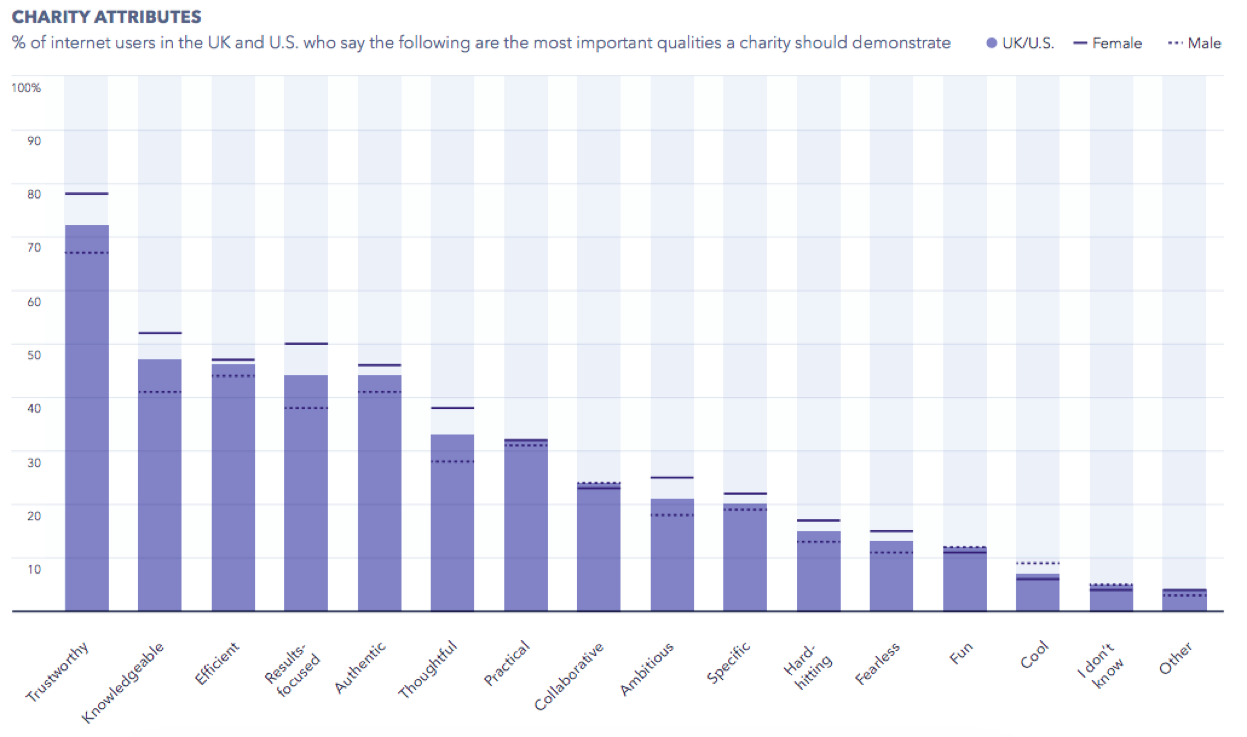
Our 2020 data from market research tool GlobalWebIndex shows that across all demographics, “trustworthiness is the most important quality a charity should demonstrate” (ranging from 66% among 16-24s to 82% among 55-64s).

chart showing most important charity attributes to donors

But demonstrating trustworthiness requires more than simply saying, “you can trust us!” Consider conducting a brand sentiment study to measure where your customer relationship may need some work. Some “drivers of trust include: ensuring a reasonable portion of donations make it to the end cause and having good management practices overall; ensuring fundraisers are honest and ethical; making independent decisions to further their cause; and making a positive difference to their cause.”

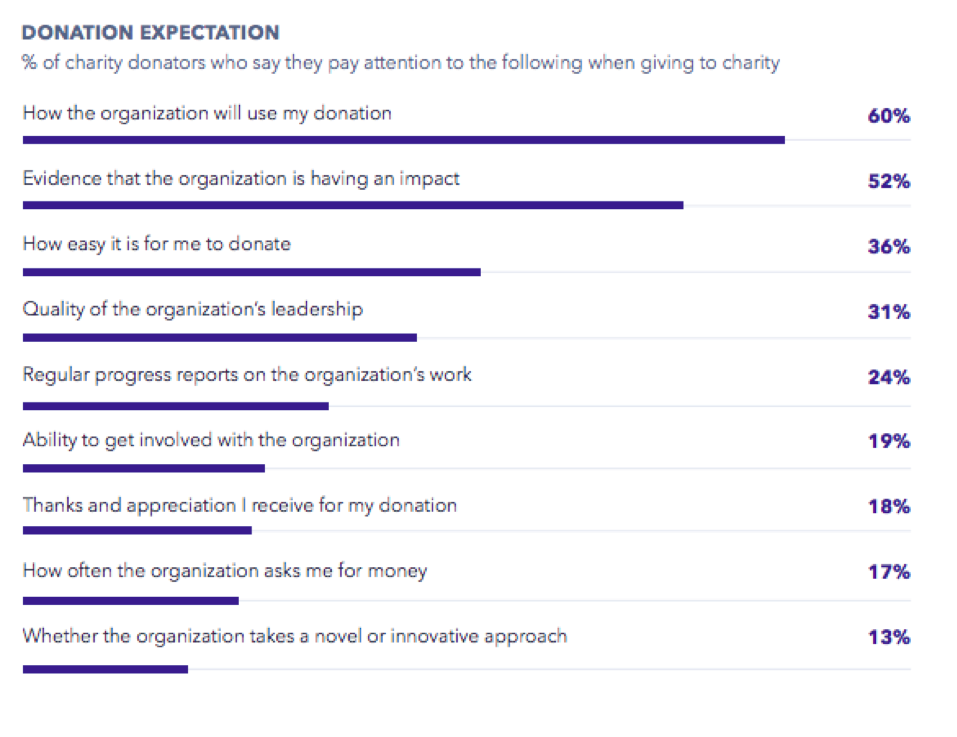
chart showing charity donor expectations

Once you’ve identified areas for improvement, it will be easier to outline a plan for the content, resources or marketing materials that need to be created or updated in order to address audience concerns.

Trend 2: Dedication to longer-form content

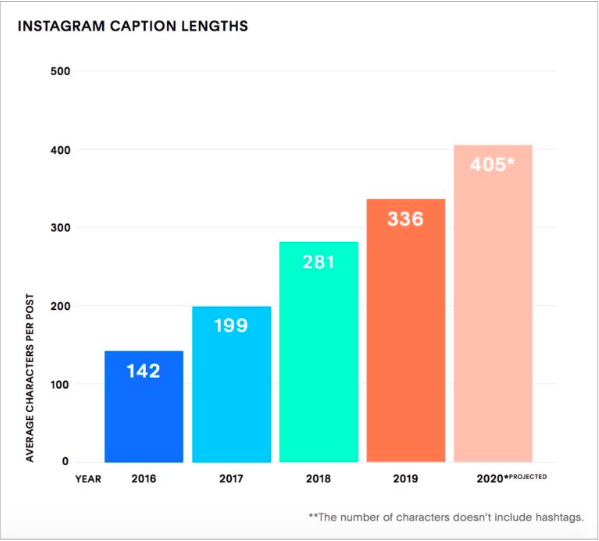
A trend we’re observing across social media channels is the use of longer-form captions and more in-depth storytelling. The average caption length on Instagram has doubled since 2016, with some predicting 2020 will see an average caption length of between 65-70 words.

chart showing average instagram caption lengths

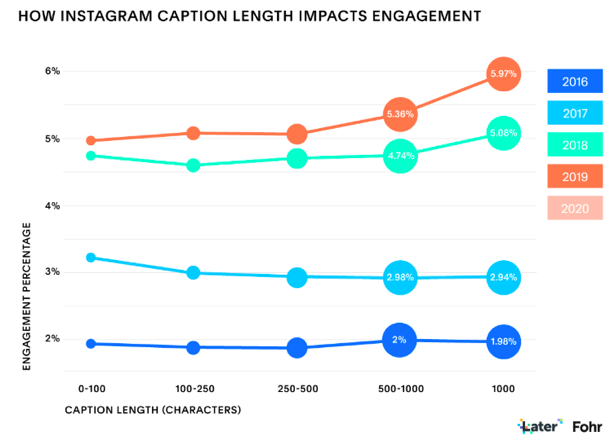
chart showing how instagram caption length impacts engagement

For dot-orgs, we think this represents an opportunity to tell more emotional, personalized stories through social media. Marketing and fundraising tactics that are highly personal, whether that be detailed stories about those you serve or the downstream impact of a donor’s gift, will prove effective in forging stronger connections with your audience in 2020.

Trend 3: A shift from me-centric to we-centric discourse

Online communities like Reddit have emerged as the go-to platforms for user-generated content. While we have seen the sheer volume of posts, photos, and reviews published on social media platforms increase exponentially, the frequency in which individuals are sharing has decreased over the past few years  (from 27% in 2014 to 20% in 2019). People are moving away from the “broadcasted self”, a marker of social sharing transitioning from “me centric to we centric.”

This shift in behavior creates an opportunity to engage with your audience on a new platform. Reddit and GWI found that 82% of community site users would be receptive toward brands participating on these sites. What does this mean for you? Find where your audience is having these conversations and join.

Want to contribute to our ongoing research about nonprofit branding and marketing? Respond to the survey link below, and we’ll share the results!

powered by Typeform

Launching the Alliance for Automotive Innovation

The combination of the nation’s two largest auto industry associations, Global Automakers and The Alliance of Automobile Manufacturers, has resulted in the new Alliance for Automotive Innovation. Branding and marketing agency Grafik was chosen to introduce the new entity and provide ongoing support. The Alexandria, Virginia-based firm led the naming, visual identity, brand strategy and transition planning, culminating in a national launch at the recent annual CES conference in Las Vegas, NV.

The integrated campaign introducing the new brand featured outdoor billboards in key auto markets, digital display campaigns and a VIP launch party for members and stakeholders at CES. Early campaign results feature high audience engagement on both the organization’s new website as well as on social media channels.

“Launching the Alliance for Automotive Innovation is an important milestone as it introduces a singular, clear and respected voice of the automotive industry,” said John Bozzella, president and CEO of Alliance for Automotive Innovation. “We valued our long-standing partnership with Grafik and their work with Global Automakers. It was a natural choice to have them lead us through this important transition and establish a strong brand and industry presence for Auto Innovators. We are very pleased with the positive feedback we have received from our members and the visibility the Alliance for Automotive Innovation has received across the industry.”

Having successfully created Global Automakers’ marketing site and authenticated portal, promoting both membership and engagement to international automakers and technology firms­, Grafik leveraged its thorough understanding of the industry and key stakeholders in service to the new association. Grafik also brought to bear its deep experience supporting such trade associations as the American Physiological Society (APS), the Institute for Public Procurement (NIGP), National Rural Telecommunications Cooperative (NRTC), and the Manufacturers Alliance for Productivity and Innovation (MAPI).

“It is always special to launch a new brand,” said Lance Wain, Principal and CEO of Grafik. “Introducing the Alliance for Automotive Innovation was a truly collaborative effort, from establishing the brand’s strategy to seeing it come alive in a national, omnichannel campaign. Positive market reception was both exciting and rewarding—but most importantly, it established a strong foundation for the brand’s future marketing and communication initiatives.”

About the Alliance for Automotive Innovation

Formed in 2020, the Alliance for Automotive Innovation is the singular, authoritative and respected voice of the automotive industry. Focused on creating a safe and transformative path for sustainable industry growth, the Alliance for Automotive Innovation represents the manufacturers producing nearly 99 percent of cars and light trucks sold in the U.S. The newly established organization, a combination of Global Automakers and Alliance of Automobile Manufacturers, will be directly involved in regulatory and policy matters impacting the light-duty vehicle market across the country. Members include motor vehicle manufacturers, original equipment suppliers, technology and other automotive-related companies and trade associations. The Alliance for Automotive Innovation is headquartered in Washington, DC, with offices in Detroit, MI and Sacramento, CA. For more information, visit our website http://www.autosinnovate.org/

About Grafik

Based in Old Town Alexandria, Virginia, Grafik is a full-service branding and marketing agency serving clients in a wide-range of industries including real estate, technology, higher education, associations, and professional services. For over 40 years, Grafik’s creative thinkers have combined business know-how, inspired design, and smart technologies to increase awareness, influence customer behavior, drive results, and grow market share. To learn more about our services and work, visit https://grafik.agency/

Back to basics: the age-old human needs behind 2020’s biggest tech trends

Imagining the future has always seemed impossible, but that didn’t and won’t stop us from trying. In the 1950s, Popular Mechanics magazine predicted that 2020 would bring personal helicopters and a network of pneumatic tubes to replace roads. And while we may not have exactly ended up there, we are heading into 2020 on a wave of increasingly personalized technologies that are impacting not just how consumers move through the physical world, but how they discover, experience, and interact with brands and with one another. 

You’ve probably already read a lot about how innovation in areas like AI, voice, and video will shape the coming decade of marketing. If you’re struggling to decide what or how to invest in new strategies as an organization, it helps to consider the fundamental human needs that are actually helping drive and justify each of these buzzworthy trends. We see these age-old desires reflected across both the client-specific research we conduct at Grafik as well as in macro trends highlighted at the industry summits we attended this year like INBOUND, Brandweek, and DC Adweek.

The Trend Watching 2020 event, in particular, placed a heavy focus on the following five human elements that are driving macro trends:

The human need for connection 

The desire to build relationships, in tandem with the takeoff of virtual reality and assistants, has primed consumers to accept, and even expect, relationships with virtual representations of brands. 

What do we mean by virtual representations? Consider what Trend Watching analysts call “brand avatars.” As digital channels continue to multiply, consumers will want to see characters who embody the brand with which they are interacting, allowing them to absorb a brand and/or service in a more immersive and memorable way.

One of the first successful examples of this we saw in 2019 was Wendy’s appearance in the video game Fortnite. The burger chain’s red-hooded mascot seized the opportunity to drive home the “evils of frozen beef,” and quickly went viral as she located and destroyed as many freezers in the game’s city as she could find.

Wendy's brand avatar [Source: PCGamesN
Trend Watching encouraged attendees to consider the following when debating brand avatars: “If you were to code your brand into life, what would they look like and what value would they deliver?” 

The human need for relevance

With the sheer amount of data that brands now have access to, people increasingly expect personalization as a standard of service. Trend Watching experts assert that this cultural shift in expectations will now prompt a period of what they’ve dubbed “metamorphic design,” in which products change, grow, and adapt to each individual user.

The more personalized a product is, the more “relevant” its value. These days, you can find personalized services for just about everything, even nutritional recommendations based off of your blood tests from services like Habit or Baze

It’s a great conversation for a marketing and product team to have together: how might your offerings and services continuously adapt or evolve based on an individual customer’s needs and wants?  

The human need for recognition

It’s nice to feel seen and appreciated. And in an increasingly cashless society, the human desire to be recognized creates the perfect conditions for what Trend Watching experts have termed “brand coins.” Brand coins act as currency for customer loyalty. 

One company effectively using brand coins is Miles, a transportation rewards app that incentivizes the use of public transportation, walking, or biking. The greener the transportation method, the more points users get, which can be redeemed at Zipcar, Oakley, and other stores. This incentive not only allows consumers to limit their carbon footprint, but rewards them for doing so, encouraging them to continue and potentially even tell their friends about it.

How can your brand engage your audience in a way that gamifies or provides recognition of their loyalty? 

The human need for self-improvement 

Research (both psychological studies on willpower, as well as my own first-person reflection on the mounting fees I’ve incurred from missed workout classes) shows that despite the best of intentions, failures of self-control result in negative consequences across almost all areas of life, from financial to physical wellbeing. 

On the heels of a widespread cultural focus on wellness, Trend Watching experts predict that in 2020, consumers will begin to welcome “interventionist” brands that act in their best interest rather than exploit their temptation to indulge in an unhealthy behavior. Take Apple iOS 12’s introduction of Screen Time tools, which allow users to track and limit the time they spend looking at mobile devices. Or British bank Monzo, which allows users to block certain purchases like gambling and fast food. 

The human need for privacy 

According to Salesforce, 92% of people are more likely to trust brands that give them control over the personal data collected about them. If 2019 was the turning point in data privacy awareness and regulation, 2020 will be the year consumers truly attempt to take back the reins on their personal information.

Consider AirlinePrivacy.com, which launched a platform that informs passengers of the airlines using facial recognition to identify people during the boarding process. This tool prompts visitors to send pre-populated tweets to the airlines that use facial recognition without consent, or book through alternate airlines who do not use this technology. 

What controls are you putting in place to ensure your audience has ownership over what data they sharing with you? Are you proactively communicating to them about how and why their data is being stored? Compliance with CCPA regulations, which go into effect next month, are a good place to start. 

New technology is exciting and inspiring, but any organization’s short-term success and long-term brand power are hinged on its ability to meet its audience’s most basic human needs, no matter the tool or channel. 

Counting down the clock to CCPA

The California Consumer Privacy Act (CCPA) is a new consumer protection law set to take effect January 1, 2020, with enforcement beginning July 1, 2020. This legislation loosely follows Europe’s General Data Protection Regulation (GDPR) and aims to give Californians control over the use of their personal data. While this piece of legislation specifically applies to California residents, at least 15 other states have developed similar “copycat” laws, suggesting a widespread adoption of similar legislation nationwide is near. 

To help you prepare, we’ve answered some common questions below with preliminary recommendations on how to ensure you’re compliant. We encourage you to speak with your legal team to determine an approach that fits your organization’s specific practices. 

New rights for consumers under CCPA

According to the California Department of Justice, the CCPA gives Californian consumers the following rights:

• Right to know what personal information is being collected, used, shared, or sold.

• Right to delete personal information collected by you or your partners.

• Right to opt-out of the sale of personal information. This includes sharing personal information with third-parties.

• Right to non-discrimination in terms of prices or services when a consumer exercises their rights.

Qualifying for CCPA 

If you collect information—whether voluntary through contact forms or involuntary through website cookies—from current or prospective Californian consumers, you will need to comply if one or more of the following criteria applies:

• Your annual gross revenue is more than $25 million.

• Your organization receives, shares, or sells personal information of more than 50,000 individuals.

• Your company earns 50% or more of its annual revenue from selling personal information of consumers.

Complying with CCPA

Unfortunately, there’s no one-size-fits-all solution to CCPA compliance, but we’ve outlined three basic recommendations to help you get started. 

    1. Document the data you’re storing and where it’s stored: create a data inventory that identifies the personal information you collect, how you collect and use it, the partners and platforms that you share the information with (think paid search providers like Google, CRMs like HubSpot, website optimization tools like HotJar, etc.), and how the information you collect is retained, secured, and disposed of. 
    2. Review vendor/third-party data practices: identify all vendors and third-parties with which personal information is being shared, review the existing contracts with those parties to ensure compliance, and confirm the vendors and third parties, themselves, are compliant. 
    3. Make updates to your website: update your privacy policy to reflect the data inventory and vendor/third-party contracts and practices you’ve documented. Simultaneously add a consent pop-up to your website that educates users on the personal information being collected with a link to your privacy policy. Finally, add a “Do Not Sell My Personal Information” link to the homepage of your website. Click here to learn more about making your website and privacy policy compliant.

If you have questions about CCPA or would like a quote for integrating our ready-made consent pop-up solution on your HubSpot, Pimcore, or WordPress website, don’t hesitate to reach out.

Sources not cited above

• American Bar Association, California Consumer Privacy Act

• BakerHostetler, The California Consumer Privacy Act: Frequently Asked Questions 

• The National Law Review, Top 10 Things to Do to Prove CCPA Compliance

The early adopter catches the competitive advantage

Think back on some of the most impactful digital marketing technology to hit the mainstream over the past two decades. Search engines. Customer relationship management tools. Twitter. Were you one of the first to join and master these platforms, or were you late to the party?

There’s no shortage of companies that classify themselves as “innovative,” but the reality is that less than 200 early adopters paved the road for digital marketing to evolve into what it is considered today: normal, industry-standard marketing. These early adopters were the first to subscribe to new tools and ideas that had the potential to disrupt markets and provide a competitive advantage. They tended to be open-minded, active within industry communities, well-spoken within their fields of expertise, and unafraid of failure.  

The concept of early adoption was first addressed by a theory called the “Diffusion of Innovations,” popularized by Everett Rogers in his 1962 book. Rogers classified individuals or groups into five categories: Innovators, Early Adopters, Early Majority, Late Majority, and Laggards. 

Image source

In the graph above, the normal distribution in blue shows the percentage of Innovation adopters by category, while the yellow curve shows the aggregate market share progression of those groups.

Rogers’ theory makes many classical claims about each category in reference to age, prosperity, community connection, risk appetite, education, and authoritative influence. 

INNOVATORS
Very young in age
Very prosperous
Well-connected to the community
Highest risk appetite
High level of education
Heavily respected as an authority within the community

EARLY ADOPTERS

Young in age
Very prosperous
Well-connected to the community
High risk appetite
Highest level of education
Highest respect as an authority within the community

EARLY MAJORITY
Older in age
Prosperous
Connected to Early Adopters community
Medium risk appetite
Medium education
Some respect within the community

LATE MAJORITY
Older in age
Somewhat prosperous
Connected to Early Majority community
Low risk appetite
Low education
Low respect within the community

LAGGARDS

Oldest in age
Low prosperity
Low connection within the community, if any
Very low risk appetite, if any
Low education
Low respect or not known within the community

Wow, some of that seems harsh! Maybe there’s more to the story?

These categories were first created in the 1960s, a time long before the Internet and the digital revolution. In the modern day, I’d insist on the following caveats:

“Education” has taken on a different meaning. Back in the day, the only recognized way to become knowledgeable about a topic was through a higher-learning institution. But today, some of the best developers and tech experts in the world don’t have a bachelor’s degree. In the spirit of modernizing this theory, it is probably wise to equate “education” with expertise in relevant knowledge domains.

“Age” does not necessarily refer to years of existence. It may be true that from an individual perspective, younger tech experts are usually more inclined to adopt a newer approach to solving a problem. But does this hold true for a company’s “age” based on its number of years in business? Sure, we hear about contemporary, innovative start-ups pushing for new paradigms, but even though Google isn’t adolescent in years, it would still be considered an innovative leader. An example outside of the tech world is Walmart and its cutting-edge applications of information systems that began in the mid-1980s (when the company was already over 20 years old). In this sense, it might make sense to think of “young in age” as a willingness to introduce change or new ways of working. 

Caveats aside, there are some timeless and valuable lessons to be learned from this theory, namely around prosperity and risk.

“Prosperity” speaks, in part, to available opportunity. Unsuccessful organizations are less likely to have the capital to sustain a high risk appetite, and thus experience more friction when attempting to move to earlier categories of the curve. And some Early Adopters are prosperous not because of innovation adoption, but because of earlier successes or infusions of capital that allow them to take on more risk.

In terms of “Risk Appetite,” consider Brene Brown’s modern wisdom: “There is no innovation and creativity without failure. Period.” If you don’t know Brene, she’s a badass deliverer of tough truths. Risk implies the possibility of failure, and this shouldn’t be feared. It may feel uncertain and scary, but failure is one of the most important parts of innovation. Failure is progress, and it should be treated as a constructive investment. Failure can be learned from and reveal new opportunities. Organizations that promote a culture that accepts constructive failure are more likely to obtain competitive advantages through innovation. Companies that fear failure are more likely to find themselves at a disadvantage; technology moves too fast to plan on a long term status quo.

So early adopters are good, and late adopters are bad?

For a business, yes. Technology is everywhere, and flourishing industries tend to be intertwined with it. For a company to avoid being left behind by adversaries, it needs to have some semblance of observance towards riding the tech wave as it matures and unfolds. 

However, when it comes to individuals, I just don’t think it’s that simple. As a developer, I have worked with professionals that are eager to adopt new tech as well as those who are more conservative and set in their ways. I have seen greatness on both sides of the spectrum. It is fascinating to observe the contrast in how these different kinds of thinkers approach problems and craft solutions. Though their methodologies may be divergent, diversifying a development team with resources that fall into different innovation adoption classifications can result in a strengthening of the entire team. With the right blend of professional respect and active listening, they have the capacity to shed new light in unlikely places. 

There is strength and opportunity in diversity of perspective. It feeds imagination; the very essence of invention. What’s more innovative than that? 

Want to know what kind of adopter you are? This quiz is a fun place to start!

Should all websites be accessible?

Episode Summary:

The Americans with Disabilities Act, known as the ADA, was signed into law in 1990 by George H.W. Bush, protecting the rights of the disabled and the impaired. But since then, businesses have been hit by a record-wave of lawsuits that allege websites are not ADA compliant. However, the cost of making websites accessible can be steep, ranging anywhere from several thousand dollars to a million. The costs and effort involved have left the development community, businesses, and the agencies that support them divided on the issue. In this episode, front-end developer Paul Miller discusses the moral gray areas of ADA website compliancy.

Transcript: 

Clara:

The Americans with Disabilities Act, known as the ADA, was signed into law in 1990 by George HW Bush, protecting the rights of the disabled and the impaired.

**Sound clip of George Bush**

  • Every man, woman and child with a disability can now pass through once closed doors, into a bright new era of equality, independence and freedom.

Clara:

While previous ADA lawsuits focused on the physical barriers to access businesses, such as wheelchair ramps, closer parking spaces, or easy to access brailed headlines, the conversation has shifted to the ethical questions websites now impose when it comes to accessibility for all.

**News sound clip**

  • Businesses, now hit by a record-wave of lawsuits in connection with the Americans with Disabilities Act. In particular, lawsuits that allege websites are not ADA compliant.

Clara:

In recent years lawsuits have targeted businesses across a number of industries, including retail e-commerce sites, such as Rihanna’s Fenty Beauty, streaming services like Hulu, or even sites of respected educational institutions such as Harvard and MIT.

The root of the problem? In the ’90s Congress didn’t anticipate the crucial role the internet would have in the 21st century. However, the cost of making websites accessible can be steep, ranging anywhere from several thousand dollars to a million, depending on the scope and the complexity of a website, leaving the development community ,the businesses involved, and agencies divided on the issue.

To help break this down even further I have with us in the studio, Paul Miller. He’s a full stack developer who specializes in front end development. His passions revolve around the latest advances in CSS, animations, and as of the last two years, accessibility.

So Paul, we’ve seen this issue catch like wildfire in recent months. What do you think was the catalyst for all this debate?

Paul:

It’s really hard to pinpoint what’s made this fall into the zeitgeist, but like most things, once it’s in there, inside the Twitter verse, it just becomes a central focus. And for me, this is when things really started to come into focus for myself, I just started to focus more on accessibility and what that meant for me as a developer and what my moral obligations are, if I have any, for that matter.

And as best as I can summarize it, it kind of boils down to three main points against working towards accessibility. And then one point towards working for accessibility. For it, is that it’s a moral obligation for the developer.

There’s a rough estimate of about 20% of individuals online who have some kind of mental or physical disability. So, de-facto, that means that 1/5 of the people who are on the internet are working through something that typically someone with a mouse and keyboard and general functionality of their of their body would not have to struggle through.

So the point is that you want to assume that whoever might be on your website might be struggling with these things. And you don’t want to make it harder for them. Er-go, it’s a moral responsibility of the developer. When the ADA was first put together in the 1990s, the idea was that this is mostly for those who are going through either in-person discrimination or have to get over some kind of physical hurdle that their disability was keeping them from being able to surpass on their own.

And now that has been co-opted as a means of litigation against companies that aren’t compliant with accessibility rules that are now being co-opted into the ADA.

Let’s just look at how things have changed for both of us when it comes to finding a job. I remember I could go to Subway, fill-in an application, and just get to work that day. But I can’t think of a single place on the planet anymore that takes a paper application. Everything is done online. So am I just going to say, ‘Well, you have a physical disability so you can’t work here because you can’t go through our website.’ They don’t have the option. And that’s the problem.

That’s the big controversy ⁠— the arguments against it kind of revolve around what’s moral or immoral for one person might not be the same for another person. Because moral is a big gray area of conversation.

One of the best things about the web is that the friction of starting and growing a business is low, and accessibility adds to that friction. And this one I specifically don’t agree with, but handicapped people bear some responsibility in managing their own condition and site entirely on the developer to work around that.

Are these people worth it? That’s, I mean, that sounds really awful. But like that’s really what it comes down to, you know, are these people worth the extra effort to make things accessible? The extra money, to buy the time to make it accessible, and the extra friction, it adds to starting your own business to make this consideration for other people.

**Music fades up**

I personally think so. I think that that’s the gold standard that we should be achieving.

**Music break**

Clara:

I’m sure that it varies by how big a site may be, but how big of a lift is rehabbing a site that already exists to make it more accessible?

Paul:

To develop without accessibility in mind from the get go, and having to do all this posthumously, becomes a massive game of jigsaw. Because once you start restructuring, things become more accessible. You don’t know what you’re going to end up decoupling as a result. And one thing leads to another and all of a sudden, things start breaking that you can’t explain.

I personally think, and I’ve seen the result of this, is that if you start thinking about accessibility, from the design phases before it even hits development, that’s when you start seeing the least amount of friction. And if…I understand that some designs are so fantastic that it’s difficult to see how accessibility can work with them.

**Music fades down**

But I point to Apple and Microsoft in this regard. These are two massive companies with their own design presence ⁠— Apple, especially. They know how to make something accessible and cool all at the same time. The entirety of all of their websites are accessible. And they have entire accessibility tool sets dedicated to it. And they put out information for developers to follow when it comes to adhering to accessibility guidelines, both Apple and Microsoft. So I say, if you want to see an example of it done correctly, and start seeing the trailblazers on this very subject, I would look at Apple and Microsoft.

Clara:

So right now no formal government standards exist for businesses to follow to ensure that their website at a compliant, but there are guidelines such as the Web Content Accessibility Guidelines, that are sort of meant to act as a baseline for making websites accessible.

Could you tell us a little bit more about these guidelines, who enforces them, and in your experience what role, if any, they play in the early stages of a website’s development?

Paul:

WCAG guidelines aren’t proposed by any kind of official government agency or any kind of agency that has some kind of like, you know, litigious power in order to enforce it on others.

However, they are often cited when litigation is brought up. Myself and many other of my peers ⁠— we use WCAG as a metric for how to see whether or not something is or is not accessible. There’s three levels, you have a through triple A, (but) the sweet spot is double A ⁠— you want to at least be at that point. And that’s when you can say you have an accessible website. And that’s just become an implicit norm. Everyone accepts that as like, the gold standard, so to say.

But prior to that it was just the ADA and there was no verbiage inside of it that suggested websites need to be compliant until around 2006, when the internet started to become more prevalent. (People) Started to realize things like Facebook, and Twitter, and Instagram, and YouTube — all of these things are starting to pop up. And we’re all starting to foresee see that introductory look into the new digital age. And old laws tend to become living documents. And that’s what the ADA has become. Now that’s the main enforcement tool used for litigious offices to say, “Keep eBay or Hulu or Beyonce in check.”

A good first step on how to bridge that gap that we’ve been talking about — I cannot recommend Dave Reaper Rupert’s a live in whining attrition cards more. They succinctly go through, like, very common components that any developer will end up building out and explaining from the very get-go, how to build them out to be accessible, what you have to include in order to do that. So it’s like it–it’s the spark notes of accessibility. Where as WCAG is the full novel.

Clara:

So it sounds as if ADA lawsuits can be sort of a murky thing to navigate when it comes to who should be held accountable for these things. You know, should it be the buyer? Should it be the website developer? Should it be the agency? Who’s actually liable in these lawsuits? And do you think we’ll ever see a day when agencies will be required to include accessibility in scope of works?

Paul:

That’s a very difficult question to answer. Is it the agency’s responsibility to put it inside of the-the language of the initial contract? Is it a development team within the agency to make sure that this is part of the development process? Like, again, is this a moral obligation or is this friction? And it’s difficult to say.

If you were to ask me personally, I think it’s the agency’s responsibility to put that language inside of the contract itself. To say that, you know, “We will be doing X or Y specifically with accessibility.” Either at cost of the of the vendor or at cost of the agency.

Now that becomes problematic because now you’re talking about whether or not an agency should be (quote, unquote) donating money towards a good cause. Agencies need to become smarter about how they gauge out timeline it’ll take to complete a project and keep accessibility in mind. Because at the end of the day, it does add additional development time it does add additional tests, it does add additional loops that are just dumped through to make sure that everything is working correctly between PC or Mac and phones for that matter. And there are people who can’t use computers — they have to do everything by other phone. But me personally, I think the onus falls on the developer, I think part of it should be looking (to) understand (the) implicit understanding of our job titles.

But clearly not all developers agree with this. So ultimately, I think when it comes to reality it falls on the agency or whoever is being contracted to build the work to be very upfront about the additional time and the additional costs that this kind of accessibility layer will end up costing someone.

We developed websites for the web, it’s web development, that’s what we do. So we should be able to section certain parts of the website off because we’re trying to be speedier, we didn’t know any better. That’s no longer a good enough excuse. The information’s out there. And if you’re willing to just type in ‘Accessibility’ into Google (it) will be some of the first things you see via Apple, via Microsoft, via WCAG, via the Mozilla Development Network. It’s everywhere. It’s no longer excusable.

**Music fades up**

Clara:

Paul Miller is a full stack developer who specializes in front end development. You can learn more about Paul, at PaulKMiller.com.

I’m Clara Shannon and you’re listening to Studio G.

Raising awareness for the Colorectal Cancer Alliance

Episode Summary:

A rebrand is more than just a visual refresh. It should also change the way your organization works internally, engages the community, and fundraises. Since rebranding the newly merged Colorectal Cancer Alliance (CCA) several years ago, the organization has been able to double its revenue and build a highly engaged network of supporters that share its dedication to ending colorectal cancer in our lifetime. In this episode, CCA’s Chief Development Officer shares the process behind merging two brands, building an engaged “Nation of Allies” community, and capturing the urgency of the organization’s efforts through a new brand mantra: “Tomorrow Can’t Wait.

Transcript: 

Clara:

When cancer is found in the colon or rectum, it’s called colorectal cancer. It is the third most common cancer found in the United States, it’s the second leading cause of cancer death, and, contrary to popular belief, it affects men and women of all racial and ethnic groups.

In today’s episode, I sat down with Grafik’s Chief Brand Strategist Hal Swetnam, Lynn Umemoto, Principal, Client Strategy, and Regan Huneycutt, the Chief Development Officer of the Colorectal Cancer Alliance, the oldest and largest cancer nonprofit in the United States.

Grafik and the Alliance have been working together for nearly three years, and together have successfully raised awareness of the dangers and methods of prevention for colorectal cancer.

Our discussion led to some really interesting topics and fun anecdotes surrounding the challenges between agencies and nonprofits. We also talked about how our work over the past three years has not only successfully helped the organization raise awareness, but also raise funds.

So sit back and take a listen.

Hal:

Hi!

Regan:

Hi!

Clara:

Well, first and foremost, Reagan, thank you so much for being here today. We are so thrilled that you were able to join us. As we dive right in, would you mind giving us a little bit of an introduction of who you are and what your role is at the Alliance?

Regan:

Well, I’m the chief Development Officer at the Alliance. I’ve been with organization three years now and I had my three year anniversary just a couple weeks ago.

And you know what is so funny, just reflecting on getting prepared for this interview, my very first week at the Alliance is when we were interviewing all of the firms that we were considering to bring on board for the rebrand. So it’s just kind of fitting that here we are three years later.

But in my role, I am responsible for revenue generation. So I lead the fundraising team. And we have been very, very lucky and very blessed to experience wonderful growth in the couple of years–the organization has almost doubled in revenue in those three years, so we’re about a $13.3 million nonprofit. And we raise money in a couple different ways through our individual giving program. So those are folks who either make major gifts to the organization annual fund donations, do their own third party fundraising events, or unfortunately, a lot of giving from individuals in memory of people. So someone who maybe passed away from colorectal cancer and they give to us in that person’s memory. We also raise money through our own signature special events. So we have a 5K Undie Run Walk series in 20 cities across the country and a Blue Hope Bash that started in DC 10 years ago. I believe that has now replicated to four additional cities. And we’re adding three more next year, we do a couple other signature fundraisers and other zip codes as well. We raise money from corporate and foundation givers. So our industry partners, and quite a few family foundations that believe in our mission and support the good work that we do.

So I sort of lead the high level strategy for how we raise money and am very fortunate to have a great team and to be a part of building this organization and ultimately helping end this disease in our lifetime.

Clara:

That’s incredible. Congratulations on everything that you’re doing. What was your hope in this rebranding initiative and what was most important to you and your team?

Regan:

I think that that really evolved over time. I would say in the beginning, it was really about unity, and us coming together as an organization and as a community.

So the Alliance, previously the Colon Cancer Alliance, had merged with the Chris4Life Colon Cancer Foundation in January of 2016. I joined the team in April, and then we partnered with Grafik. It was early summer…it was, early summer?

Hal:

Yes, it was early summer.

Regan:

Yes, literally when I started. So you know, I had never been through a merger before either in a for profit or nonprofit setting. And it was just an amazing experience. It’s really like bringing two families together. You know, there’s duplications of roles, there’s, we did it this way, but we did it that way. We had a lot of even like visual elements in the brand–not so much branding, but just kind of messaging and language and things that were attached to Chris4Life that there was some energy around hanging on to some of that. And it was the legacy of Michael’s mom (Michaels Sapiensa our CEO), his mom was Chris and the Chris4Life Colon Cancer Cancer Foundation was founded in her memory. So we were in this kind of brainstorming phase of figuring out who’s on first and what stays and what goes.

So the process of exploring this rebranding really helped accelerate that sense of unity and bring those two teams together. And then sort of the backdrop to all of that was the community that we represent. You know, colorectal cancer kills 50,000 people a year, it’s the second leading cause of cancer-related death, and we’re a $13 million nonprofit. And back then we were $6 million nonprofit. I mean, that should not be the case.

So we really talked as a team about, you know, what is it that we can do that helps galvanize this community, that helps bring people together, that helps really kind of put a flag in the ground that says, “We’re going to do something about this disease. And we’re going to help grow awareness for colorectal cancer.”

Like, we’ve seen so many other disease states like breast cancer, and Parkinson’s and Alzheimer’s and so many others, and the rebrand really was a great vehicle to do that. So we really honed in on, what is our identity? What is our name? What is our look? What is our feel? How do we talk about ourselves? What is it that we’re committed to doing, and then we were able to launch that to our community as sort of this rally cry, and they completely responded.

And it has been such an important vehicle in the growth trajectory that we’re on, it really did evolve. It was in the beginning, like I said, a lot about the merger and bringing the staffs together and kind of figuring out who’s on first. And then as it developed, it completely shifted to being about our community and what our community wanted. And what it was they felt like they expected from the nonprofit that represents their disease day and just been a really cool evolution to witness.

Hal:

It’s funny, because when you talk about that, I forgot that you were so new to the Alliance when we walked in the door. And, and now that I looked back, it’s like…you were Switzerland, through a lot of the process, right?

I mean, because there was like, wait a second, like you said, “We used to do it this way. Why are we, why are we emerging away from that?”

Regan:

Yes.

Hal:

And it’s so funny you say that, but when you think about that process, there must have been things that you were like, considering, “Are we going to get through this process?” It can seem to be so daunting at first, because there was so much on the table.

Regan:

Yes.

Hal:

What were you most concerned about?

Regan:

I’m a very, like, tactical, right-angle type person. So, I’m thinking about like, in the supply room there’s like boxes and logo letterhead, and, oh my God, like, just the task of reprinting, I just go to things like that. And I felt like, early on in our meeting, it was just like, “We gotta let go of work, it’s going to take time,” it’s not like the day that we launched the new brand, like all the new logo things will be here. It’s going to be an evolution in our process.

And I think you guys helped talk us off the ledge on a lot of those things. But um, yeah, it’s a really interesting process to be in, especially fundraisers, the development team is a lot of Type A personalities, a lot of very kind of confident, self-assured people. And they’re normally like, pretty okay with sharing their opinions. And I will never forget, when we came in here to you all’s office, to see, I think you showed us like three versions of the brand? And I mean, it’s like, you were in front of a firing squad.

**Laughter**

Hal:

Right.

Regan:

Like this, like that, da, da, da!

I think you guys even used the analogy, don’t “Mr. Potato Head” it. Don’t pull this, from this, and this. But I think I made a comment at the end, like, you guys are awesome. You just took all that feedback. But part of why the feedback, I think was so intense, is that we’re working for a nonprofit, many of us have lost loved ones to this disease, we’re insanely passionate, and not to say people that are, you know, working for a for-profit businesses aren’t passionate, but we’re just kind of cut from a different cloth.

We eat, sleep, breathe this. And we were so excited about what this meant for our community that there were a lot of opinions and a lot of really strong-willed people. And we got through it. I mean, there definitely were some times where people had to…I always use that saying, like, “kill your darlings,” you know? You gotta let it go. You got to move on.

But I think that there was so much value in us as a newly merged entity going through that process, like you talked about, like a framework on which we built partnership and collegiality. And, you know, alliances, alliances formed! I mean, it just there–there were really critical conversations that had to be had. And people had to really put their thoughts and their feelings and their opinions and their criticisms on the table. And it really helped move us forward as a merged entity. But there were definitely a lot of moments where I was like, “Wow, this is a lot.”

Clara:

How do you think that the rebrand has changed the way that you work within the organization? Now, looking back?

Regan:

That’s a great question. I think that–and this was, this was very much kind of Michael’s vision and expectation in that–we were not going to be status quo, either as an organization or our new brand. It was about being disruptive, it was about being non-traditional; we wanted to really kind of push the boundaries a little bit.

I think now how we operate as employees, like, we’ve seen how that was a place of discomfort for a lot of us to be kind of cutting edge and to do things differently. And now we’ve seen this great result that’s happened by doing that through the rebrand. And now I think it’s made us all feel a little bit more comfortable doing that in our daily job. So being more willing to take risks, or to do things differently from others, or to, you know, totally throw something out the window and start over.

It’s just really kind of fed this entrepreneurial culture, innovative startup mentality. And I think that really started with going through the rebrand process, because an almost 20-year-old organization changing its name, that’s a big deal.

But you know, what? The building did not burn down because we did that.

**Laughter**

So how can we take that and apply it to other things that we do in our daily work? So it was a great experience.

Hal:

There are two parts of that. And one was, when we came back and said, “Hey, we think we have a mantra.” And then there was like, later on, it was the visual expression. But I remember sitting in that meeting, when we said, “We think this is about you know, ‘Tomorrow Can’t Wait.’” Right? And especially you were like, “Wait, I think we got something here.”

Regan:

That was like a goosebumps moment, for sure, yeah. That was huge. Yeah. We talked a lot about urgency. So, urgency within the community and the people that we work so hard to support pass away, and that’s hard for us, especially as staff and hard for our community. So we have this feeling of urgency to do really good work and to make a difference for people. And for that to pull through in ‘Tomorrow Can’t Wait.” It was such a galvanizing moment. I’m getting goosebumps just talking about it right now. It was like the essence of what we are about as an organization. And amazing that you guys, like, I don’t know what secret sauce is in there to come up with that. But it was very cool to see that you guys—

Hal:

That really came from you guys, I mean that’s really kind of you to say, but that really came from you guys, because it was clear that urgency was in the air, it just had never been put down on paper. Everyone kind of felt that.

Regan:

Yeah.

Hal:

Yeah, and we knew that it was time for that, we just hadn’t really articulated it well.

Regan:

It’s really helped us to separate ourselves from our competition. And that sense of urgency and that kind of freshness and the, “we’re not status quo.” And we’re going to push the envelope a little bit; that has helped separate us from others. And it really gives kind of a great conversation starter, when you’re sitting down and talking to a potential donor, it’s really easy to articulate how we’re different from others. And the visual identity really backs that up as well.

Clara:

So we could diverge a little bit and talk about a Nation of Allies. Part of the effort was to galvanize your network, you know, the survivors and the patients, the volunteers, everybody that was involved. How has the impact been on that effort?

Regan:

You know, it started being about staff and about bringing the two organizations together. And it pretty quickly transitioned to being about the community and the people that we represent and Nation of Allies, like that was, that was that other goosebumps moment. That was like, “yes, that’s what we’re–that’s what we’re talking about.”

You know, we’ve worked really hard to message that and to help understand what it means. And part of why I think it’s so effective is that it–it can mean so many things to so many different people in so many different settings. So there’s a…there’s a really strong connection, I think, between community and fundraising, especially with younger donors.

It’s not about just writing a check and putting it in the mail, people want to feel like they’re a part of something and that they’re doing something and they’re helping facilitate some type of change–that they’re in a community of similar people that share in the same desired outcome or have the same passions or expectations. So that is the Nation of Allies. And so, in the fundraising world, it’s this great kind of vehicle through which we can talk about our donor community, and that you are belonging to something because you’ve given your resources to help advance our mission.

And people like that; it makes them feel good, it makes them feel like they’re part of something bigger, and that they’re in this community with other people that are on the same journey. And like, there’s like catnip in that, like some specialness about being a part of that. And it’s definitely helped us raise money, for sure.

Hal:

I would bet, or I would hope, that there would be some nonprofits listening in, or maybe even some development officers listening in that recognize there’s a need to go in and kind of fine-tune the brand a bit, you know, develop some better language and better messaging. But I remember in the course of those conversations, and it was a long kind of very thoughtful, progressive set of conversations. There were times that I could just tell you were like, “Oh, my gosh, where are you taking us?”

Can you talk about some of the—because clearly there were…there were meetings that I said to Lynn, like, “We’re in big trouble with Regan, she’s not on board here, we’re gonna have a separate conversation.”

Regan:

Oh, I’m…I’m trying to remember anything specific that might have made me react like that. I think at its core, it’s–it’s fear. The fear of change and moving in a different direction. And what you put at risk is people’s willingness to open their wallets to you.

So, you know, I think at some point, we have conversations about like, well, when will people figure out they need to make their checks out to Colorectal Cancer Alliance instead of Colon Cancer Alliance? And like, think of the issues that that creates, and donor confusion, and just some of those practical pieces were just, they were scary, because it was changed. And it was different.

And you know what, if people don’t like that we changed our name, or that we let go of the of the Blue Star ribbon, are they not going to be willing to give to us? We’ve doubled revenue in the last three years. So clearly that was not a problem. I know the rebrand actually helped us attract new donors. And it helped us increase giving levels of current donors and it gave them kind of a peek into where we’re going, and the future and what’s possible, you know, with the vision that we’ve set out at the Alliance. And that translated into dollars, definitely. I think my kind of, like, practical logistical side of my mind freaked out a couple of times, because it is scary, and it’s risky.

And you know, it is already a crowded space. So to make changes to our identity, and our name and our brand and our look and our feel, and that potential risk whether people would come back and support us again. Yeah, definitely kept me up a couple nights.

But we got through it.

Hal:

Yeah, we got there. And you guys are–you guys are awesome at being really surgical at finding, you know, those donors, the right people.

But I’ve gotten a sense from conversations that people are finding you.

Regan:

Yes, readily.

Hal:

Absolutely. It has changed dramatically. What do you see there?

Regan:

Yeah, we’ve gotten amazing feedback about the website, the look, the feel, the messaging, the energy you get from looking at our site is so different from others in the space. I think the fact that we have had a four star rating with Charity Navigator for so many years, we have great financials, we check all the boxes on being good stewards of donors dollars, that certainly helps.

But a website, that first impression for so many donors that are in that kind of research phase of deciding who is it that I’m going to support, we are sending a very compelling message, even through just the homepage, and it translates for people and I’m very grateful for that.

Hal:

We’re excited about it. I gotta tell you that, you know, we have a lot of different kinds of clients and they’re all rewarding in different ways. But you guys have been super rewarding because it has been so neat to be part of the conversation and see the transformation and see people that were so willing to like, you know, in some cases take a risk.

Strategically we know that we have a foundation and a reason to do this. But still, it’s like you said, we have to kind of talk you off the ledge. And you guys were willing to say, “Yes, let’s do this.”

So if someone is listening to this, and they say, “Oh my gosh, I gotta write a check for these people!”

**Laughter**

How do they get a hold of you?

Regan:

ww.ccalliance.org.

Hal:

And ask for Regan, yeah.

Regan:

And click the donate button!

**Laughter**

**Music fade up**

Clara:

Regan Huneycutt is the Chief Development Officer of the Colorectal Cancer Alliance.

I’m Clara Shannon, and you’re listening to Studio G.
Branding a family-owned business

Episode Summary:

It can be scary to change anything about a long-established, well-loved brand. But when done right, the rewards far outweigh the risks. Grafik’s recent rebrand of Demosphere, a Virginia-based company with a 30-year track record in sports team management technology, shows that evolved, modern brands resonate with both longtime customers and new ones. In this episode, Demosphere’s President discusses the creative process and the company’s new mantra: “The Team Behind Team Sports.”

Transcript: 

**Sound Effects: whistle, sounds of children playing**

Clara:

Just about everyone can relate to the unbridled joy of playing sports as a kid. Maybe you are your high school soccer star..

**Sound Effect: crowd cheering**

Clara:

…or you dominated the basketball court.

**Sound Effect: shoes on basketball court, intro music fades up**

Clara:

You spent all your mornings in a lap pool, or you just couldn’t wait to get to your after school softball practice.

But as a kid you likely weren’t focused on all the work involved behind the scenes of the sport you were playing – all of the organizational, administrative needs any organized sports team needs to be successful. People need to know where to go, who they’re playing against, when and where their practices are being held, as well as what equipment to bring.

Demosphere has created integrated user friendly tools specifically for the way sports organizations are run. They take the busy work out of sports management…so that players, teachers, parents, and even amateur adults can kick-back and focus on what’s most important: having fun.

What else makes Demosphere so interesting? They’re a family-owned business with over 30 years of experience. And like any family-owned business, they’re a tight crew with a long history.

So how do you go about approaching the rebrand of a client who has such a long and storied history?

We had the pleasure of working with Demosphere on a brand refresh a year ago, and I had the chance to sit down with Kris Baker, Demosphere’s President, along with our creative directors George, Gregg, and our director of client services Esther, to talk about the work we were able to produce together for the team behind team sports. Take a listen and we hope that you enjoy.

**Transition Music**

Clara:

Kris, thanks so much again for being here with us today. We’re super excited about this.

**Music fades down**

Clara:

For our listeners out there, could you give us a quick overview of who you are and just a little bit more about the work you guys do over at Demosphere?

**Fade Down**

Kris:

Sure, yeah. My name is Kris Baker and I’m the President of Demosphere. I’ve been there about 12 years. Our team is really a really tight knit, collaborative group of people and we create and extend web applications that are geared towards sports organizations. So we do things like online registration of players and teams and game scheduling and team building. And we’re really excited about our new product that’s coming out which is geared more towards referees and game assignments and things like that.

Clara:

You guys have been around for over 30 years now. What initially prompted you guys to seek out a brand refresh?

Kris:

Demosphere has a pretty amazing story to tell; as you said, we’ve been around for almost 30 years now [and] we have a lot of history. Going back to our days of working with FIFA and the World Cup technology committee, I think over time, some of that messaging may get lost in the market. And so it was a really good opportunity for us to kind of take a step back, and make sure that we understood what our message was and how we wanted to present ourselves to the rest of the world, and then get some expertise on how to properly present that message to everybody else.

George:

I bet when you first started people were printing out rosters, signing up on sheets…

Kris:

Yeah, hand writing stuff, printing stuff — I think one of the first solutions we ever built was a phone tree calling system where you would call in and you would like, leave the score on a voicemail and then somebody would go back and like transcribe everything and, you know, type it up and disseminate it for the rest of the world. So, obviously, things have changed a lot since then. And especially with, everybody [being] like, mobile first, that’s the way everything has gone. We all have a phone, we don’t always sit stationary at our computer. So this information needs to be accessible on the go, which means more development and really pushing the envelope there.

Gregg:

So for the people listening in, what do you what do you think is your differentiator?

Kris:

I mean, I think a lot of it is the fact that we have the experience and expertise in this space and a true passion for what we’re doing. When you’re building a brand, it’s not about… power, it’s not about money. It’s not about how you’re recognizing in the marketplace, but it’s really about building trust. And that’s what we’re going for is that we want people to trust who we are, and that we’re doing things for the right reasons and that it’s not about the money.

I truly believe that. And I always say that if we build solutions that people want, like, genuinely want, that’s the authenticity part of it. Then the money will come, because they’ll want to use our services and stay with us long term. So, that’s, that’s the key. I think that unfortunately, I think, a lot of businesses out there…miss that point. And it’s the most important thing.

**Transition Music**

Kris:

Our strengths, our experience and our familial aspects of our community, our greater community — I think sometimes that can also be perceived as a detriment because people do think that, “Oh, you’re a family-owned business.” But when we say family, we don’t just mean the Baker family, you know, we mean, our extended family — all of our employees, who we care very deeply about and our customers, many of whom we’ve been working with for 15 years. So it’s a whole…that family aspect is a whole community and not just the little Baker family.

George:

It also speaks to the importance of understanding your brand so that the core values of what you do remain.

Kris:

Yeah, and that’s what was great about going through the process with you guys is that you helped us kind of focus on that. We knew that messaging was there, that internal messaging has always been there since the beginning in 1990, but sitting down with you and your team and going through the exercises of just understanding our brand and who we are, it was a really fun process.

Every time we have a company meeting we always pull up our mission statement and our brand identity and the pillars and, you know, just reminding everybody that this is why we do what we do. And you look around the room and you see a lot of head nods, everyone gets it. And that way, when, you know, I hear my staff, whether it’s our support team or our sales executives when they’re out there in the market, they’re using those words to describe our company and it’s a really good feeling to know that it’s consistent across the organization.

So one of the…one of the things that you guys helped us come up with was like our tagline of, “The Team Behind Team Sports.” And I remember exactly that moment, George, when you said it, I was like, “Yes, that’s it! That is it!’ It was great.

It was a really good process. And then to even like, tack on to that point, it’s not just about what we think or about what you think based on what we’ve told you, but what do our clients think? What do our prospective clients think?  How have we been perceived in the market?

And one of the really good success stories that I can share is…so every year we attend the United Soccer Coaches Convention, which is in January of every year. So we chose that time to really roll out our brand, you know, our new brand, our new branding, new website, and just overall marketing, messaging and so forth and it was really well received. We got a lot of positive compliments, not only from clients, but also prospective clients. But most importantly from people who’ve known us for many, many, years and do know who we are at the core.

And, you know, whether or not it’s 100% corollary or not is questionable, but we walked away from the convention this year with more than double the amount of leads that we got last year. So that was really, really exciting, quite impressive growth. So we’re happy about that.

**Transition Music**

George:

Was there ever any hesitation to the questions we asked?

Kris:

Well, I guess I wasn’t expecting, when we can came in with the management team to kind of have those planned out exercises. And there was one that you guys did, which was really fun and that was the, I forget exactly what it was called, but it was something about like, five years from now, if there was like a headline about Demosphere, what would it be? And just having each one of our management team members come up with, like, what they’re thought of as what the future would be, that was really fun and interesting. And, you know, caught me a little off guard. I was like, “Wow, I don’t know, I don’t know,” but we had some similar concepts to where we thought the company was headed.

Esther:

So you mentioned that the results of the brand has definitely changed the way that you and your team approach a lot of the decisions that Demosphere makes, have you seen it actually make a difference in the company culture as well?

Kris:

I think it has reassured something that was already there. There’s one thing to kind of have this underlying feeling of how things are and how your, you know, everybody feels as being part of the company but having the like, set in stone, pillars of your brand and your tagline and your messaging on point. It’s makes a huge—it’s like the glue that holds everything together so just strengthening what was already there.

It has absolutely impacted the way that our employees interact with the outside world. They’re not afraid to say the things about like, we’re not afraid to say we’re a family owned business. We’re not afraid to say that we’re privately held and that we don’t have investment dollars out. We’re not afraid to say those things because they make us who we are, and we’re proud of it.

It’s fun to watch them like, interact with people when we’re doing trade shows and stuff and just being like, “Yep…that’s exactly on point.”

**Music fade in**

Kris:

If you haven’t done a brand refresh, it’s definitely worth the time and energy and money. It’s — it was a lot of fun. And I think the rewards will continue to pay off over time.

So thank you guys, it’s been fun…

Group:

Thank you!

Clara:

Demosphere is an Information Technology company based in Northern Virginia, catering to the technology needs of sports organizations around the country. For more information, go to  www.demosphere.com, spelled d-e-m-o-s-p-h-e-r-e.

Today’s roundtable discussion featured Kris Baker, President of Demosphere, Grafik’s Creative Directors George Nicholas, and Gregg Glaviano, along with Grafik’s Director of Client Services, Esther Nardone.

I’m Clara Shannon, and you’re listening to Studio G.
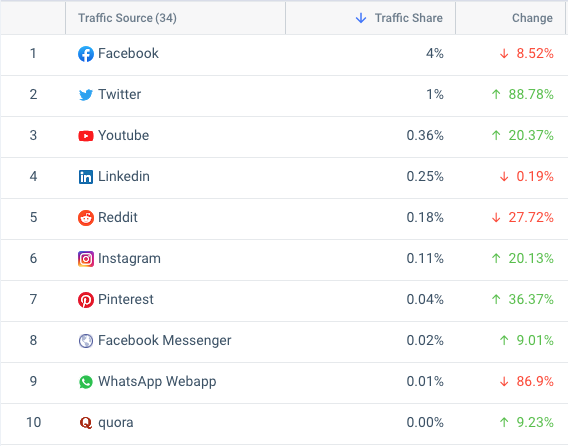
 

EPISODE NOTES

Host: Clara Shannon, Marketing Associate, Grafik

Guests: Kris Baker, President, Demosphere

George Nicholas, Chief Creative Director, Grafik

Gregg Glaviano, Principal Creative Director, Grafik

Esther Nardone, Director of Client Services, Grafik

Three brands that show pride year round

June has come and gone, and so has Pride Month–the annual month-long celebration of LGBTQ+ representation and the anniversary of the historic Stonewall Uprising in New York City. This year we saw more brands than ever demonstrate their support of the LGBTQ+ community in the form of pride collections, creative campaigns, and parades. 

These days, showing support for any social cause is popular. But in 2019 it’s not enough to say that you care, you’ve got to prove it. It’s easy to post rainbows all over social media channels, or sell limited-edition Pride-branded swag, but what else are you doing to benefit the community? How is your brand actively trying to make a difference year round?

Over the course of the month, we saw several brands who supported the LGBTQ+ community beyond the use of fancy designs and catchy hashtags. Here are our three favorite brands making a difference. 

Verizon

In partnership with McCann New York and PFLAG, an organization that reunites families and allies with people who identify as LGBTQ+, Verizon created a short film that showcases the hard conversations and tensions between family members surrounding coming out. 

Titled, “Love Calls Back,” the film depicts real parents, brothers, and sisters reconnecting through a phone call facilitated by Verizon. The conversations are raw, emotional, and very real. 

Verizon, “Love Calls Back” from Doug Harrison on Vimeo.

 “When you first called me, I should have told you how much I loved you then,” says a mother to her lesbian daughter. “I never wanted you to feel like I’m not there for you,” says one brother to another. 

The screen fades to white as two lines of text read, “It’s never too late for love to call back. Verizon and PFLAG are committed to connecting and reconnecting families.”

In addition to the film, Verizon has taken big steps towards true allyship with the LGBTQ+ community. For starters, the company vowed to make a monetary donation to PFLAG, as it did last year when it donated $250,000. The company was also the title sponsor of this year’s LA Pride, and hosted the premiere of its documentary 5B, which tells the inspirational stories of everyday heroes who took extraordinary action to care for the patients of the first HIV/AIDS ward unit in the United States at San Francisco General Hospital. Verizon’s LGBTQ employee resource group, Globe, will continue to facilitate volunteer opportunities through chapters as opportunities arise throughout the year.   

LYFT

This year’s Pride was a busy one for Lyft. The ride-sharing app launched a new feature as part of its #TwoIsTooFew campaign to highlight the representation of non-binary, genderqueer and genderfluid identities. Now, passengers and drivers alike can select their preferred pronounces as, “She/Her/Hers,” “He/Him/His,” “They/Them/Theirs,” “Pronoun isn’t listed,” or “Prefer not to say.”  


Photo of person's hand holding Lyft branded Pride flags.

Lyft also partnered with the National Center for Transgender Equality to provide driver assistance with changing the name and gender designation on a driver’s license and provided major support to StoryCorps’ Stonewall OutLoud campaign. 

These recent actions are not the only show of support Lyft has taken towards the LGBTQ+ community. Over the years, the company has also facilitated over $5 million in donations between passengers and organizations such as the ACLU and the Human Rights Campaign (HRC) through its “Round Up & Donate” feature. 

Smirnoff

Smirnoff Vodka has been working on behalf of the LGBTQ+ community for decades, and this year enlisted a group of Pride Ambassadors (including Queer Eye’s Jonathan Van Ness, superstar Alyssa Edwards, and Orange Is The New Black actress Laverne Cox) to support its multi-channel campaign, “Welcome Home.” 

Smirnoff: Welcome Home from Ezra Hurwitz on Vimeo.

“Welcome Home” was created on the premise of bringing a sense of “homecoming” to June’s Pride celebrations–cultivating a way in which members of the community can feel safe, secure, and appreciated. The campaign included a digital video series, an immersive pop-up, two limited edition Smirnoff No. 21 Pride bottles (which includes the re-release of its iconic “Love Wins” bottles), a float in the NYC Pride March and a generous ongoing donation to the Human Rights Campaign (HRC), estimated to raise over $1.5 million by 2021.  

As a result of their extensive commitment to the equal rights of LGBTQ+ peoples, Smirnoff and its parent company DIAGEO have received a perfect 100% score on the HRC Corporate Equality Index (CEI) for workplace equity, and in February 2018 they were honored with the HRC Corporate Equality Award. 

Audiences know the difference between a genuine sign of support and an empty gesture. Pride month is a celebration of the LGBTQ+ community, and the sooner brands recognize that they are in a position to raise awareness and make a difference, the better. If you really care about Pride, take action every day of the year.

Branding & marketing: when to use an agency vs. DIY

Every marketing team has its strengths and weaknesses. Maybe yours has demand generation down to a science, but struggles to maintain brand consistency. Or perhaps you have brilliant ideas about how to drive brand awareness, but nowhere near enough resources or bandwidth to get it all done. Working with an agency, a freelancer or contractor can help give you a leg up on many different types of projects—but with budgets and timelines always of concern, how do you know when it’s the right time to outsource versus DIY?

Think about it this way: your brand is like a house. No matter how old or new, it’s a structure that’s bound to require upkeep over time. Maybe the front door needs a new paint job, there are a few lightbulbs that need to be replaced, or a faucet is leaking. Many of these are problems you can fix on your own. But bigger projects—rewiring the electric, building an addition, or replacing the floors—almost always require a bigger investment and professional expertise. Skimping on these repairs or attempting to DIY without the right expertise or tools can result in massive consequences, including rework and higher long-term costs.   

During our 40 years in business, here are some of the key situations where we’ve found it best to work with an agency instead of executing a project in-house:

When you need an objective opinion. Need a pair of fresh eyes? Agencies look at your company through a neutral lens, without any of the historical bias or office politics that often impact internal decision-making. This is particularly important during a rebrand, during which we’ll conduct extensive research about your company through internal/external surveys, first-party data, and reviews of your competitive landscape. Often, agencies have access to digital research and analysis tools that are often too expensive for most in-house teams to justify, yielding larger sample sizes and more meaningful conclusions. A partner that can help you take a step back and ask the hard questions will ensure you address any weak spots within your brand and market only your best, most distinctive assets.

When a project requires seasoned or specialized talent. Whether it’s navigating your first merger/acquisition or adding a new technology to the mix, bringing in a team that’s been through the process many times before can ensure better, more predictable outcomes. Your typical staffing needs may not warrant a logo designer or brand strategist, but creative agencies often bring both specialized skills and a depth of experience to the table that means faster turnaround times and better results. Working with an agency means you get access to exceptional talent without having to navigate the competitive labor market or pay a premium to employ them full time.

When you don’t have bandwidth to execute a major project. Your marketing train can’t grind to a halt just because a major initiative like a rebrand or a website redesign is in progress. Outsourcing special projects to an agency ensures your team can continue to manage its existing workload without too much disruption. That said, managing an agency can require a lot of work and coordination on your part. The right partner will take the time to understand your team’s existing workflow, consider budget and resource constraints, and develop an actionable roadmap that extends beyond the signed work order.

When you’re in a creative rut. When you’re consumed by supporting various stakeholder needs and meeting internal deadlines on a daily basis, it can be difficult to think outside the box. Infusing fresh new thinking into a brand’s identity or coming up with the next big idea for an impactful campaign requires taking risks, experimenting and having broader visibility into what will capture your audience’s attention. Because agencies typically have experience across a diverse range of clients and industries, they often bring new and bold ideas that can differentiate your products and cut through the noise.

When you’ve got big, hairy, audacious goals…but aren’t yet sure how to achieve them. A full-service agency partner is accountable for more than just big ideas and beautiful creative. Once they’ve helped you translate your high-level vision and business goals into measurable marketing objectives, a true partner will help you build and implement a plan that generates tangible results. 

If you’re facing any of the challenges above, consider reaching out to an agency like Grafik to see how we can support your needs.


Place branding opportunity zones

The foundation for a national revitalization boom was laid in 2017. That’s when the Investing In Opportunity Act was passed and developers began to laser focus on some of the country’s most economically distressed communities. Over the past two years, more than 8,700 areas across the country have earned the designation of Opportunity Zone, and Forbes reports that revitalization efforts in these communities could impact as many as 35 million residents.

Designed to generate new investment and drive business into forgotten neighborhoods, Opportunity Zones offer developers and investors significant tax benefits. Work must be well underway before the end of 2020 to take full advantage, though. Locally, we see plans rolling out for several communities — plans for destinations designed to attract a new generation of business owners, shoppers, diners, and residents. The potential is great. But so are the challenges.

At Grafik, we’re seeing how some of the issues developers face can be addressed through a strategic effort focused on defining and clearly communicating their intention for the area. Stakeholders need to understand the vision. As Paige Grzelak, one of our clients at Western Development, notes, “To get a deal done, investors have to see the full potential for a project. They’re already doing their due diligence, but to move forward with underwriting, they have to have a clear picture for how a site will be transformed, how it will stand out from other areas, and how it will attract businesses and residents.”

About 18 months ago, Grafik began work on one of the largest opportunity zones in our region. With capacity for 6200 units and approximately 8 million sq. ft. of buildable density, Buzzard Point is at a size and scale that it will be a tremendous addition to the local market. On completion, it will be a true destination neighborhood with new office space, homes, shops, restaurants, and many new entertainment venues.


Photo of Grafik placed banner ad for Buzzard Point.


Our work with stakeholders at Buzzard Point, and our conversations with developers at other opportunity zones, has helped us identify a number of key steps for establishing a solid foundation for future success — exercises any group might want to consider as it begins to plan and design a new community.

Step 1: Define A Narrative

There must be a consistent storyline that captures the vision for area. At Buzzard Point, we identified foundational messages, and then created a statement every developer could use in marketing and communications efforts. Audiences see that shared narrative as a sign that everyone is united in their approach to the new neighborhood, and is working collaboratively to make that vision a reality.

Step 2: Develop A Name

Oftentimes there’s a lot of value in an area’s current name, but with opportunity zones, it may be necessary to consider the pros and cons. If it’s determined that a new name is needed for the community, it’s essential for the name to map back to the vision. Optimally, the name should help underscore the community’s uniqueness — its features, or landmarks. If, on the other hand, the current name lives on — as it does at Buzzard Point — then the narrative should refer back to the community’s history or heritage.

Step 3: Establish Personas

With narrative set, research helps to identify those who are most likely to be attracted to the new area. In an area the size of Buzzard Point, the initial conversations include civic leaders, commercial brokers, business leaders, and potential residents. Personas were developed according to their current perceptions, communication needs, and digital behaviors — all from research. Additional personas will fuel marketing efforts as construction progresses. For opportunity zones, persona development is critical to ensure clear and consistent communication, PR, and marketing.

Step 4: Create A Consistent Look & Feel

Ultimately, the vision for any opportunity zone must be captured visually. Early on, CGI renderings are de rigueur, but alone, they may not be enough to tell the story. As anticipation builds and interest grows, there’s often a need for additional imagery — photography, illustration, and iconography that can be applied consistently to the new community. At Buzzard Point, we developed a flexible logo system that could be used across a wide variety of materials. From wayfinding and signage to presentations and proposals, developers share a single logo that reflects their shared vision.

Step 5: Roll Out A Digital Presence

A dedicated website and social media presence should be used to centralize information about the community and reflect its evolution in real-time. For Buzzard Point, we developed the web presence, but also set up social listening to monitor mentions of the neighborhood, measure positive and negative sentiment, and identify trending topics.

No doubt, opportunity zones will continue to play a significant role in the redevelopment and revitalization of urban areas around the country. They represent an extraordinary potential for local and national developers alike. The transformation of each area will require investment in thoughtfully communicated vision —  to the people who will work there, play there, and live there.

_______________________________________________________________________________________

Need help developing personas? Our tried-and-true e-book will help you document the right content, channels and tactics needed to reach your ideal customers. Click here for more.