Pro Bono criteria

Our firm is often called upon to engage in pro bono work. Sometime a long-standing client will ask us to provide our services for a worthy cause. Other times, employees of our firm might have a specific interest that could use our help. The reasons vary.

However there is a list of criteria we’ve learned to ask ourselves before making a commitment, and we offer them up for discussion as a good rule of thumb for others about to take this leap. Here’s our top 10.

1. Our first consideration is timing. Can we as a firm take on the commitment based on what we’ve already committed to in our studio? As much as we may want to, if our resources are thin, we have to pass.

2. Is the cause something we’re passionate to support? And will it go against the beliefs of even a minority in our firm?

3. Will a partner lead this charge? We don’t believe that it sends the right message to ask our employees to make a personal commitment of time and energy if we are not leading by example.

4. Is the potential client specific about their goals? It’s not enough to want a new identity or website. When working for a pro bono cause we seek actionable results for these clients. Our time is too valuable to create something for the sake of making it “new.”

5. Can the client afford to produce something of quality? This one’s admittedly a bit tricker to stick to. You must be up front regarding this question. Don’t wait till after you’ve committed. If the case is such that there is no funding for creative services, we still must know that the client can either find funding to produce quality execution or has secured other partners who will donate their services— at the same level of commitment that Grafik brings to the table.

6. Are we committed to the work being done on business hours? From our experience, we’ve realized that it’s critical that our staff understands Grafik is serious about the commitment we’ve taken on.

7. Will this effort foster a deeper relationship with our long-standing clients? Another tough one to answer. Only you can figure this out.

8. Can we create a story in our community around our effort? OK, it may sound a bit self-serving but it is a real consideration as we make our choices.

9. Can we exercise our creative chops? Another consideration that may on the surface sound less “selfless,” but pro bono work is not charity.

10. Is the potential client willing to give your firm creative freedom? You’d assume if they’ve approached you, that must respect what you can offer. Not always the case. Please don’t dance around this one. Be specific.

Should you be able to to answer yes to all of these. Of course. But if you end up with half on the affirmative side, go back to question #1 and then make your decision.

The right tool

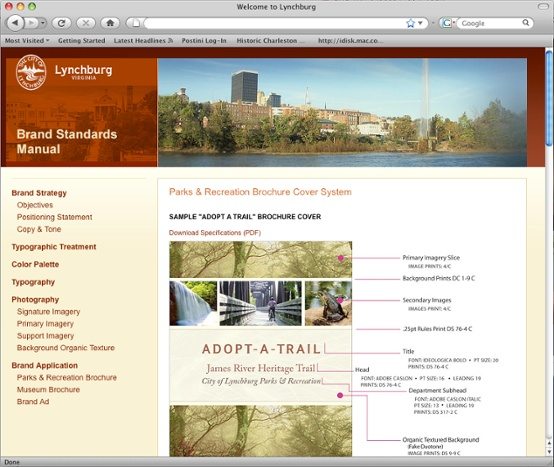
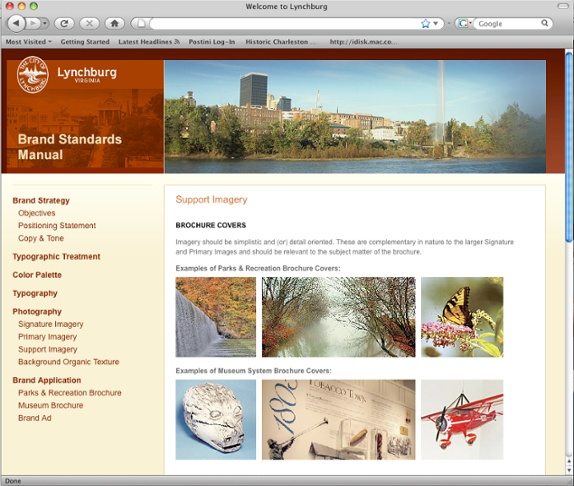
From our first kick-off with the city of Lynchburg, Virginia we knew it made more sense for Grafik to establish the brand sensibility from a high-level “look & feel” and then have our client’s various departmental teams develop materials specific to their needs. After creating a few key marketing pieces, including their new website and tagline, we set out to produce an online Brand Style Guide.

The guide is now available to the various departmental design teams who are putting it to good use. And  we’re no longer cringing.

Detailed description that deconstructs the Parks & Recreation Collateral Template, Brand Style Guide
Detailed description that deconstructs the Parks & Recreation Collateral Template

Lynchburg VA Website Brochures

But what are we going to call it?

Wuvie. That was just one of the names Gannett Digital had developed for its new social network for moms. And as you might well imagine, it failed to inspire a single positive response with focus group participants.

Of course, the other names they had generated faced some pretty harsh criticism as well. And through the ordeal, our friends at Gannett learned just how painful naming can be.

It’s the same for everyone. You start a naming project, and everyone has a clear idea of what the name should communicate. But after weeks of searching, someone invariably strays off into the land of nonsensical terms and portmanteau words. I don’t want to go there — but my clients sometimes do.

Anxious to be done with it, they make long lists of ridiculous, and completely unpronounceable names. They find the wikiHow page on how to create a make up a word, while away hours on naming sites, or (and you knew this was coming) download an app for that. Then, the next time we get together, they unveil a name that looks like an alphabet soup spill.

“You can call your company anything you like,” I tell them, “but you better have the time and budget to make a whacky name meaningful. (Quick: Any of you know what companies like Xoopit, Squidoo, and Ponoko do?)

Not long after the focus group testing, we persuaded Gannett to let us take a crack at the name. And I gave them the best advice I could: Be patient. In the end, they were. And that’s why their national social network isn’t called Wuvie. You can check it out for yourself at MomsLikeMe.com.

Meanwhile, if you’re in the process of naming a company, or a product, you might want to think twice about a name that means nothing to anyone. The last thing the world needs is another Eefoof.

Short term fix won’t solve long term goals

So today Etrade introduced a new online portfolio tool that will allow investors to cut out investment advisors. Supposedly it will give self-directed investors, after filling out a questionnaire, a recommended asset allocation model. According to an Etrade spokesperson this is geared towards the investor that is leaving a full service firm, still needs guidance but wants to control investing himself.

Etrade Online Advisor Platform

So here are my unvarnished thoughts. Oh- that will work really well as long as the markets start to recover and numbers go up. And it will work really poorly as individual investors start lining up on the ledge as markets start to tank. Perhaps one of the most valuable aspects of having a long term relationship, and I mean long term, with an RIA is the advice you get when markets start to tumble. The words “long term” have a different meaning, and it takes real discipline to keep and maintain a long term investment strategy. Yes, I suppose the last 2 quarters of 2008 have shown us that stuff happens- but keeping that long term prospective is where an outside counsel can really help.

Since when did financial advice only become about performance? Yes- some of it is about asset allocation, some of it is about risk ratios, but some of it is about listening, being sympathetic. But some of it is also about reminding investors what their long term goals are, reminding them of historical patterns, and pointing out where models continue to work, and where they don’t. Lots of it is about experience and expertise and research- commodities that the do-it-yourself-financial-advisor may not have.

And so, once again our online replacements for real advisors, will attract average investors that want to cut out any fees, and want to control all their assets themselves. But I bet that will only work in the short run. In the long run… do you really want to take your advice from a company that makes wonderful commercials but whose own stock is down a gazillion percent and who has flirted with bankruptcy? Not the kind of investment advisor that I want in my court for the long haul.

GM “re-invention” or more of the same?

I work in the advertising industry, but for the life of me I just don’t get the ad execs that recommended that GM, on the very day it files for bankruptcy, leaving thousands unemployed, creditors owed and the people of the US of A holding the bag—how on that very day can they recommend  launching a completely meaningless, self absorbed  TV campaign?!!

If you really want to reinvent yourself,question the wisdom of placing a video instead of plowing that money back where it belongs—getting this behemoth up and running again. All these “victory images”—hackneyed, and trite. Instead give us straight talk and action.

Now what I will give them credit for is putting up a pretty good “reinvention” web site that does answer lots of questions… of course some marketing hype. But at least on this microsite you get detailed information on concrete actions.

Time to play it unsafe

Funny how we call ourselves creative thinkers, but go about our work the same way day after day. We’ve developed our own tried and tested formulas for problem-solving. We’ve chosen the tools, the process and the atmosphere that makes us most comfortable. And in doing so we’ve created a safety zone.

Now don’t get me wrong, playing it safe in an awful economy is never a bad idea. It’s just not the way to get to the best solution. Breakthroughs only occur after you’ve hit the wall once or twice, and in truth, most of us aren’t willing to put up with that kind of pain. No, we prefer comfort.

In the most recent issue of CA, Milton Glaser says one of his greatest influences was Picasso. “His incredible willingness to abandon his own accomplishments … was the most important thing you could learn from Picasso; this incredible desire to give up what you know and always move toward uncharted waters. That ambition, is what I thought was extraordinary.”

We all know the uncharted waters Glaser’s referring to. When we first got into this business, that’s where we spent most of our time. And now that we’re a little older, (and hopefully a little wiser) it’s where we need to return.

So let’s go. There are no rewards for safety. So let’s go get uncomfortable.

Just launched!

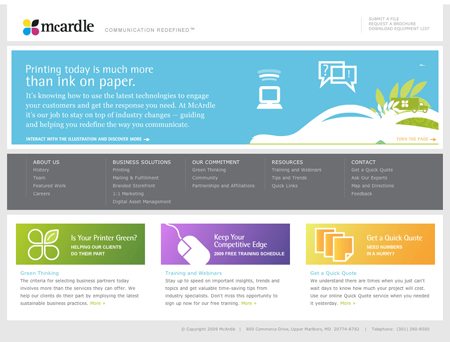
We’re pleased to announce the launch of McArdle’s new website (www.mcardlesolutions.com). Long known as one of the area’s top printing companies, McArdle has evolved their knowledge, service and offerings to stay one step ahead of the rapidly changing communications industry. They approached Grafik to help communicate their evolution from ink on paper to today’s full breadth of offerings which include customized training, digital asset management, 1:1 marketing and more. With over 10 years of experience working together, Grafik began a rebranding process from logo design, print collateral, display signage and now— a new website.

McArdle's new website

The new website navigation design allows users to easily find the service they need while surfacing other services that visitors may not be as familiar with. A series of “Did You Know?” facts throughout the website support the effort to communicate their depth and breadth of expertise and service.

The website also communicates a level of personality and service McArdle is known for by their long standing client relationships through the straightforward design, color choices, illustration style. Features such as “Ask Our Experts,” and “Get a Quick Quote,” allow McArdle to raise the bar on customer service and generate new ways to stay in touch with prospects and clients.

Social consistency

I love social media. I spend hours each day (maybe too many perhaps?) checking Facebook on my iPhone or Mac, tweeting (@psubuzz) and following the various “thought leaders” on Twitter, uploading pictures of my wife or puppy to Flickr and Facebook, streaming music from Last.fm, and reading the latest web news from Mashable or Techcrunch. So, it is not surprising that I am asked by my coworkers here (almost daily) why I haven’t blogged yet. And the answer to that question can be broken down into two simple points, the later being the most important:

  1. As much as I know about social media, there is so much more that I don’t know and have yet to learn.
  1. Social media requires consistency.

My officemate Tony (@tonyvia on Twitter) and I had this discussion last week as we kicked around the growing social media needs of our clients. Too often, social media is thrown about recklessly as a silver bullet, a means to generate big business, or a box that can be checked as companies develop their marketing plan. But as people have found out, social media is not a means to generate substantial revenue (yet), social media is not a quick and dirty way to market your company, and social media is certainly NOT a silver bullet. Social media is instead a way of thinking, a way of living, and a way of doing business. In 2009, social media can no longer be ignored when developing your business plan. Instead, social media should be a substantial component of your business strategy, one that requires an investment of time. It’s a way to get your message out, a means to connect with an audience, and largely, a way to talk with your peers, your customers, and sometimes, people that have never crossed your mind.

That said, let me return to why it’s taken me a few months to post… social media, like brand management requires consistency. And I have asked myself over and over, as any company should do before sticking their toe in the social media water, “can I provide enough consistent value to make the effort worthwhile?” This is my personal brand on the line, and to a certain degree, Grafik’s brand, as it is your brand when you participate with the social media community. It would be considered a failure in social media terms (and my own for that matter) if I were to make one post, and then never post again. Consequently, it would have a negative impact on my personal brand. The same thought process applies when setting up your company profile on social media platforms. Social media is not just setting up a MySpace profile or a Twitter account —The people you are connecting with need to perceive consistent value from what you are providing.

So, it is after some serious thought, that I say “yes.” I, as well as the rest of our interactive team, can indeed provide consistent value to our clients, our colleagues, and hopefully, value to the larger community. We live and breathe this, and I know we can successfully apply what we know to our clients. And we will do our best to share that on this blog. Heck, this is fun for us… and I look forward to the ensuing conversations that will take place with each other moving forward. Because again, social media is not a checkbox… it’s a way of connecting…

Join me in making 2009 a year to connect with our customers and with each other. Comments are welcome or email me (Brad at Grafik dot com).

Stationary

As we prepare to launch our new identity—yes, including a blog redesign and web redesign for the anonymous detractors out there…. I have been thinking if stationary is dead. I looked at a matrix of how much stationary we go through and it is surprisingly little. We communicate through emails, pdfs and occasionally fax. But with the exception of proposals and the occasional thank you note—we go through very little formal stationary. I looked at our backlog—at 2 boxes of stationary a month—we have a year’s backlog.

So then I started thinking—should we be thinking differently about stationary—about printing versus printing on demand, about looking at new ways to communicate—and by extension looking at new ways that our clients should be communicating? I would love your thoughts as I try to puzzle this through. Oh—and one more thought—how can we best repurpose our existing 22 boxes of stationary so we use the paper but do not have to put off our new id? Pads have already been suggested—so put on your thinking caps.

AMEX test-marketing

I am pissed. And here I thought that sexism in marketing was going the way of the water buffalo. But NOOOOOO.

On Saturday, my husband, David got a beautiful three dimensional piece in the mail. I could not wait to open it up—but since it was addressed to Dave, I did not open it. Instead I waited eagerly until he appeared, and watched as he opened a very beautiful invitation from American Express to become a platinum card member. The direct mail piece was a custom made box with a beautiful gross grain ribbon. And it kept unpeeling to reveal a beautiful vellum flysheet—and then the bummer—all that was in the box was a tiny 4″x4″ brochure exclaiming the virtues of being an AMEX platinum card member.

My husband’s reaction: wasteful, environmentally unsound, stupid, and why did I waste time opening a box that was essentially empty? But I can tell you that Amex dropped a chunk of change on the piece.

So then, after all that drama, I turned to open my mail, and to my surprise, there was my invitation to become a platinum member. But the difference—mine was in a plain No. 10 envelope. And the brochure was standard fare. And I thought—how totally stupid of American Express.

Why?

Well for one—we have a joint account. Did they not think I would see his elaborate invitation as compared to my run of the mill DM piece?

Two, did they make an assumption on who was the big breadwinner and big spender in our house—the male? Wrong wrong wrong.

Three—did they not understand that as a woman I would feel somewhat slighted that my male partner got the uppercrust invitation and that I got second class citizen treatment, again?

Oh I am sure that they have tested this package. But they got it all wrong… Neither of us think it is wise to pay an additional fee for the privilege of having a grey colored card. And, both invitations ended up in our recycling bag.

Screwing your head on straight

I was reading an article in the December issue of Investment Advisor that was addressing the dilemma that many advisors are feeling in today’s tough investment environment. Most are still counseling patience, but in the same breathe admitting that they have never really seem a historical precedent to what is occurring in the markets. The article contrasts the conflict between the head (rational judgement) and the heart (emotional reaction). What is interesting is the influence of the heart overriding the head- among the advisors. ” This is the ultimate stress test. The emotional quotient of what we are going through is arguably for most advisors at an all time high,” notes advisor P.J. DiNuzzo.

One reason for the increased anxiety, as if just watching the fortunes of your clients evaporate is not enough, is the entering  of uncharted waters. Advisors are in a situation without historical precedence. ” I don’t think there is panic among advisors, just uncertainty.” While the past performance is not guarantee of future results, they are hoping that history will repeat itself, and investments will return to an upward trend. But, as any good advisor will tell you, no one knows for sure.

This morning I got a phone call from my RIA. Now this guy is so cool and calm, that he wouldn’t sweat in the middle of a forest fire, let alone an economic melt down. He was responding to a call that I put in to him on the wisdom of harvesting tax losses—and yes there is wisdom there. What struck me, was his candor—his admission that he had not seen anything like this before, that his firm had never actually harvested tax losses before, and that he could not be certain as to the direction of the markets or my investments. I gulped.

But I also realise that the reason I stick with him is that he is completely without guile, and as honest as the day is long. One of the advisors in the article wrote,” One of the things we are doing with clients is to remind them what their goals are and to keep the focus there as opposed to the immediate situation”. Another noted, “I think that what differentiates my clients’ perspective from others is that they have a tremendous amount of trust in what we are doing.”

And when I think to my conversation this morning, isn’t that what made feel comfortable telling my advisor to let it rip? Trust and planning. And keeping your head screwed on straight.

Grafik
Privacy Overview

This website uses cookies so that we can provide you with the best user experience possible. Cookie information is stored in your browser and performs functions such as recognising you when you return to our website and helping our team to understand which sections of the website you find most interesting and useful.