Brand overhaul for JK Moving Services

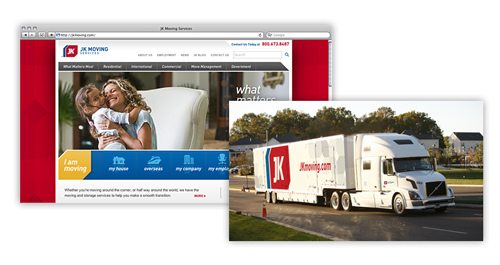
JK Moving Services is no longer the area’s best kept secret. Fresh from a brand overhaul, the nation’s third largest independent mover is quickly gaining ramping up marketing efforts, and attracting customers preparing to move their families, their offices, and their employees. Armed with solid research, Grafik helped JK identify a distinct competitive advantage, and leverage an astonishing string of ongoing testimonials. The newly revamped brand architecture includes smart new naming conventions that highlight the mix of services, as well as platforms that promote cross-selling.

JK Moving Services Logo

Grafik’s comprehensive program touched every aspect of the brand including a powerful brandline (What Matters Most), and a new corporate logo. We redesigned JK’s trucks and uniforms, developed a full suite of print and online sales materials, managed a significant website overhaul, and established  a robust social media presence with active Twitter and Facebook accounts, SEM, and a company blog.

With a mandate to convert prospects into clients, Grafik made a strong recommendation to transfer media dollars spent on conventional placements to online paid search and key words. We also simplified the call to action by removing the myriad phone numbers found on all their previous materials and replacing them with jkmoving.com — a change most notable on JK’s most prominent advertising presence, the moving trucks.

The company that appeared to be a local “mom and pop” moving company now feels like a national carrier of choice. Of course, the work is just beginning. Look for more great things to come from JK Moving Services.

The secret to happiness?

I am about to divulge the secret to complete and utter happiness in life. And you’ll be pleased to know it’s absolutely free. What’s more, anyone can be happy — you don’t have to be brilliant, highly creative, rich, or even beautiful. All you have to do is be good at one thing: managing expectations.

Sounds silly, but that’s it. That’s the secret. Managing expectations is everything. It’s the simple, bullet-proof solution for a happy personal life and a successful professional career. Here’s why: If you can set clear expectations and then deliver on them, you’ll be loved by all. Don’t believe me?

Think about your significant other. Do you know what your special someone expects of you? Have you ever asked? Chances are, no. And that’s why you run into to trouble from time to time. Take it from a guy who’s been married for 20 years, the moment you learn what your better half wants and needs from you is the magical moment you can start to manage expectations. She’s happy. You’re happy. Let’s move on to your job.

Managing expectations at work is often a little easier. Your wife probably won’t give you an annual performance review. Your boss, however, will. And if not, you should walk right in and talk about it. See what happens when you tell your boss you want to know what you can do to make him happy. Same goes for your co-workers. Find out what they expect of you. Or better yet, let them know what they should expect of you — and by the way, make sure you set expectations you can meet, and even exceed. Be honest about what you can do and how you can do it. If you over-promise, you’ll quickly disappoint. You may even lose some of the respect you’ve worked so hard to establish. In a nutshell, no one will be happy.

So now that you’re thinking through this whole business of managing expectations, let’s talk about your customers. They have considerable wants and needs. And it’s up to you, as an organization, to address them. So how do you do it? Well, you take everything you’ve just learned about your personal relationships, and apply it to the hundreds, thousands, or millions of people who will ever use your products or services. Only in this case, we’re not going to call it managing expectations. We’re going to call it managing your brand — because that’s exactly what it is.

Brand management is asking customers what’s important to them. It’s about starting conversations, listening closely, and then setting expectations, careful not to overpromise, or underwhelm.

The best brands don’t talk about themselves, they talk about their customers’ needs. They keep the conversation going, and develop new products and services accordingly. And all the while, they are simply managing expectations — and often exceeding them.

So there you have it. That’s the secret. And my hope for you is that you’ll get really good at this one thing — and in doing so, get really good at being happy.

Global Automakers: the strategy behind the name

Global Automakers Logo

I’ve a couple of friends who have changed their names as adults, but I must say I often find it difficult to embrace this without having some context around their reasoning. I often “forget,” or truthfully—even resist the change and call them by their former names until I know a bit more about why their old name wasn’t good enough. I find even if it’s none of my business, I still want some help adjusting.

Renaming an organization can often encounter similar challenges. Dedicated employees who have long worked for an organization in the midst of such a change, if not properly informed, might feel mislead. External audiences who have done business with a renamed organization might wonder what prompted the effort. And shareholders will, no doubt, wonder, ‘is it worth it?” But a change for the right reasons can often be a good business decision when an organization or its industry has evolved.

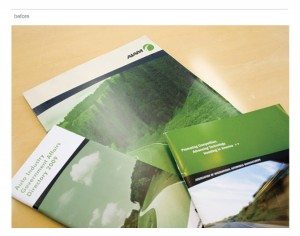
The Association of International Automobile Manufacturers, (AIAM) approached Grafik to rebrand their organization. Let’s start with some context. While the association members are some of the most respected and forward-thinking automobile manufacturers in the world, the association itself was often passed over by the media to weigh in on key issues that effect the industry including policies on free trade, government mandates and more. The organization also suffered from dated, but nagging perceptions that the association was comprised of “foreign” manufacturers—this, in a time when just about every manufacturer collaborates across borders. Rebranding offered the organization an opportunity to update its image and better define their voice. The new effort would also allow them to improve their communications tools to members and the public.

Another factor, the timing was right. AIAM was planning to move their headquarters from Virginia closer into DC for a stronger physical presence near Capitol Hill. This meant they would need to develop new signage and change their address on all past communications tools.

Grafik began with a series of interviews to get a pulse on the organization’s goals, communication efforts to date and marketing resources. We knew that naming might be something to consider, but needed a deeper dive to weigh the advantages and disadvantages of such an effort.

Just as important, we knew if we were going to suggest a new name it had to be memorable—something easy to say, after spending years getting lost in Washington DC’s association acronym soup. We learned that even answering the phone for the organization was at times, challenging. “Hello, this is A-I-A-M.” Or, “Hi this is Aim.” If the front desk wasn’t comfortable saying their name consistently, how could they expect others to?

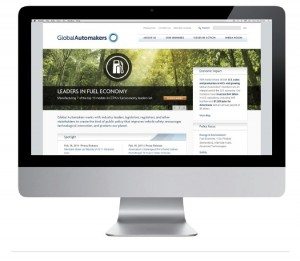
While considering the name, the show had to go on. Grafik reviewed their communications tools and competitive set to compare how like-minded organizations were communicating. The website, their primary marketing tool, was difficult to navigate and failed to surface the information that defines their industry leadership, innovations and investments in the U.S. market. In tandem with our rebranding strategy Grafik began an interactive discovery process to create the next generation website with new tools to publish content and get their message out as needed.

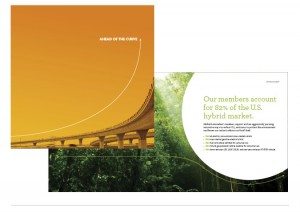
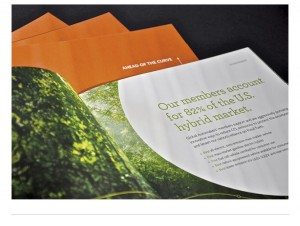
Still considering a name change we began exploring creative execution including the logo, brand thematic and voice of the organization. We developed “Ahead of the Curve” which captured the history of leadership and innovation that the association’s members have aspired to. Then, after brewing a witches’ potion and sacrificing a designer who unwittingly stayed late at Grafik, we proposed “Global Automakers” as the new name to move forward with.

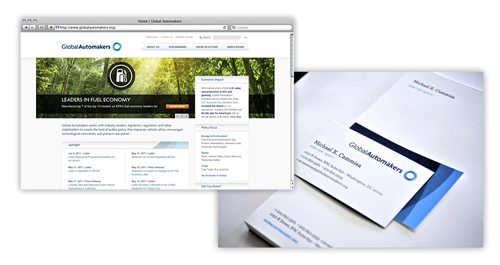
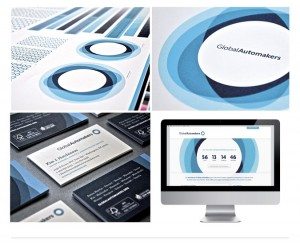
Grafik developed the new integrated identity including the redesign of the recently launched website, and we continue to consult with Global Automakers regarding future needs.

Global Automakers Brochures

Global Automakers Logo 2

Global Automakers Quad Compilation

Global Automakers Members Accounts

Global Automakers Members Accounts 2

Global Automakers Fuel Economy

Global Automakers Energy and Environment

Grafik goes Miami.

Grafik is starting off the new year with a new client in the education sector—Gulliver Schools. Gulliver is renowned for its International Baccalaureate (IB) World School Programme, Signature Academic Program offerings, and Blue Ribbon School designation. The prominent school has been providing the finest in academics, visual art and performing arts, and athletics to its student body since 1926 from its Miami campuses.

“Grafik has a strong core competency within the education sector working over the years with such notable institutions as Johns Hopkins University, George Mason University, and Strayer University,” said Chief Creative Officer, Hal Swetnam. “Engaging with Gulliver Schools to enhance its already reputable brand is a complement to our roster of current engagements with Georgetown University and DC Prep.”

According to Gulliver’s Head of School John Krutulis, Grafik was selected “for its strategic approach to Gulliver’s branding needs and strong reputation for delivering bottom line-oriented results in the education industry.” Grafik will focus its efforts in the development of cohesive messaging, as well as look and feel for the larger Gulliver brand.

Gulliver Schools is a 501 (c) (3) private, not-for-profit, independent, coeducational, nonsectarian day school with the mission of providing a superior college-preparatory education and ensuring an outstanding dynamic learning environment which recognizes and nurtures the unique talents and gifts of each student. For more information about Gulliver Schools, please visit www.gulliverschools.org.

DC water

DC Water Is Life

I was sitting in the office today bitching about the fact that we were not called in on the RFP for the DC Water renaming and logo project. I have seen the new mark around town and I like it. It has presence and a strong brandline, “Water is Life.” I asked Teddi our VP of Business Development to find out which agency produced the campaign only to find out that the District of Columbia Water and Sewer Authority held a national competition in 2010. The Authority invited anyone in the 50 states to take part in a speculative competition for $2,000. Presumably, since the Authority had been under fire for contaminated water and asbestos, they figured this was in part a band-aid to a poor image. And, in order to save money, they started the process by opening up a public competition.

From the press releases, I have been able to figure out that there were three winners—who each were paid a princely sum of $667. And you have to look really hard to even find the designers’ names. The Water Authority drew 177 entries from all over the country! Feast your eyes!

Water Authority Entries

The Authority press release is actually pretty crafty as it does not actually say that the logo was chosen from the competition—the logo was a result of “pulling together the considerable public input from our competition.” This reads to me that the Authority  had to eventually go to a professional source to get their branding done. They do not mention the name of the firm—and it is quite possible that I could be mistaken—but somehow I do not think so.

So what has happened with this rather inconsequential speculative competition? Well, 174 people who volunteered their time for the competition got nothing. Three “winners” got $667 and their names are almost hidden from view—so no publicity at all. The Authority got to pay $2000 PLUS all of the time it took to hold and publicize a competition, sort through all of the entries, scan all of the entries, hold a judging, make a poster…. etc. And, since a Washington Post report notes that they are expecting the cost of the rebranding to be over $160,000, I would bet my eye-teeth that a professional firm actually implemented the overall identity since it is done quite well. And, while I expect that it will be hard for DC Water to own their trademark since the phrase is already trademarked, (and they would have found that out that if they went with pros) the tagline and execution is done very well.

Is there a lesson in all this? Frustratingly yes. Contests for brand expressions are rarely successful since there is no backbone to a mark or logo if there is no understanding of the brand. Holding a logo contest invites pretty symbols that are rarely on point or on brand. A brand exercise for a beleaguered organization like DC Water  should have dealt with a whole host of issues besides the mark. And perhaps when they started working with a professional firm, they were asked the right questions. We’ll never know.

These contests are rarely successful for the public as the agency they entrust with spending time and money wisely often forgets to factor in the amount of time and coordination it takes to run a contest, and rarely considers what happens if the contest nets zero appropriate marks.

Speculative contests are rarely successful for the entrants—who hope that winning may be their launching pad to success. Witness how much publicity the designers actually got—both the contest winners and the firm chosen to execute—and you can see that dreams of fame are misguided.

In the end, DC Water is lucky. They evidently ended up working with a strong designer or firm that understands logo systems and they got a fresh clean look. But they could have been equally unlucky had their contest mandated that one of the entries be chosen. In that case the DC public would have had to endure another 14 years of a poorly concepted, poorly crafted mark.

More than “thanks”

“When you are born with ginger hair, and grow up as the son of a military man — praise is a strictly rationed commodity. So it meant a huge amount to me when you embraced Boden and ordered lots of colourful clothes.”

That’s the opening line on one of the best letters I’ve ever seen from a retailer. Most of the time, these kinds of notes are crafted with all the passion and thoughtfulness of a takeaway menu. Companies regularly miss the opportunity to enrich their story and elevate the brand.

Truthfully, my wife would continue to order from Boden even if she hadn’t gotten this letter. But in the past few weeks, I’ve heard her tell several friends about the note — friends who might never have considered Boden. With one brilliantly written letter, Johnnie Boden has cemented a customer relationship and sparked interest in potential shoppers. One refreshingly genuine bit of copy is enhancing the entire Boden brand experience.

The letter ends just as wonderfully as it begins: “Being a British male, I’m obviously not terribly good at expressing my feelings. But with a slightly quivering upper lip, I’d like to say how grateful I am for your unwavering support.” How’s that for a window into the soul of the company?

Michael Eisner once said that a brand is a living entity, enriched or undermined cumulatively over time, the product of a thousand small gestures. This letter was one of those small gestures — small but highly impactful.

Boden Logo

The LeBron brand — just freakin’ do it!

Sports and branding: I am passionate about the former and I love to consult with my clients on the latter. So I can’t help but be fixated on the recent buzz pertaining to LeBron James and the so-called “hit” on his brand equity ever since he made, in my opinion, the ill-advised television special to announce he was switching from his hometown team to the Miami Heat.

To set some context for those of you who have no idea what I am talking about—LeBron James, the all star player formerly of the Cleveland Cavaliers, and probably the most celebrated basketball star since Michael Jordan, went on national television in July and announced that, as a free agent, he was leaving the team that drafted him seven years ago. In his mind, joining the Miami franchise with a few other all stars already in place, would give him the best chance to win an NBA championship.

Now I’m cool with athletes switching teams when they are free agents. Happens all the time and it is the prerogative of any free agent to go where they feel most comfortable. But the manner in which he made the announcement made headlines all over the sports world­, and it was seen by many as a selfish and backstabbing move against his home state (he grew up and attended school in nearby Akron, Ohio). Here is a brief clip of the announcement:

Shortly thereafter, the backlash started. According to Mark Cuban, the outspoken owner of the Dallas Mavericks, “LeBron’s brand will take a $1 billion hit, give or take a few bucks.” While that statement may be a slight exaggeration, a recent poll about LeBron by the Q Score company—the Q Score is a measurement of the familiarity and appeal of a brand, company, celebrity, or television show used in the United States­—shows LeBron’s popularity rating has plummeted since his announcement and is currently below the average sports celebrity.

But I found it really interesting to see how Nike, a key LeBron sponsor, took the opportunity to not only come to his aid in what appears to be an attempt to help him repair some of his brand image, but also make sure they are protecting one of their biggest assets. Weiden & Kennedy did the spot and I personally love it. It is somewhat bold, in your face, and guaranteed to grab attention—just like Nike always does.

Now I can’t say that this ad will start the path to brand rating recovery (although I think it is great for Nike), but considering what other elite athletes have done over the years­—adultery, domestic violence, using banned and illicit substances—this sports fan gives LeBron credit for staying clean and living by his sponsor’s famous tag “just do it.” Yeah, he made a mistake in how he delivered his decision to move on. But I believe his success on the court will ultimately define his brand which I am sure will be memorable and plenty lucrative, to say the least.

A gap in judgement

Gap Logos

I think most people would agree that a brand is someone’s gut feeling about an organization, or company. In other words, it’s intangible, individual, and very personal. That’s why managing a brand is so tricky: it’s really managing expectations. So it shouldn’t surprise anyone that the reaction to Gap’s new logo was so overwhelmingly negative.

Millions of consumers have adopted Gap as an essential facet of their own personal brands. And it reflects more on them than it does the company. It’s like the old maxim, “Your brand doesn’t belong to you, it belongs to your customers.” That’s not to say that the company doesn’t have the right to change, or evolve the logo, but there has to be a really good reason.

Over the past week or so, as the company was responding to the overwhelming criticism, one Gap executive noted that the company is changing, and management was hoping the new logo would represent that change. But what is that change? And shouldn’t that change have been perceptible to consumers before Gap made any effort to reflect it?

Gap’s new logo failed because there appears to have been no real rationale for it. I imagine the lousy economy and decreased sales might have been the catalysts, but even these don’t support sweeping changes to the most significant visual expression of a major consumer brand.

In the end, this entire ordeal will serve as a cautionary tale for other brands, and a proof point for anyone seeking to illustrate the power of social media. But for now, we can only scratch our heads and wonder what Gap was thinking. If the short-lived logo represented anything, it conveyed a sense of uncertainty, carelessness and frustration — all of which is painfully revealing for a retail company that has seen better days.

Does a logo have to change? A look at the Grafik logo.

We have been working with a very successful business that has been around for about 30 years. As part of a strategic plan we recommended that the company revisit their logo. And some very interesting questions were raised. How critical is a logo as part of a brand? The company has been successful as a mom and pop organization, has never done marketing, and wants to increased visibility.  Will upgrading their logo add revenue or effect their bottom  line positively?  In this case, the company has a huge public facing infrastructure that would have to be changed; unlike some companies that would only have to revisit marketing materials and corporate stationary if its logo changed, this company could have as much as a $3-5  million price tag linked to changing a mark. Any logo change results in retooling a fleet of trucks, issuing new uniforms, new crates and new boxes in addition to building signage, business papers and marketing materials. Not an insignificant change.

Grafik Logo 1

It got me to thinking- how much can a logo really change things? My overall philosophy has been and continues to be that a logo is only a small part of a brand’s identity. It is  signature or a punctuation mark- it is never the whole story. I often counsel clients- especially new start ups- not to spend too much time and money on logos unless there is a budget to fully support the mark. By that I mean a sum of money that is large enough to imprint a new logo on the viewers’ minds. Normally  a logo becomes a strong foundation to a much larger brand exercise. And as many times as not we may only update a mark rather than create a new one if we feel that its contribution is not significant. In this case, the mark is seminal to the brand and very visible, and the current mark is somewhat problematic.

I started to look inward at our own mark to see if Grafik’s logo, untouched, could have carried us to where we are today. The flat out answer is “No”- but then again- we are playing in a visual space, so the way we portray our organization has ramifications.

Our first logo- created in the mid-seventies was created by a former partner, Alex Berry. The seventies were characterized by an abundance of warm colors and a love affair with san serif type faces- both apparent in this early version of the Grafik stationary. Sidenote- we thought we were being very hip by always using the logo rather large ( horsey now that I look at it) and always vertically. Our presentation materials were non-existent, and as a start up we created our identity on the fly.

Grafik Logo 2

After about 6 years we knew we needed a refresh. The company was migrating from a small boutique design firm of three or four people to a group of about 8-10 designers. We felt compelled to redesign the mark to look more “professional”. While this is a bad scan from a really old piece of stationary- this was before computers- we went for a much more conservative look.Typical of the time- the mid seventies- we opted for a soft moss green and a warm brown- subdued and subtle. Everything about the new look was restrained. We still really only viewed our brand as a logo and the way it was applied to stationary and business cards and did not really understand that it had to be used consistently. Along the way, the foundations of our brand, strong thinking, creative excellence and great client service were starting to be formed. I’m not sure that at that point we even understood who we really were- but we started to understand who we wanted to be.

Grafik Logo 3

By the 80’s I knew I needed to make a bold move. Our company was growing, our reputation was spreading and with the advent of the computer, our business model was evolving. I threw out a number of ideas to some of my creative staff- and decided we would have an internal competition to redesign the new look. I fully expected that one of the art directors would clinch a new look and feel. Low and behold, Dave Collins- at the time one of our youngest designers and now one of our partners, came in with the winning logo- a complete departure from where we had been.  It had the swagger that our studio needed- a fresh new look and feel that symbolized  a company on the move. Bold, yet restrained, we moved all of our materials to red and black- from our proposals, our pitch books to our stationary. For the first time we were getting compliments on the packaging of our proposals and on the quality of our communications. And for the first time we were starting to understand how a brand can really extend its reach.

But nothing ever stays the same. Dave’s logo carried us for about 5-6  years and in that time Grafik was growing from a design firm that had a good local reputation to a firm that had a solid reputation for branding intitiatives regionally and to some extent nationally. In the mid 90’s we realized that our good old red and black logo was dated and we went for a more refined elegant look. We were working with a lot of fashion and luxury clients and it was important to have a contemporary identity. Again we looked to one of our younger designers, Jonathan Amen, to give us a mark that had a relationship to our existing logo.

Jonathan not only revisited our mark, but he pushed us to look at an entirely new color palette and a new family of fonts. Gone was red and black as the dominant color palette. In- a soft green, an orange, a light blue and a switch from coated papers to uncoated papers. The new logo was reinforced with a series of ultra light circles that was a more sophisticated treatment than the heavier logo from the 80s. Our presentations became increasingly sophisticated but one thing was lacking. While the mark produced beautifully on paper, embossed or stamped, it was not as successful on the web. As more and more of our work became interactive we realized that we needed to capitalize on our web presence and that our current logo had limitations.

A combination of designers including Mike Mateos, Ivan Hooker and Gregg Glaviano  joined to create a new mark.They kept aspects of the original “G” created by Dave Collins, and transitioned the color of the mark to a more orange-red. The new “G”, while evocative of its predecessors, stands on its own and marks the transition of Grafik from design firm to branding agency. Our logo is an accurate depiction of the Grafik brand that still values intelligence, creative and service excellence. This time, with 20 years of branding under our belt we understood the importance of brand consistency and so we changed everything from the website, to email signatures and business templates to the interior of our offices. We launched the new logo with an online video and built internal consensus by making the logo change the focus of our annual company t-shirt.

Grafik Logo 5

Back to the original question. Could Grafik have grown as much if we had kept the original logo? In a profession that is judged in part by style and execution, it would have been hard to use a mark created in the late 70s to symbolize the organization we have become today. Looking at successful brands there are very few that have not had to adapt to new trends, new technologies, new ways of presenting themselves. A mark that might have worked a dozen of years ago may lack the energy, sophistication or professionalism to carry the company forward. Now we even have to consider the mark’s proportions to be successful on a mobile device.

So back to the dilemma faced by my current client. The question that I posed to him was not if the old logo matched to goals and positioning that we set forth for his company today. The question posed was would the logo take the company where it wanted to be 5, 10, 20 years from now. The answer was no. It was a hard answer given the costs associated with a change. Nevertheless, it was the right answer.

Why the term “green homes” is all fuzzy and “LEED for homes” is all Greek

Thanks to an army of late-comer home builders, all vying to jump on the latest trend bandwagon, the term “Green Home” has been so overused and ill, defined thereby rendering it confusing and ultimately meaningless to new home shoppers. Let’s face it, to really live in a “Green Home” today you’d have to harvest your own rainwater and store it in a cistern on the roof of your bamboo hut.

LEED for Homes on the other hand, has been virtually invisible to the average consumer. Although the term does have equity with some savvy home buyers, the same ones who are down with all the latest trends in New Urbanism and Sustainable Developments. But, by and large, it’s likely the average new home buyer still doesn’t have a clue as to what it really means. Yet some new home builders continue to tout the fact that their neighborhoods are LEED for Homes certified. That would be fine if the USGBC (US Green Building Council) promoted their LEED for Homes program to the public in a major way. But they don’t right now and it’s still not common knowledge.

Welcome to Old Town Commons, located in Old Town Alexandria, this is EYA’s newest residential neighborhood. And it’s one of the largest LEED for Homes certified neighborhoods in the entire country. So, since we’re a big believer in speaking plain English, we proposed a new way for EYA to talk about the features of current construction best-practices and energy efficiency design to prospective home buyers. “Smart City Living,” is the term we’ve coined to highlight the advantages of buying a new EYA home; and it’s prominently displayed in the sales office as well as a soon-to-launch interactive counterpart for EYA.com. The objective is to translate technical features into tangible homeowner benefits so prospective buyers get a clearer picture of EYA’s holistic approach to “green” building, as well as a better understanding of the advantages that a new EYA home offers.

EYA Smart City Living

2009 online annual report for Volunteers of America breaks new ground

Longstanding client Volunteers of America (VOA), has been working with Grafik for over five years. Together with the VOA creative team, there was an initiative to keep the organization on the cutting edge to maximize budget and reach for their 2009 Annual Report. The collaboration yielded the amazing work that can be found at http://annualreport.voa.org/.

The Annual Report is groundbreaking for the organization for many reasons. It takes what was formerly a one-dimensional product with limited reach to a limited audience and turns it into a multi-purpose tool, with unlimited reach and potential. Eco-friendly, using no paper product at all, the interactive website is not only a tool that informs stakeholders and interested parties in VOA’s 2009 activities, but can be used by VOA in future presentations and meetings throughout the year.

Gregg Glaviano, Creative Director and Partner at Grafik says, “Having worked with VOA for over five years designing their printed annual reports, the online delivery allows us a richer more versatile experience that can reach a broader audience than before and with less waste. I believe Grafik’s advantage is understanding both mediums and working with our clients to recommend the tactics that will deliver the greatest results for their investment. ”

This is a wonderful example of Grafik’s history of creating partnerships that forge new paths of excellence that serve not only our clients, but the greater good of us all.

Cadbury

Cadbury logo

If there was a list of great examples of brand, Cadbury would have to top the list. As the Kraft/Cadbury deal (takeover) becomes finalized, it is not the chocolate bars or creme filled eggs that Britons are fearing they will lose, it is what Cadbury stands for. Britons, yesterday, were so angry at the takeover that the former trade minister, Lord Digby Jones, was quoted as saying, ” My big wish is that Kraft get it when they see what made Cadbury the iconic brand they wanted to buy, and that’s its people, its reputation. That’s what Cadbury’s is, and they’re buying something that’s more than just a chocolate company.”

Hard at work

“…more than just a chocolate company.” That is the epitome of a successful brand; more than the sum of its products. The Cadbury brand is successful due to its people, its values, its history, its relationship with its employees, and of course the chocolate candy that the English have grown up with. Cadbury is seen as a force for good, constructing a model village in 1879 for workers to live in away from the industrial wastes; pioneering worker involvement in labor negotiations; and treating its workers fairly providing an excellent pension and medical benefits before they were mandated. Even the founding of the company was based off of a social benefit: the founder, a Quaker, developed chocolate drinks as a way to wean people off of alcohol.

The Cadbury brand has come to be synonymous with fairness, warmth, decency, compassion. And the Kraft brand? Cold, huge, uncaring, impersonal. And ironically, Kraft was rated highest in a yearly survey analyzing brand sincerity. The Reputation Institute analyzed the data of their annual Global Pulse survey and figured out that U.S. corporations perceived to be communicating with the most sincerity had the best reputations. Kraft was the top of the list.

Krap

And so, while the ingredients for the chocolate bars may not change, and the taste may remain the same, the brand will not. And if Kraft is smart, they will look beyond the total number of units sold, and they will do everything in their power to preserve the Cadbury brand, because the brand loyalty they have is hard to replace.

Grafik
Privacy Overview

This website uses cookies so that we can provide you with the best user experience possible. Cookie information is stored in your browser and performs functions such as recognising you when you return to our website and helping our team to understand which sections of the website you find most interesting and useful.