House of brands

One of the questions that we often have to address with new clients is how they are organized…brand architecture is the fancy word. Some clients are comfortable spinning off new companies when they develop a new product or look to expand horizontally to a new business sector—a House of Brands. Others create business units that operate independently but must conform to a corporate set of brand guidelines—a Master Brand. Understanding which branding model a company  should choose is based on many factors. There may be good reasons to launch different companies if they are making competing products. A House of Brands is an expensive proposition since each new company has to be marketed independently. With a House of Brands if one company fails, or has a bad reputation, it only takes down that entity and does not tarnish the parent company. With a House of Brands, if something untoward happens to one business sector, it may have an adverse effect on the whole company.

Pepsico Brands
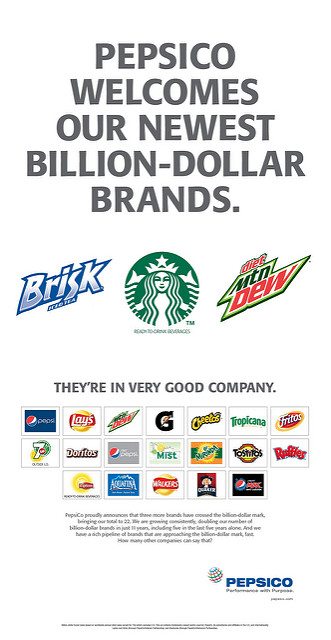
Pepsico’s House of Brands

Glancing at the New York Times last week I saw a wonderful example illustrating Pepsico‘s House of Brands. I, for one, had no idea that Pepsico owned Gatorade or Starbucks—two signature brands that have very different brand personalities. And certainly the wholesomeness that is part of Quaker’s brand might conflict with the junk food identity that is Cheetos. There are many good reasons to keep them separate.

A different perspective is told in an article that ran in the New York Times on January 6 on the new BMW slogan. BMW is the classic example used to illustrate a Master Brand. Rather than promote many different car models, BMW promotes one. Recently they launched new brand advertising. The article notes, “The new advertising depicts the BMW as the ultimate driving machine,” whatever the model. The tagline has been used continuously by BMW since it was created in 1975. This of course is significantly cheaper than having to support all of the different brands that Pepsico supports. But Master Brands do have challenges. As Renée Richardson Gosline, an assistant professor of marketing at MIT Sloan School of Management, notes, “a campaign that emphasizes a consistent brand essence is powerful, but BMW has to keep in mind that luxury consumers seek distinction, even within the brand. So, along with the egalitarian message that all BMWs are ‘ultimate driving machines,’ BMW has to make owners of different models each feel special as well, by building relationships with the owners of each model.

Choosing whether to adopt a House of Brands versus a Master Brand should not be made by default. While brand architecture is not always looked at, it is critical and will effect everything a corporation decides from mergers and acquisitions to naming conventions. At the very least, determining a company’s organizational structure should be a mandatory part of any brand exercise.

Great new site for Mohr Retail @ MohrRetail.com

Mohr Retail

We are very proud of our new work for retail training giant, MOHR Retail, the company that has trained the staff of household brands including T.J. Maxx, New Balance, and Verizon Wireless, in its 30 years in business. Through a discovery process that included a brand audit, interviews, and a competitive review, we were able to define four brand pillars that helped  establish a clear strategy for the web redesign. The site focuses on the importance of MOHR Retail’s trainings by using the main messaging area to promote the core attributes that set them apart from other training programs. Our brand study also made it evident that a name change would reinforce their expertise in the retail space and MOHR Access—became MOHR Retail.  Brand strategy always guides design at Grafik—and that is why clients like Michael Patrick of MOHR Retail have this to say about working with Grafik.

“We are all so proud of what you have created. Thank you for listening, bringing your expertise, and translating our vision into reality. The site shows us in the best possible light. It communicates that we are a leader in retail training, offer fresh and important insights, and are a substantial organization that is ready to handle the full range of needs retailers may have. If this doesn’t grow our brand and drive business, I’m not sure what would. We made the right decision when we chose Grafik!” —Michael Patrick, Founder & President, MOHR Retail.

“Seriously Amazing”: Smithsonian launches a new brand line

Smithsonian Stamp

The Smithsonian announced this weekend that they are launching a new brand line, “Seriously Amazing.” Before you read any further, in the interest of complete disclosure, you should know that Grafik has worked with the Smithsonian on many of their initiatives including the branding of the National Museum of the American Indian, and a brand exercise for the Smithsonian Institution’s Latino Center. And we have had a beef over the years, on behalf of all of the excellent branding firms in Washington, D.C., that we are never invited to the dance. So in the context of having a large chip on my shoulder, I have to say that the new tagline for the Smithsonian is really pretty good—excellent in fact. The firm called in for the assignment is a well-known branding agency in NYC, London, and Dubai Wolff Olins and branding museums and international institutions is their specialty.

A news item in the Washington Post on Sunday shows that Wolff Olins spent the time to research, and get input from many of the museum directors and board members. As a pre-eminently political beast it must have been a huge endeavor to interview all of the people necessary to build consensus for the new line—one that costs $1 million dollars. It seems they hit the nail right on the head, getting a huge round of applause when they launched the brand last week.

I personally like “Seriously Amazing” as it taps into the research as well as the vast store of treasures that are held by all of the museums making up the Institution. Known for years as the “Nation’s Attic,” the new tagline has a more forward direction. It remains to be seen how the mark will play out in future fundraising and the awareness building campaign.

Job well done, Wolff Olins! Oh, and a note to self: Every time the Smithsonian cries poor to our local D.C. agencies, we should think of the tagline’s million dollar price tag and refuse to do their work on a pro bono basis.

Can a brand own words?

Eat More Kale Campaign

Driving home from work the other day I was listening to NPR and heard a story about a battle between Chick-fil-A and a small Vermont T-shirt manufacturer who is producing T-shirts saying “Eat More Kale.” Chick-fil-A owns the tagline “Eat Mor Chikin” and, indeed, the corporation has done a splendid job advertising their fast food chicken restaurants through the Eat Mor Chikin campaign. It seems that the T-shirt manufacturer, Bo Muller-Moore, has been doing a booming business producing “Eat More Kale” shirts out of a studio above his garage and has enough orders to support himself. He decided it would be wise to apply for a trademark for “Eat More Kale” and was confronted by a cease and desist letter from the chicken guys. In a statement, Chick-fil-A  said, “We must legally protect and defend our “Eat mor chikin” trademark in order to maintain rights to the slogan.”

Eat Mor Chikin Campaign

Laws regarding trademark and patent infringement are complex, which is why we always tell our clients to consult with their own trademark lawyers or use one of ours. But one test of trademark infringement is whether there would be confusion in the marketplace or whether the existing brand equity would be diluted. Muller-Moore’s lawyer commented in a New York Times article, “There’s no one out there that’s going to come forward and say, ‘I thought I was buying a Chick-fil-A product but I got this T-shirt.” Add to that the fact that the food chain does not have a franchise operating in Vermont so there is even less chance for confusion.

Can a company or brand own words exclusively? Clearly many wonderful campaigns have been copied such as the Got Milk? campaign that I wrote about several weeks ago. Harley Davidson has copyrighted the sound of their motorcycle—and no other motorcycle or bike can use the same sound. But can you hold a copyright to the words “Eat More? I did a quick search on Google to see how many “Eat More campaigns and ads there have been. Witness just a few.

A wide variety of "Eat More..." initiatives

Clearly there have been many campaigns that have used the the words Eat More.” And it is equally clear that Chick-fil-A has done a superb job of imprinting their brand through their deft ad campaign. So what has been accomplished and what are the effects of this lawsuit? Well, Eat More Kale has gotten way more publicity than they ever thought possible, getting national coverage in the NY Times and an NPR spot. Muller-Moore has tapped social media and drew incredible support from Facebook followers, both a former and the present governors of Vermont, and a groundswell of kale lovers nationally.

At a recent press conference, Governor Peter Shulmin of Vermont noted, “If you think that Vermonters don’t understand the difference between kale and a chicken sandwich, we invite you to Vermont, and we’ll give you a lesson about the difference between a kale and a chicken,” Shumlin said. “There are some very distinct features that should be noticed in that difference. Kale is a vegetable; chickens are birds. Birds create manure; kale eats manure.”

Eat More Cake Campaign

What has the Chick-Fil-A brand gained—a tarnished reputation as a corporate bully that flies in the face of its humorous campaigns. How many people will look at the cows and think of the “Eat More Kale” controversy and leave with a bad taste in their mouths? With little possibility of confusion and not even one Chick-fil-A restaurant in Vermont, one has to wonder if this was a giant mistake by the Chick legal department with little thought how it might effect their brand. In this case their cease and desist order may have a real correlation to less counter orders. Governor Shumlin sent this message to Chick-fil-A, “Don’t mess with Vermont. Don’t mess with kale. And, Chick-fil-A, get out of the way because we are going to win this one.” (Source: NPR.org—Chicken Vs. Kale, Kirk Carapezza)

Eat More Kale t-shirt

Ivory Soap Dope: a brand evolution

Ivory Soap Vintage
Vintage Ivory soap

Okay. I freely admit that I love old packaging. My house is filled with thousands of antique tins, old boxes, and discarded packaging from days gone by. I notice packaging, so when Procter & Gamble decided to pump up the packaging and advertising for one of its oldest brands, Ivory soap, I was eager to see what change was in store.

The new campaign devised by Wieden+Kennedy is nothing short of brilliant. But the new packaging by Sterling Brands is uninspired. One has to wonder why their advertising agency did not show the new look on any of their ads, TV spots, or online placements. If you want to look at 125 years of Ivory soap packaging, Procter & Gamble has set up a Facebook page that shows all the different ways they have wrapped their pure white soap.

The most controversial aspect to their simple blue and white packaging was the Procter & Gamble logo which was thought to have ties to Satan.

Old Ivory soap packaging the showcased an P&G logo that was thought to have Satanic themes
Old Ivory soap packaging the showcased a P&G logo that was thought to have Satanic themes

For years urban legend maintained that the man in the logo was proof of the company’s ties to Satan. Supposedly the curlicues of the moon man’s beard was an array of 6’s and if you connect the dots with the 13 stars, three 6’s appear. The curlicues at the top of his head resembled the horns of a ram representing the false prophet. Eventually in 1985 the Procter and Gamble logo was taken off of Ivory soap. Over the years the Ivory logo has been modified and most recently Wieden+Kennedy modernized the wordmark. Tag lines have also changed and those in use over the years have included:

  • Pure Clean. Pure Ivory.
  • 99.44% Pure.
  • So Pure it floats.
  • Keep it pure, clean and simple

“Ivory is P&G’s oldest and most beloved brand, and while consumers relish in the nostalgia and heritage of the product, it’s time for a holistic reinvention of the brand as we work to touch and improve more consumers’ lives in more parts of the world more completely,” says Jay Sethi, Ivory brand manager. “We’ve answered the call for consumers wanting a ‘simple and clean’ solution and the most powerful aspect of Ivory still remains the simplicity of the product.” Lisa McTigue Pierce—Packaging Digest Oct. 4, 2011.

Karl Lieberman, creative director, Wieden+Kennedy, spoke about the new advertising. “Unlike a lot of other brands, Ivory has stayed true to its equity. It has remained the antithesis of the overly complicated—from its ingredients, packaging and advertising—it’s a throwback to an era where there wasn’t time for such things. And that’s what makes its new voice so refreshing.”

Ivory Soap "99 44/100% Pure It Floats" packaging
Ivory has changed its look over the years, but has always kept it simple.

But while Ivory has remained a strong brand since 1879, competition in the soap category has changed. The Ivory brand has been running third to Dove and Dial. (Source: NY Times, Nov. 7, 2011). Product managers felt that with the increased consumer focus on cost savings during the recession years, it was a good time to promote the Ivory brand promise of “value and simplicity.” “Renée Richardson Gosline, an assistant professor of marketing at the MIT Sloan School of Management, also predicted the simplicity of Ivory and its campaign could appeal to consumers. However, she also questioned the absence of the new Ivory packaging in advertising. ‘If you’re proud of the packaging, show it off,’ she said.”

Ivory Soap Current Packaging
Display of Ivory soap products

A method to method

Method's Pink Grapefruit Dish Soap

I am a sucker for beautiful packaging. So it is no surprise that while drifting through the aisles at my local Safeway three years ago, I spied some hand soap and moisturizer that was absolutely beautiful and also at closeout prices. Needless to say, as the bargain shopper that I am, I scarfed up 10 bars of soap and several bottles of body wash. And that is how I was introduced to the Method brand, one of the most progressive brands in the market today.

When customers expressed their thoughts on the blog to changes to the packaging, a Method employee gave an informed and thoughtful response

I recommend spending some time on their website and to pay close attention to their social media (Twitter and Facebook) since they seem to be doing everything right. They use their site and their blog to tap into the desires of their loyal fan base—and most importantly they actually listen and act on what users say. Take the pink grapefruit dish soap. Now this is a dish soap that I can really get behind—it has a lovely smell, has great packaging and is priced right. About a year ago they decided to change not only the packaging, but to rotate in a new fragrance. BTW—they are unique in that they are constantly changing fragrances and producing limited editions. If a limited edition proves to be very popular, it is elevated to permanent status. Well, pink grapefruit was rotated out. Pink grapefruit lovers were irked, voiced their complaints, and the company has brought back the fragrance and will most likely give it permanent status.

Diagramming green

Not only is Method customer friendly, but environmentally friendly as well. Method uses the minimum amount of materials when creating their package design, and the few materials that are used, are  biodegradable. Even the product (inside their package) has been designed to be eco friendly as well. Their site has a section devoted to the environment, their products and many of the their mantras have to do with being more eco-friendly.

Perhaps what I like most about this brand is that they are aggressive about engaging their audience. Their blog is up-to-date and interesting. They listen to and respond to comments in a thoughtful way, and their web presence fosters a friendly, engaged, progressive brand, and most importantly, they have brought back pink grapefruit!

The different Method bottle designs

Professional branding

One of my favorite clients recently sent me a link to Private Wealth magazine. There I found a very interesting article that discusses how high-net worth (HNW) clients make choices selecting an investment advisor. Which do they rank higher, expertise or brand? Before reading the article I would have thought that while brand is important, expertise has to win out. (And this coming from a person who makes her living off of branding no less!) The authors, Russ Alan Prince and Bruce Rogers have proven me wrong. They submit that “…the ultra affluent want to work with exceptional experts. So you might conclude that expertise trumps brand. In a perfect, rational world, that would be correct. However, the world we inhabit is far from perfect and rational. In sourcing the ultra-affluent, it turns out, brand outshines expertise all the time.”

They have created an expertise/brand matrix that I think can be applied to most professional services businesses. Most professional organizations want to be in the upper right hand corner—Talented Leading Authorities: they have the expertise to do an excellent job for their clients and they will have the opportunity to do so,as they are well-known among their target audience.

Expertise Brand Matrix

A person who is an Incompetent Leading Authority has the brand awareness and visibility—but no skill set to accomplish the tasks. The authors make this point, “Talented Leading Authorities and Incompetent Leading Authorities are actually on the same playing field. The reason is really quite simple. When it comes to choosing professionals in complex, specialized and unfamiliar fields, the ultra-affluent and their advisors are usually incapable of making proper evaluations.”

Professionals also do not want to be in the Hidden Talent box. This translates to a person who is very experienced but has no visibility and a weak brand. They have the knowledge and skill set to meet their clients’ expectations, but no brand recognition—so they remain invisible. In situations where a Hidden Talent is matched against a Talented Leading Authority, brand will cast the deciding vote for the latter. Prince and Rogers conclude that in building an HNW practice, Leading Authorities dominate. “Incompetents are rarely successful except for the rare wealthy client or two—often relatives. Hidden Talents tend to stay hidden. Hence, the competition is among the Leading Authorities—and, as we’ve stated, they’re on equal footing.”

The Private Wealth article was clearly addressing the financial services industry. But really, it is applicable to any service professional. You can be the best thing since sliced bread, but if no one knows about you, you are toast. And we have all run into examples in every industry where we expect to see an expert only to find that the King is wearing no clothes. Unfortunately when there are no ways to get an objective assessment, consumers fall back on brand. Famous imposters will continue to steal business from the Talented Leading Authorities based on name alone; witness the success of Bernie Madoff.

Thrive — a model of strategic branding

My favorite commercial right now is a beautifully simple spot, that visits a series of sleepy environments in the earliest hours of the morning. There’s a brief, plainspoken narration — a voice who implores the viewer to go looking for something that’s been lost. And it all ends with the camera focused on a lone runner in a suburban neighborhood. Across this scene are the words, “Find Your Momentum. It’s arguably the most powerful 30 seconds on television these days. Why? Because it so elegantly expresses the heart of the Kaiser Permanente brand.

The whole campaign is brilliantly simple. And as a tagline, “Thrivecontinues to inform every creative execution and, I would venture, every strategic marketing decision. If I remember correctly, the initial TV spots ended with a longer line, “Live well, Be well, and Thrive, but it’s the more succinct, and ultimately more powerful, “Thrive that is positioning the organization as a visionary healthcare provider. And it’s a very compelling rallying cry.

In a recent press release, SVP of Marketing and Internet Services, Christine Paige said that with its three newest ads, “Kaiser Permanente aspires to provide the inspiration, motivation, and tools needed for individuals, families, and communities to take their health to the next level. In other words, Kaiser wants everyone to thrive. It’s not an advertising idea — it’s an idea worth advertising.

Thrive was first launched in 2004, and it has yielded a long string of smart advertising, including — of course — this latest ad. Sure, it helps to have a partner like Campbell Ewald creating great concepts, and a phenomenal voice-over like Allison Janney (you might remember her as C.J. Cregg on the The West Wing), but at the end of the day, it’s Kaiser Permanente who gets the credit for transforming a one-word tagline into a corporate mantra, and continuing to find new ways to demonstrate how Kaiser’s perspective is singular and meaningful.

Kaiser Permanente Thrive

The difference between pathogens and a puppy’s wet nose

Sloppy dog kiss
Sloppy dog kiss

When the Smithsonian Institution Traveling Exhibition Services (SITES) asked Grafik to help brand a fun, informative, and interactive traveling exhibition titled “Outbreak,” we were just a little concerned—did the title really map to the described experience? Allow me to put this in context:

Challenge: An exhibition on zoonoses to be titled “Outbreak.”

Marketing Description: “Zoonoses are diseases that can move from animals to humans like rabies, Ebola, mad cow disease, avian flu, and, H1N1. They are increasingly common; 75% of recent emerging human diseases come from animals, and 60% of all human pathogens are zoonotic. The exhibition from the SITES and the American Veterinary Medical Association, takes a closer look at these diseases and the animals we love and rely on in a whole new way.

This engaging, highly interactive exhibition explores the critical health links between humans and animals. Veterinarians, physicians, and the entire medical and scientific community, play a critical role in this story. Working together they find ways to predict, prevent, and, cure the zoonotic diseases that threaten life across the globe.

Zoonoses Direct Mailers
Zoonoses direct mail package

Filled with games, videos, and hands-on components, and ideal for any age group, the exhibit probes the science, the genius, and the humanity that goes into keeping mankind healthy, in the face of so many dangerous pathogens.”

Now don’t get me wrong, the plans behind the exhibition looked great, but talk about a tough marketing sell. Note the conflicting message in the last sentence, “Filled with games… many dangerous pathogens.” As we approached the branding, we developed several concepts under the original “Outbreak” title, but couldn’t help but feel the name was working against the intention of the exhibition. We asked if we could suggest alternative names, and they agreed. We all decided to rename the exhibit Zoonoses.

This direct mail package targeted to museum curators is a set of oversized cards packaged in a silver tin case, highlighting key exhibit features. The front side of the cards is an array of cheerful animal close-ups combined with questions designed to help us tell the exhibition story from an inviting perspective. To convey the family-friendly nature of the exhibition design, we took our inspiration literally from the the new name, ZOO-NOSES. Who knew that the answer would be right under our noses? Sorry, I just couldn’t resist.

Our work on  Zoonoses won the first prize at the 2011 SPC Awards for the Best Fund-Raising/Membership Materials. Presented by the American Association of Museums’ Standing Professional Committees, those awarded were from hundreds of entrants in the fields of exhibit design, publications, and technological achievement among many.

The Del Monte brand

Del Monte Fruit Cocktail Can

I remember as a kid in the 1950s looking forward to my mom opening up a can of Del Monte fruit cup for dessert every Thursday night (there was nothing as good as picking out the grapes from the fruit cocktail). Some nights it was Del Monte brand half peaches or canned peas for dinner. In the ’50s and early ’60s canned fruit and vegetables were the food of choice and Del Monte was the most favored brand. As one of my colleagues said, “I would not have eaten Libby’s even though they had a much better jingle.”

I have not given a thought to Del Monte for years and years—I never eat canned food any more. Driving home one day last week, I heard a report about Del Monte settling a lawsuit with Barclays. And yeah, I was surprised to find out that they are still in existence.

Del Monte Logo

How can a brand virtually disappear? I did a very unscientific study of 20 people of varying ages on the Del Monte brand. I asked them what products Del Monte produces and if there was any emotional reaction to the name. Almost everyone older than 45 knew the brand and had fond recollections of eating Del Monte canned food. The company was defined as “wholesome,” “family,” and “quality.” The age group from 35-45 knew the name, and most could only identify the fact that Del Monte made some kind of food product. A few said that they would never buy their products since they never buy canned foods. The adjectives used were less positive since the association with “canned” was a negative with this group. The last group 25-35 had no idea what Del Monte produces. For them the brand simply did not exist. Looking at the Del Monte website, I was surprised to find out that in addition to their canned food line, they have a large product line that geared to pets. All of these sub-brands are marketed independently and not under the Del Monte name… which I think is probably a very good thing. After all, who wants to buy canned fruit cocktail from the same group that produced canned cat food?

Milkbone Container

The Del Monte brand has become less relevant as our tastes in food have changed. In the ’50s and ’60s, convenience was king, it was still hard to ship fresh food globally, so the produce you found at the stores had to be in season. You could not get peaches from Chile in the dead of winter, so Del Monte’s canned peaches became a good substitute during the winter months. As fresh fruit and vegetables became more available and as questions regarding preservatives more numerous, canned fruits and vegetables lost favor and a mighty brand started to wane.

Strong brand strategies have to change and evolve. While Del Monte has developed a line of fresh fruit cups and puts their name on fresh fruit such as bananas, one wonders if it is too little too late. Their brand can not escape the association with “canned” products.  And so it is no surprise that the corporate giant is on the sales block.

Are you being “brandwashed?”

Martin Lindstrom's Brandwashed
Martin Lindstrom’s bestseller, Brandwashed.

You might not expect anyone in my position to ever recommend a scathing exposé on branding, but Martin Lindstrom’s latest bestseller, Brandwashed, is one of the most fascinating books I’ve read all year. In 255 pages (that go by all too fast), Lindstrom explains how today’s brands employ a remarkable range of psychological traps “to obscure the truth, manipulate our minds, and persuade us to buy.”

Lindstrom has been in the business for a very long while; his first job was with Lego, helping to develop new product lines at the early age of 13.  He’s advised some of the largest global organizations on how to build their brands and, grow marketshare. Lindstrom spent a vast amount of time behind closed doors with CEOs, brand managers, and research directors learning the darkest secrets of the world’s most powerful marketers. Now, as consumer advocate, he’s revealing many of them, and answering questions we’d have never thought to ask:

Why is lip balm so addictive? There’s an eye-opening story of highly-addictive ingredients, and, an “inactive” ingredient one manufacturer has been using for decades to erode our lips so we’ll keep buying more. Did your most recent shopping trip make you think you’re losing weight? Lindstrom lets you in on “vanity sizing”, a new pitfall that makes consumers think they’ve gone down a pant size. And, what about your weekly trip to the grocery store — do you find you spend more in some stores than others? Learn about data that proves shoppers who enter a store with a right-side entrance, and then move counterclockwise through the store spend more money than those who enter stores from the left and do their shopping in the other direction.

If you’re in marketing, this is a must-read. How else are you going to find out how sex sells, what makes celebrities such powerful persuaders, and, why a royal family needs brand strategists.

Grafik is humming with new campaigns just released for Software AG, Global Automakers, and JK Moving

Over the past few weeks and months, Grafik, one of the DC-Metro area’s leading marketing communications firms has been working overtime to produce exceptional work for three clients, all very recently released. In keeping with our core competency—integrated brand strategy—these new campaigns weave strong brand positioning throughout print, direct mail and interactive executions.Grafik has been working with three distinct divisions of Software AG, a global player in business process excellence, to develop lead generation programs that represent a strong departure from the rest of the industry. The newly launched “Know” campaign, for example, is a breakthrough marketing solution for supply chain logistics. Described by the client as edgy, sexy, and compelling, it delivers all the necessary information across print, direct mail, html emails, trade show signage, banners and giveaways, event invitations, and a microsite.

Software AG Microsite

In contrast, the Association of International Automobile Manufacturers (AIAM), came to Grafik looking to redefine its position. Labeled as the “foreign” automakers’ association by its rivals, it needed to change the ongoing conversations on the Hill, and present its members as global brands. After a comprehensive strategic rebranding effort, Grafik proposed changing the association’s name to Global Automakers and  focusing messaging around the new brand line, “Ahead of the Curve,” which points to the leadership and innovation of its member companies. We then launched the brand with an integrated identity that includes a robust new website.

Global Automakers Web Site and Business Card

Simultaneously, Grafik took on a rebranding initiative for JK Moving Services, the third largest independent moving company in the nation. With five divisions marketing independently from each other, Grafik set about to dismantle the silos, and promote cross-selling throughout the organization. Armed with solid research and exceptional customer testimonials, we embarked on a one-year overhaul that touched every facet of the company. Grafik completely reorganized the brand architecture and established new naming conventions, developed the new brand line “What Matters Most,” overhauled the website, launched a new blog, designed a new system of collateral, and significantly increased their social media presence. Now when one of the newly designed trucks crosses the country, JK doesn’t look like a “mom and pop” operation — it stands out as a professional national carrier of choice.

JK Moving Web Site and Truck

Grafik
Privacy Overview

This website uses cookies so that we can provide you with the best user experience possible. Cookie information is stored in your browser and performs functions such as recognising you when you return to our website and helping our team to understand which sections of the website you find most interesting and useful.