
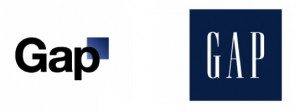
I think most people would agree that a brand is someone’s gut feeling about an organization, or company. In other words, it’s intangible, individual, and very personal. That’s why managing a brand is so tricky: it’s really managing expectations. So it shouldn’t surprise anyone that the reaction to Gap’s new logo was so overwhelmingly negative.
Millions of consumers have adopted Gap as an essential facet of their own personal brands. And it reflects more on them than it does the company. It’s like the old maxim, “Your brand doesn’t belong to you, it belongs to your customers.” That’s not to say that the company doesn’t have the right to change, or evolve the logo, but there has to be a really good reason.
Over the past week or so, as the company was responding to the overwhelming criticism, one Gap executive noted that the company is changing, and management was hoping the new logo would represent that change. But what is that change? And shouldn’t that change have been perceptible to consumers before Gap made any effort to reflect it?
Gap’s new logo failed because there appears to have been no real rationale for it. I imagine the lousy economy and decreased sales might have been the catalysts, but even these don’t support sweeping changes to the most significant visual expression of a major consumer brand.
In the end, this entire ordeal will serve as a cautionary tale for other brands, and a proof point for anyone seeking to illustrate the power of social media. But for now, we can only scratch our heads and wonder what Gap was thinking. If the short-lived logo represented anything, it conveyed a sense of uncertainty, carelessness and frustration — all of which is painfully revealing for a retail company that has seen better days.