
It started with one RFP. The referral source field said “Microsoft Teams,” and we assumed it was a data entry error. Someone had typed the wrong thing, or the form had misfired. We cleaned it up and moved on.
Then it happened again. Different company, different deal—same field, same answer. Then ClickUp showed up. Then Slack. Over a few quarters, we had a cluster of inbound leads who had found their way to us through internal collaboration tools. Not a landing page. Not a LinkedIn post. A chat thread they were already in, that we would never have access to.
We stopped cleaning the data and started asking questions. What we heard was something like: “Someone in our #agency-vetting channel mentioned you. I went back and found the thread.” Or: “One of our consultants had flagged you in a ClickUp comment months ago. When the budget opened up, I searched for it.”
These weren’t referrals our attribution model was built to handle. Nobody clicked a link. Nobody filled out a “referred by” form. Someone typed a few sentences in a private channel, and it was enough to start a six-figure conversation.
What we were bumping into has a name in marketing circles: dark social. It’s the vast category of online sharing that happens through private, untracked channels, where no referral data ever reaches your analytics tools. By most estimates, dark social accounts for roughly 84% of all online content sharing. And in B2B tech especially, where buying committees of six to twenty-plus people privately align before contacting any vendor, it’s where the actual decision gets made.
The research backs up what we were seeing in Grafik’s own CRM. According to Wynter’s 2024 survey of B2B marketing executives, 73% rank peer recommendations as the most influential factor in deciding which vendors to consider—above analyst reports, above content marketing, above paid. A separate study found that 84% of B2B decision-makers start the buying process with a referral. And 65% of CMOs say they start vendor searches in peer communities, not search engines.
Those peer communities increasingly live inside the tools your buyers use to do their actual work. When someone needs a vendor recommendation fast, they don’t Google it—they drop a message in the channel where they already have their colleagues’ attention.
As usual…B2C figured this out before most B2B brands did
A few weeks ago I was holding a can of Bobbie infant formula—the kind of purchase where parents are obsessive about peer recommendations, group chats are in constant use, and brand trust is everything. On the lid: a sticker that read “As featured in your group chat.”
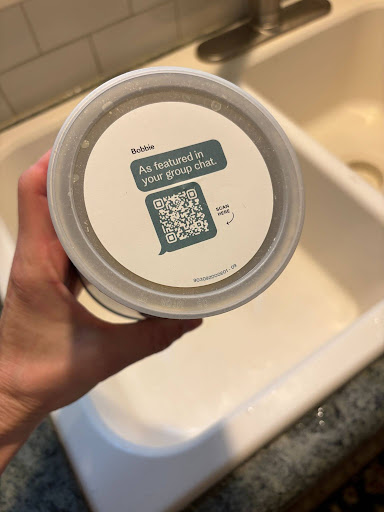
It stopped me, because in addition to being clever copywriting, it showed a brand that understood exactly where its word-of-mouth was happening and decided to validate it rather than ignore it. Most B2B companies are still trying to build referral programs that route around this behavior. Bobbie just put it on the can.
The category is different, obviously. But the dynamic isn’t. Enterprise buyers recommending a vendor in a Teams channel are doing the same thing parents do in a group text: asking people they trust, in a space they feel safe, before making a high-stakes decision. The only difference is that B2B marketers have been slower to acknowledge it as a channel worth caring about.
Why your NPS doesn’t capture any of this
A glowing Net Promoter Score response sitting in your CRM is worth less than three sentences from a colleague in a chat thread. Same sentiment, different context. Within the group chat, the reader knows the person who typed it. They’ve seen them push back on bad vendors and software. They know they don’t throw endorsements around. And, the message is often arriving at exactly the moment they’re making a decision.
That’s referral marketing at its most potent: trusted source, perfect timing, zero friction.
What actually gets a brand typed out, unprompted?
After digging into where these leads came from and what the referring conversations looked like, a few things became clear—none of them are marketing tactics, exactly. They’re upstream of that.
Specificity. Vague satisfaction doesn’t travel. What gets typed out is the particular: the account manager who caught a problem before it became a crisis, the deliverable that landed better than expected, the process that made the client look good internally. If you’re not creating those moments on purpose, you’re waiting on luck.
Clarity. People share what they can explain quickly. If your value proposition takes a paragraph to convey, it won’t get conveyed in a chat thread. The way your clients describe what you do in private is usually simpler—and more convincing—than anything on your website.
Low social risk. Nobody recommends a vendor they’re not confident in, because it reflects back on them. There’s an old adage that, “nobody gets fired for hiring IBM.” IBM earned that default trust through decades of consistency. What are you doing to build the same kind of confidence? Your referral rate is, in many ways, a measure of how safe clients feel putting their name behind you.
What CMOs can actually do about it
While you can’t pay-to-play within a private Teams channel, you can do the work that makes your brand worth bringing up when someone asks.
- Engineer the moments worth retelling: work with your CS and delivery teams to find the inflection points where clients feel genuine relief or pride—then make those moments more intentional and memorable. The support that came through fast, the deck that landed the internal buy-in: these are the things people type out when someone asks.
- Give clients language they can actually use: positioning should arm your clients, not just persuade prospects. If someone can’t summarize what you do in two sentences, they won’t try in a thread. Simple, jargon-free articulations of value are the ones that travel through dark channels.
- Build the communities where the conversations happen: Peer communities, client roundtables, invite-only dinners or networking events—these help create the relationships that eventually surface in group chat recommendations. If you follow Grafik, you know that me and our SVP of Growth co-chair a community of interest for marketing and revenue leaders through the Northern Virginia Tech Council. We do that not only to keep our finger on the pulse of what’s happening in our local industry, but to gain face-to-face time with prospective partners and clients.
- Stop cleaning this type of data—and start reading it. If a collaboration tool shows up as a referral source, resist the urge to correct it. Call the prospect. Ask who mentioned you and what they said. That conversation will tell you more about your word-of-mouth health than any survey or NPS report.
- Make it easy to stake a reputation on you. Consistent delivery, honest communication when things go sideways, quality that holds across the engagement—these lower the perceived risk of recommending you. Referral rate is a confidence metric as much as a satisfaction one.
The part no one wants to hear
Group chat referrals aren’t a trend you can get ahead of with a campaign. They’re the natural result of a decade of buyers learning to trust peers over vendors, now running on faster and more searchable infrastructure. The research has been pointing here for years—it just took a few anomalies in our own CRM to make it personal for me.
Bobbie figured this out in a category where the stakes couldn’t feel higher—and their response, rather than a campaign, was simple acknowledgement. They named the behavior and validated it. That’s the posture worth borrowing.
Every time one of these dark social referrals lands, I treat it as a report card. Someone in a conversation we’ll never read decided we were worth mentioning. The best marketing our agency does happens in rooms we’re not in—and the only way to influence what gets said there is to earn it.